


Sophia Nicole Salivio
news editor
JAGGAER releases JAI, an artificial intelligence assistant for procurement teams, now available to customers.
This tool is designed to answer staff questions about purchasing rules, suppliers, contracts, and spending within JAGGAER’s procurement system. It also analyzes company spend data to identify off-contract purchases, supplier risk, and areas where costs can be reduced.
JAGGAER says early customer usage suggests support tickets could drop by 50% in the first year. In some cases, adoption has increased by as much as 1,000% week over week, and the tool is currently used in over 40 workflows.
JAI accepts plain questions in 28 languages. The answer is based on the customer’s own documents and data, rather than public internet sources, and uses the same security and access controls already built into the platform.
The announcement comes as procurement teams face increasing pressure to manage compliance, supplier monitoring and cost control without adding additional administrative work. For many organizations, routine questions about approvals, preferred suppliers, and contract terms still go through support desks and in-house experts, delaying purchasing decisions and increasing ticket volume.
By placing these answers within the procurement system, JAGGAER aims to reduce routine support requests and reduce the time staff spend searching for policy documents. The company says that if customers decide to use Assistant, they can deploy it immediately.
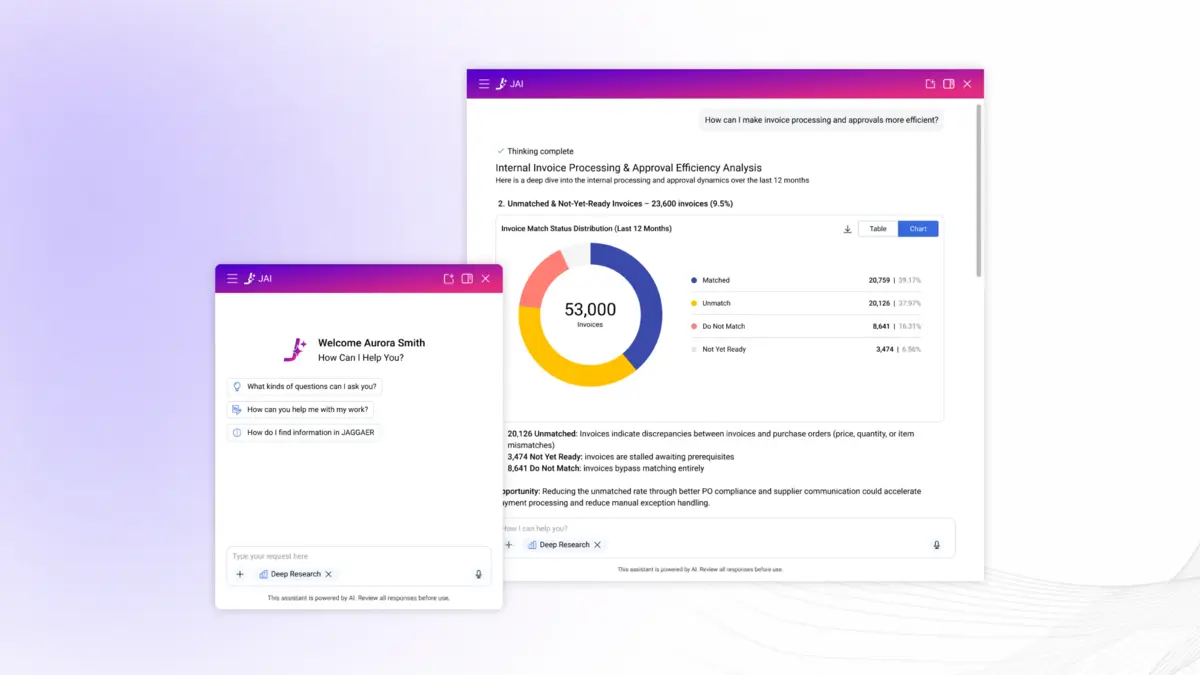
early use
A leading financial institution described the challenges of managing procurement and supply chain guidance across multiple documents and locations. The assistant has already seen improvements in speed and accuracy during its early access period.
“As a financial institution, we have to adhere to very high standards from both a regulatory and contractual perspective. In practice, this means that our supply chain teams have to refer to and adhere to a complex set of principles. These are set out across a variety of guides, from risk standards handbooks to procurement guides, and are often located in separate locations or outside of our internal systems, making the reference process difficult.”
“JAI changes that. By creating a unified view of all these standards, users can quickly and efficiently find answers to their questions without leaving the system. We’re confident in improving ticketing times and audit readiness in the future. But the time savings and accuracy of details we can see in the early access phase is already a huge win.”
JAGGAER announced this launch as part of a broader push to further incorporate artificial intelligence into procurement workflows. Rather than being delivered as a separate tool, JAI is built into the core platform and can leverage policy and transactional data already held within the system.
JAGGAER CEO Andrew Roschko said the product aims to help users make decisions with less manual effort. “Procurement has always been about making smart decisions with limited time and information. JAI completely changes that equation. JAI is built into the core platform and actually earns trust. JAI understands your business, respects the rules, and provides answers you can act on. This is just the beginning.”
AI governance
Along with this announcement, JAGGAER announced that it has obtained ISO/IEC 42001:2023 certification for its artificial intelligence management system. The company described itself as the first source-to-pay software provider to obtain the standard.
This certification covers governance processes for how JAGGAER develops and manages artificial intelligence capabilities, including handling risks such as data governance, security, and bias. For software buyers, such standards are increasingly being used as a measure of how vendors control the use of generative and analytical AI in business systems.
JAGGAER operates in the procurement and supplier management software market, where vendors add conversational interfaces and data analysis tools to long-established workflow systems. The pitch is to help employees get answers faster and procurement teams to identify non-compliance or inefficient spend faster, but adoption depends heavily on the quality of company data and internal rules.
The company has approximately 1,200 employees worldwide and sells software for procure-to-pay and supplier collaboration processes.


