
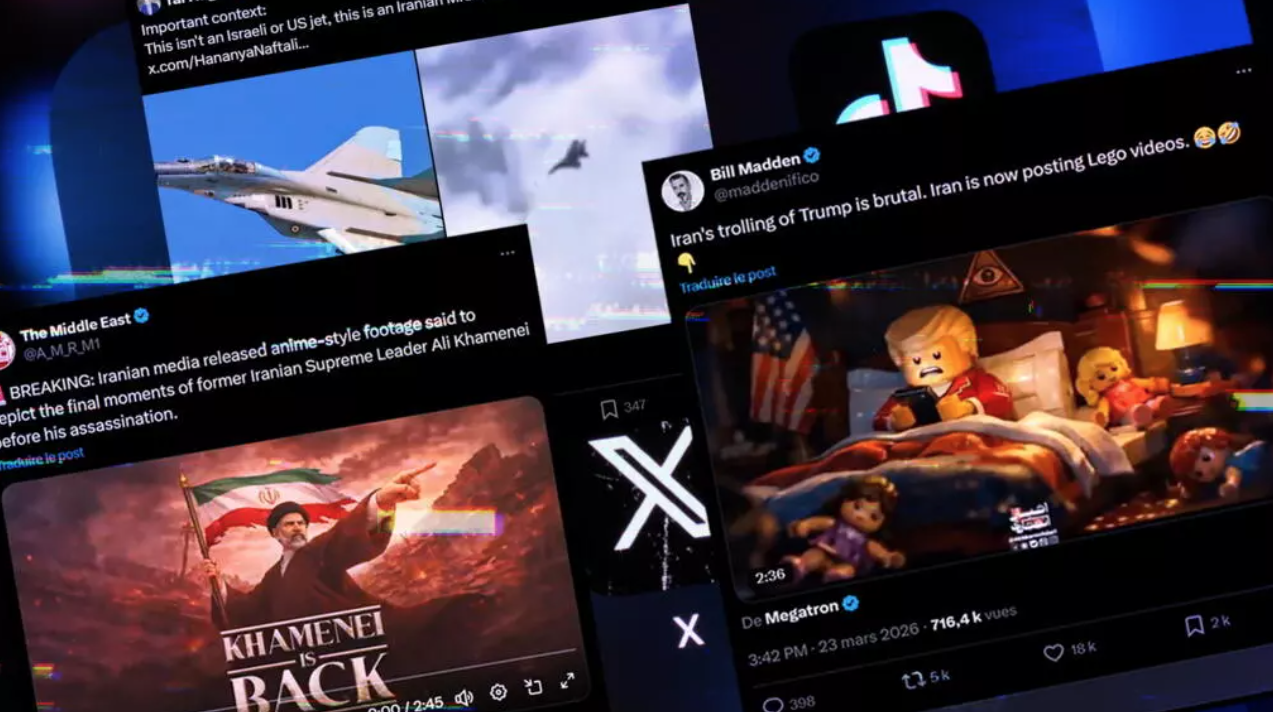
Iran has used social media to spread information about its war with the United States and publicly criticize President Donald Trump.
AI-generated videos and memes are being used to stir up anti-American and anti-war sentiment online, with content reaching millions of viewers. Experts say this is the first conflict in which AI content has been used in a war over information.
First war to use AI-generated video for online propaganda
Whitney Phillips, a media ethics professor at the University of Oregon, told NPR that President Trump has normalized online trolling in world politics. This would explain why Iran is using similar techniques during its war with the United States.
“This is the language that President Trump speaks, and this is the language that world leaders speak with him,” she said.
Iran has been posting AI-generated videos, memes, and out-of-context footage as part of its information war. One example is a Lego-inspired video showing Iranian soldiers fighting President Trump and Israeli Prime Minister Benjamin Netanyahu. It depicts Trump gambling on the war effort, lying to the American public, and being pursued by various representations of the Epstein file.
“Propaganda includes memes and cartoons that are not intended to be perceived as genuine, but are very good at spreading political messages,” Darren Linville, co-director of Clemson’s Media Forensics Hub, told FRANCE 24. [seems] Genuine, and Iran is often portrayed as being more successful in the conflict. Both are widely shared among communities critical of the war and desperate for this message. ”
@therogdnc A new Lego-inspired video has been released by Iran’s Explosive News Team.
♬ Original song – RogueDNC
These social media posts were published en masse by Iran shortly after the United States and Israel launched attacks on the country in late February. An investigation conducted by France 24 newspapers and Clemson University said the posts were relayed by state media and media outlets, as well as dozens of social media accounts with ties to Iran.
Melanie Smith, an information operations expert at the Institute for Strategic Dialogue, told France 24: “This is the first time we’ve actually seen AI-generated content being used very deliberately to cause confusion and confusion about what’s actually happening on the ground.”
What is also new in this information warfare is that Iranian information warfare is targeting Americans.
“They’re not used to the message of the country that the U.S. government is bombing being directed at them. This is completely new,” Emerson Brooking, strategic director of the Atlantic Council’s Digital Forensics Institute, told NPR.
Why is Iran using AI and memes in information warfare?
Teen Mank, a senior lecturer in criminology at Nottingham Trent University and an expert on digital warfare, told FRANCE 24 that experts say Iran uses these techniques because AI videos “travel quickly and appeal to emotions that people already have.”
“These create a lot of noise, even when they’re clearly fake, because it’s easy to convey complex ideas through visual storytelling using these shared cultural references,” Munk said.
Research shows that America’s involvement in wars is unpopular among Americans. According to a poll conducted by Ipsos, American public opinion is “overwhelmingly” opposed to war with Iran. According to the survey, 58% oppose an American military attack and 78% oppose the idea of American troops on the ground.
“The Iranian regime wants to make the conflict as painful as possible for the United States and Israel, and if they can target those who support President Trump and Israel.” [Prime Minister Benjamin] Prime Minister Netanyahu is doing that, and it may ultimately shorten the war,” Linville said, according to France 24 newspaper.
More than 1,500 civilians have been killed in Iran since the war began, according to Iranian health officials, and at least 14 U.S. military personnel have also been killed. Brooking points out that the social media content used during the war does not reflect real-life experiences.
“I think this is another very strange and uncomfortable experience that many of us are having and feeling right now, the content and the commodification of war, the way war is becoming part of the attention economy,” he said, according to NPR.


