Matt Hatton, Transforma Insights Founding Partner
In the world of IoT, there has been a lot of discussion lately about the impact of “physical AI,” “AIoT,” and, more broadly, the combination of two technology areas: artificial intelligence and the Internet of Things. In Transforma Insights’ view, the value from AI is most evident at the intersection of the physical and digital worlds, where the Internet of Things exists. For example, some of the most obvious impacts of AI are with use cases such as autonomous driving, and on a more mundane level, efficiency savings (in terms of cost, energy, fuel, welfare, etc.) through operational efficiency improvements such as defect detection, workflow optimization, fleet route planning, and PPE detection.
The natural knock-on effect will be increased demand for IoT deployments to feed AI. At the same time, the demands of AI will place even more stress on the networks, platforms, and approaches used to deploy IoT, with requirements for edge processing, low latency, and generally deployment complexity. To properly address the physical AI opportunity, IoT delivery methods must evolve.
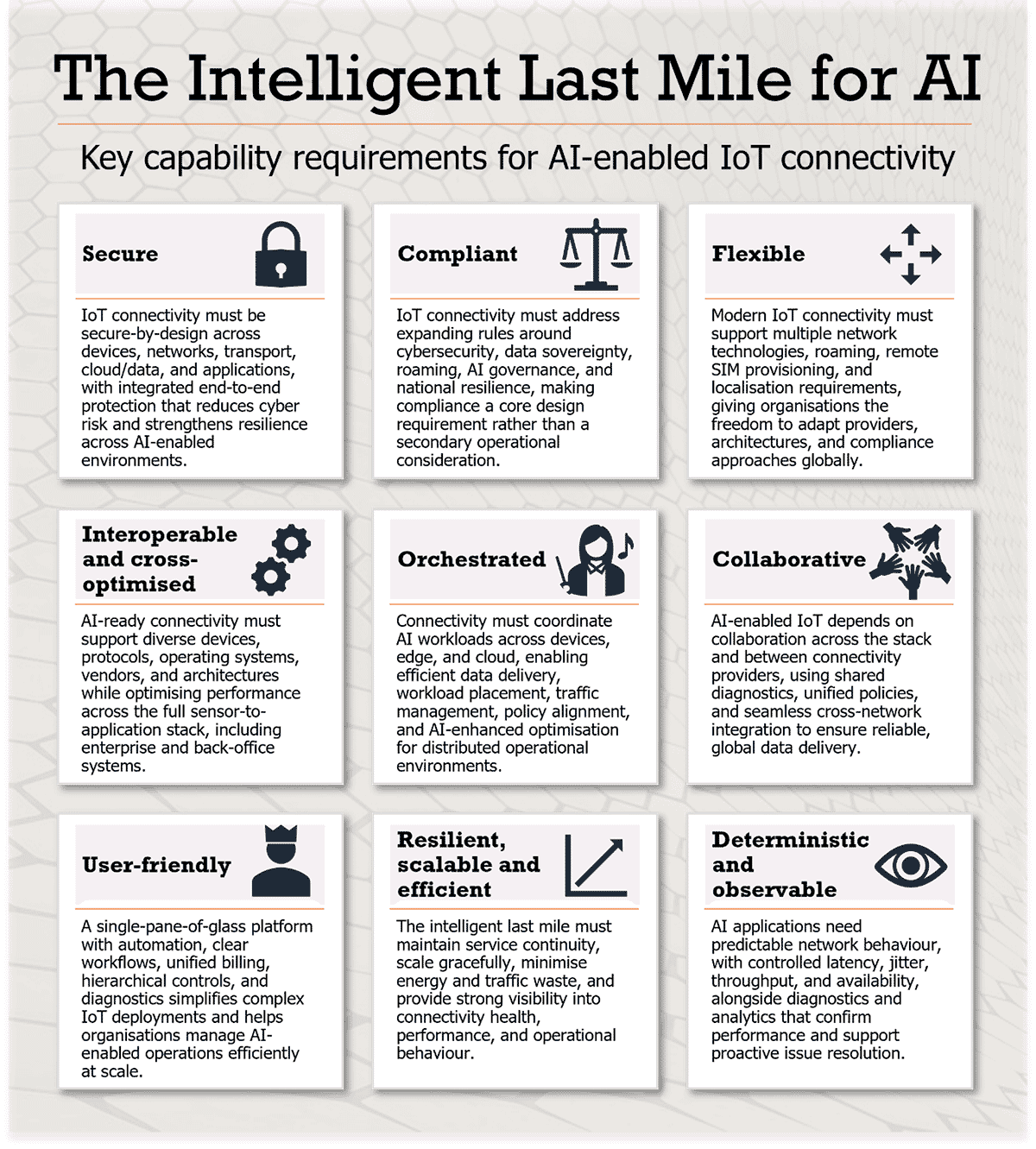
One aspect of that evolution is explored in a new report from Transforma Insights, sponsored by Tata Communications. “The Intelligent Last Mile: How networks need to leverage AI to meet the evolving needs of the IoT” examines how the delivery of IoT connectivity must adapt to the demands of AI to become ultra-efficient, compliant, secure, and flexible. The nine key characteristics of AI-supporting IoT connectivity solutions outlined in the report are:
Designed with safety in mind – The best mechanism to address growing security threats is to adopt a “secure by design” approach that considers all elements of an IoT application holistically and carefully considers the overall approach to security.
Compliant – Regulatory compliance has long been a part of the IoT through device certification and safety requirements. However, as the IoT increasingly supports critical infrastructure and sensitive applications, the scope and complexity of regulations, particularly around security, data sovereignty, and AI, is expanding. Compliance is therefore no longer a secondary concern, but is becoming a core element of IoT connectivity.
Flexible – Mechanisms for providing global (cellular-based) IoT connectivity have evolved significantly over the past decade, including the advent of remote SIM provisioning to manage connectivity and the increased availability of network technologies optimized for various aspects of IoT, such as NB-IoT, LTE-M, and 5G Standalone (5G SA). While the abundance of different technologies certainly helps address IoT needs, it also comes with a degree of complexity. Ideally, the IoT connectivity proposition should offer a complete suite and the flexibility to choose between them depending on the customer.
Interoperable and cross-optimized – A truly comprehensive “last mile” of AI incorporates a variety of deployment environments, including inside buildings, highly remote locations, and globally distributed environments. This also includes a very heterogeneous fleet. This provision should provide sufficient interoperability to manage devices, device vendors, and networks with a wide range of characteristics, including features such as eSIM management. There is also a focus on cross-optimizing different functions of IoT solutions, from sensors to gateways, networks, clouds, and applications, taking into account factors such as power management, processing, AI model management, and cost.
Orchestrated – Next-generation connectivity propositions must be designed to support AI workloads across devices, edge environments, and central cloud platforms. As applications rely on faster decision-making cycles, richer contextual data, and increased autonomy, networks become key determinants of how information is transferred and where computations occur. Local inference often requires proximity to the data source to minimize latency and reduce transport overhead, but large-scale training and aggregation still relies on central facilities. Supporting this distribution requires a connectivity layer that can efficiently and predictably distribute data across all layers of the architecture.
cooperative – The intelligent last mile must increasingly support more collaborative operating models, as AI-powered systems rely on collaborative behavior across the IoT stack. No single component can operate in isolation, as data is collected, processed, and processed across devices, edge platforms, orchestration layers, and cloud environments. Federated features include shared diagnostics, open APIs, a unified policy framework, and a federated management model that improves data flow and overall quality of service.
easy to use – Another important aspect of IoT connectivity capabilities relates to user ease of use given the complexity of deployment. A unified experience built around the Single Pane of Glass (SPOG) platform allows users to manage devices, connectivity, policies, and AI-related data paths from a single environment, reducing friction and risk of configuration errors. Centralized billing, integrated support channels, and integrated problem resolution simplify management by eliminating the need to navigate multiple suppliers or interfaces. Hierarchy management, intuitive interface, automatic provisioning, data visualization, and other features all improve user-friendliness.
Highly resilient, scalable, and efficient – An intelligent last mile must tolerate network interruptions, fluctuating signal quality, and hardware failures through built-in resilience mechanisms. Additionally, as device fleets grow and AI models demand richer data, the connectivity layer, especially the underlying connectivity management platform, must scale without introducing latency or congestion.
definitive and observable – AI applications often rely on predictable behavior from networks. Deterministic performance requires tight control over latency, jitter, throughput, and availability. Features such as prioritized traffic classes and deterministic scheduling allow devices to deliver data within defined ranges, supporting real-time inference and reliable operation.