image:
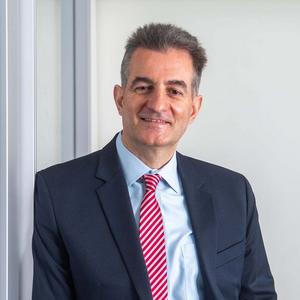
Boston University’s Yanis Pasharidis has been elected to the prestigious AIMBE College of Fellows, which recognizes the top 2 percent of medical and biological engineers who are transforming health care and medicine.
view more
Credit: Boston University / Rafik B. Hariri Institute for Computation and Computational Science & Engineering
The American Institute of Medical and Biological Engineering (AIMBE) welcomes Ioannis (Yannis) Pasharidis to the 2026 College of Fellows. This peer-elected membership is one of the highest professional honors in the field and recognizes the top 2% of medical and biological engineers whose contributions have had a transformative impact on health care and medicine.
Paschalidis is a distinguished professor of engineering (electrical and computer engineering, systems engineering, and biomedical engineering), founding professor in the Department of Computing and Data Sciences, and professor of biostatistics at Boston University School of Public Health. He is also the director of the Rafik B. Hariri Institute for Computing and Computational Science and Engineering, the university’s largest research hub that fosters interdisciplinary computing and AI research across all of BU’s colleges and schools.
Pasharidis was recognized for his “outstanding contributions to artificial intelligence and machine learning methods in computational biology and medicine.”
At the heart of Paschalidis’ research is the fundamental challenge of designing intelligent systems that maintain reliability under uncertainty. His research integrates optimization, control, and stochastic modeling with machine learning to develop methods that remain robust to the uncertainties, imperfections, and noise inherent in medical data while maintaining interpretability for real-world use. This mission is driven by convergence research, a strategic approach that integrates disparate fields, from data science to clinical practice, into a single unified framework to solve complex societal problems.
“Yannis’ research reflects the strength of Boston University’s intensive research, which brings together approaches from electrical engineering, biomedical engineering, medicine, computer science, and artificial intelligence to have a transformative impact on medicine,” said Kenneth Lutchen.Vice President and Vice President for Research, Boston University. “His research shows how interdisciplinary and focused collaboration can translate discoveries into meaningful advances in medicine.”
This sentiment is echoed by leaders within the engineering community who see Pasharidis as a bridge between technological innovation and human health.
“Yannis Pascalidis’ induction into the AIMBE College of Fellows is a powerful recognition of the type of bold, focused research that is most needed today,” said Elise Morgan, Dean of the College of Engineering and Maysara K. Sukkur, Professor of Engineering Design and Innovation (Mechanical Engineering, Materials Science and Engineering, and Biomedical Engineering). “His ability to integrate artificial intelligence, systems thinking, and biomedical insights will not only advance engineering research but also reshape the way we approach the most complex challenges in medicine.”
A systems approach to AI in healthcare
Paschalidis’ work is unified from a system-level perspective across domains. In computational biology, His research on protein-protein docking applied optimization techniques to predict molecular interactions and contributed to the mathematical basis of drug discovery. Optimization also worked in engineering metabolic division of labor to engineer microbial communities. In clinical practice, his research using electronic health records (EHRs) has shown that longitudinal patient data contains early warning signals of disease and can predict major health events well before they occur.
He introduced a framework for federated learning across distributed EHR systems at a time when privacy regulations limited data sharing. This approach demonstrated that collaborative machine learning is possible without moving sensitive data and established a new paradigm for secure, large-scale healthcare analytics.
His research in cardiovascular medicine further explains this change. By applying supervised learning to longitudinal EHR data, his model was able to predict heart-related hospitalizations nearly a year in advance. These insights enable early intervention and support a broader transition from reactive to proactive care.
Recently, Paschalidis and his group developed a new robust machine learning framework primarily motivated by biomedical applications. He extended these approaches to neurodegenerative diseases. His research has developed an AI-driven approach to analyze speech patterns and identify early markers of cognitive decline. These models have demonstrated high efficacy in predicting progression from mild cognitive impairment to Alzheimer’s disease, years before clinical diagnosis. This study demonstrates a scalable and cost-effective screening approach for Alzheimer’s disease and related dementias by relying on accessible non-invasive data.
A hallmark of all these efforts is the integration of diverse data sources. His research combines clinical, demographic, and behavioral signals, including digital biomarkers such as voice, to capture aspects of disease that may be missed by single-modality approaches.
From model to infrastructure: BEACON platform
These methodological advances—robust optimization, multimodal learning, and interpretable AI—are now operationalized at scale through BEACON, an AI-driven platform for global infectious disease surveillance operated in partnership with BU’s Center for Emerging Infectious Diseases (CEID) and Boston Children’s Hospital. The BEACON platform continuously ingests and analyzes disparate data streams and leverages AI to filter, assess, and prioritize signals of emerging health threats. Its architecture reflects the core principle of integrating automated intelligence with expert verification and decision-making.
“The goal is not to replace human expertise, but to augment it,” Pascalidis says. “BEACON is designed to integrate diverse data and rigorous models to support faster, more informed decision-making.”
In doing so, BEACON represents a transition from standalone predictive models to an integrated, open-access, real-time system for population-level decision-making, addressing the long-standing need for a shared and transparent public health infrastructure.
leadership and influence
Beyond his scientific accomplishments, Mr. Pasharidis has helped shape Boston University’s extensive research ecosystem at the intersection of engineering, computing, and health. In addition to his leadership of the Hariri Institute, he co-leads Boston University’s Task Force on AI in Research and Education, is a member of the Intensive Research and Education Task Force, is Academic Director of the AI Development Accelerator (AIDA), and serves on the advisory board of the Center for Health Data Science. Previously, he served as director of the Center for Information Systems Engineering (CISE), where he remains a faculty member.
With more than 10,000 citations and an h-index of 56, Paschalidis’ admission to the AIMBE College of Fellows highlights a career dedicated to creating trusted AI systems that can address the world’s most complex health challenges. He was officially inducted on April 13, 2026, during the AIMBE annual event in Arlington, Virginia, joining a distinguished AIMBE membership that includes four Nobel Prize winners, 27 recipients of the President’s Medal for Science, Technology and Innovation, and more than 400 Fellows who have been inducted to date in the National Academies of Engineering, Medicine, and Sciences.
Disclaimer: AAAS and EurekAlert! We are not responsible for the accuracy of news releases posted on EurekAlert! Use of Information by Contributing Institutions or via the EurekAlert System.