
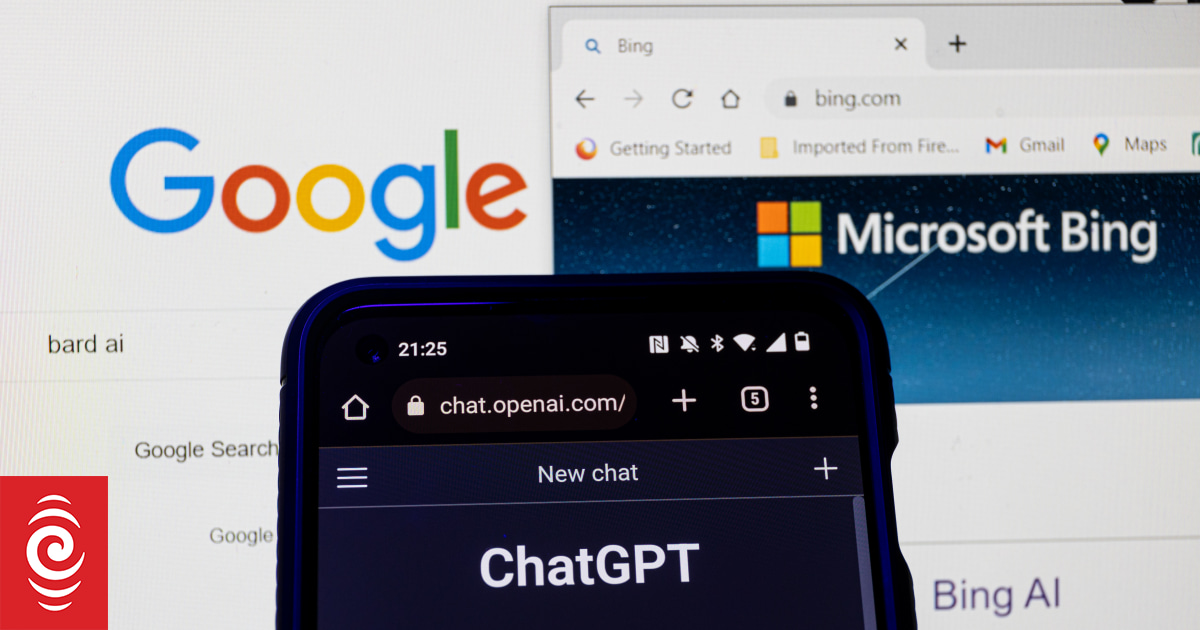

More and more people are using AI to find information, but what does this mean for companies looking to get AI’s attention?File photo.
photograph: 123rf
As AI changes the way we search for information, New Zealand businesses are feeling the impact.
Over the past two decades, search engines such as Google have replaced the yellow pages and changed the way people find information and services.
But AI overviews and chatbots are ready to answer everything from “best time to travel to Japan” to “good local plumber.”
For Kiwi businesses, this change has not always been positive.
Greg Whitham, General Manager of Market Engagement at Datacom, has decades of experience in digital communications.
He has seen companies’ online presence grow from a small part of their strategy to a critical part of acquiring customers. We are also familiar with how technological advances can impact your business.
“We’ve definitely seen a drop in traffic to our site. I think there are very few companies or brands that haven’t seen a significant drop in traffic to their website.”

Greg Whitham is General Manager of Market Engagement at Datacom.
photograph: Supplied
Witham said the company’s website traffic has changed dramatically this year and it has quickly adjusted to get AI’s attention.
“We have certainly seen an increase in so-called zero-click impressions, so people were still seeing our content, but they were seeing the content being returned to them by AI agents. The new focus has very little to do with servicing the customer or servicing the customer’s agents, because it is the customer’s agents who are effectively introducing the brand and presenting the content to the customers who will become the end customers.”
Grant Johnson, CEO of website company Rockets Park, said traffic from ChatGPT has more than tripled this year.
It was a growth that responded to changes in the way people seek information.

Grant Johnson is the CEO of Rockets Park.
photograph: Supplied
Johnson said that in the age of AI-driven search, online reputation is more important than having the right keywords to appear in Google’s top search results.
“What LLM does is it compiles information from so many different sources to build an image about you. Things like: What is your online reputation? Are you encouraging your customers to leave reviews? Are you just offering great service and great products?”
He said reviews and recommendations in online discussions play an important role in the answers AI generates.
“Platforms like Reddit seem to be referenced quite a bit in AI overviews, so in a way it feels like it’s leveling the playing field. It’s like if you’re a good business you can move up.”
Chris Walsh, head of research at MoneyHub, said the site was benefiting from artificial intelligence as click-through rates rose.
“I don’t think this is taking anything away from us. We’re seeing the percentage increase month-over-month. But I also think they’re high-quality visitors. So they’re using AI, they’re engaged, they want to learn more now, and they’ll probably spend about 10 minutes on our website.”

Chris Walsh is Head of Research at MoneyHub.
photograph: Supplied
In September, links from AI tools drove more than 3,000 visitors to the MoneyHub site, representing approximately 1% of total traffic.
Mr Walsh said that although the percentage is low, growth is promising.
Brett Gower, a director at the law firm Smith & Partners, said he is working to ensure that people are cited in the AI overview when people ask Google legal questions.
“We have conducted our own research into how Google’s AI Overview refers to legal issues and have seen evidence of citations to our articles as sources for the basis of answers. So I think that’s what we expect. We will continue our research in the hope that we will become a source of citations so that clients who need fact-specific answers, certainty, and even representation will contact us as a provider of answers in the first place.”

Bret Gower is a director at Smith and Partners.
photograph: Supplied
Other uses of AI were also creating other problems for companies such as travel agencies.
Julie White, CEO of the New Zealand Travel Industry Association, said AI-generated travel plans and recommendations could ruin holidays.

julie white.
photograph: hospitality new zealand
“Make sure you are well-informed and double-check that the information you get (from the AI) is correct. white lotus This is a great example of a booking made through AI being discovered. So they traveled all the way to Thailand to do the White Lotus Experience in search of this magical experience, only to find that accommodations didn’t even exist. ”
And, as Gower noted, the trend towards AI DIY solutions was also causing headaches for lawyers.
“As an aside, a lot of our clients come to us with their own AI-generated answers. I think this is similar to what doctors are facing in Dr Google’s situation, where clients come to us having assessed their situation beforehand.
“The job of advising clients is becoming more complex because very often clients don’t come to us with an outline of what they think their problem is, they come to us with an outline of their idea of what the solution might be. It’s an interesting time.”
Sign up for Ngā Pitopito Korero. Our daily newsletters, hand-picked by our editors, delivered straight to your inbox every weekday.


