image:
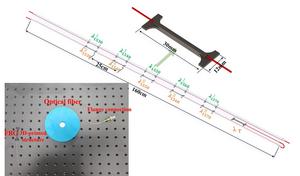
Researchers have developed an intelligent monitoring pipe that combines optical sensing and machine learning algorithms to monitor and predict 3D soil subsidence. The sensor is shown along with a physical map of the attachment of a 3D printed dog bone-shaped protective structure.
view more
Credit: Dandan Sun, Shanxi University
WASHINGTON — Researchers have developed an intelligent monitoring pipe that combines optical sensing and machine learning algorithms to monitor and predict 3D soil subsidence. With further development, the system could provide early warning of risks from soil subsidence, helping to prevent pipeline displacement, accidents due to building cracks, and even structure collapse.
“Soil subsidence directly jeopardizes the safety of engineering structures such as buildings, bridges, pipelines and slopes,” said Dandan Sun, a research team leader at China’s Shanxi University. “Our device provides highly accurate 3D measurements, A simple structure that can be buried directly in the soil.
IOptica Publishing Group Journal optics express, Researchers describe an intelligent monitoring pipe made by attaching 3D-printed protective structures, temperature-compensated components, and fiber Bragg grating (FBG) arrays to PVC pipes. They show that machine learning models can detect early soil failure and predict its progression by analyzing data collected from intelligent monitoring pipe systems.
“One potential application of this technology could be in older urban communities, which are often built on soft or unstable soils,” Sun said. “By monitoring the 3D settlement trajectory of a building’s foundation in real time and predicting whether it will enter a dangerous stage in advance, we may be able to correct problems before they become dangerous. This method could be useful for detecting landslides and monitoring the structural health of bridges, as well as subsidence on railways and highways in difficult environments.”
Capturing soil changes in 3D in real time
Monitoring soil subsidence can help detect risks early, but current methods either take measurements from a single point, cannot track the dynamic evolution of subsidence in real time, or cannot take into account complex and realistic local soil conditions.
A type of soil known as loess is found in many different regions around the world and is particularly challenging to today’s soil settling methods. This windblown silt is very loose, making it highly prone to erosion, collapse, and subsidence, especially after rain or construction.
To create a better monitoring device that can also be used in loess, researchers designed a sensor based on an array of FBGs. FBGs are highly sensitive to small deformations caused by soil extrusion and settlement, while at the same time being immune to electromagnetic interference and robust in harsh environments such as soil. To further protect the sensor and ensure stable measurements, the team fabricated a 3D-printed structure that protects the FBG from soil when buried.
FBGs are small sections of optical fiber that contain small periodic changes in refractive index. FBGs strongly reflect light at specific wavelengths. As the fibers expand and contract due to soil movement, the grating spacing changes. This changes the reflected wavelength, which can be converted into a soil deformation signal.
“Instead of a single grid, we used two sets of five-point grid arrays attached to the pipe at a 45° intersection angle, as well as an independent temperature-compensated grid to eliminate the effects of temperature fluctuations,” Sun said. “This makes strain measurements more accurate and allows us to capture deformation signals in multiple directions.”
By combining single-point signals from individual FBGs using the Frenet-Sellet coordinate system (a method that describes how curves move and bend in 3D space), the researchers were able to reconstruct the overall 3D morphology and soil subsidence trajectory.
Simulated subsidence detection
To verify the sensor’s performance, the researchers conducted indoor air tests and showed that the grating’s wavelength shift exhibits a perfectly linear relationship with strain, allowing it to reliably detect very small deformations. The sensor also accurately captured strain signals under various angles and displacements, validating its multidirectional recognition ability.
The sensor was then tested using a laboratory-based soil burial test. This involved embedding intelligent monitoring pipes in loess in a test chamber with six water bladders placed in the soil. To simulate soil subsidence, we created soil voids by gradually draining the bag. Frenet frames were used for 3D morphology reconstruction, and monitoring data was input into a machine learning algorithm for stage prediction.
This sensor system accurately identified soil subsidence caused by drainage at different stages, capturing nonlinear deformations of soil particles from regular arrangement to sudden sliding when drainage exceeded 8,000 milliliters. Moreover, the results of 3D morphology reconstruction were very consistent with the actual settlement morphology and clearly reconstructed the 3D trajectory of soil settlement.
The researchers experimented with different machine learning models and found that the random forest algorithm performed best. In predicting the amount of settlement caused by drainage, the classification accuracy of the settlement stage was 95.65%, and the relative error was only 4.02%.
To further optimize the technology, researchers plan to conduct field tests on China’s Loess Plateau, including on building foundations in rural and urban areas, in slope mining areas of open-pit coal mines, and along municipal pipelines. We are also working to optimize devices by making them smaller and more integrated, adding wireless and remote capabilities, and making devices more affordable. We also want to develop software that can be used for real-time visualization of 3D subsidence trajectories, automatic early warning of subsidence stages, and long-term data storage to make the system easier for engineering personnel to use.
paper: L. Xie, M. Liu, J. Mao, H. Liu, Y. Yu, P. Chen, Z. Zhao, Y. Fu, D. Sun, J. Ma, “Fiber Bragg grating integrated soil subsidence three-dimensional trajectory pipe sensor: dynamic soil subsidence evolution and stage prediction”, Opt. Express, 34, XXXX (2026).
Doi: 10.1364/OE.589254
About optics express
Optics Express reports on scientific and technological innovations in all aspects of optics and photonics. This biweekly journal publishes peer-reviewed original articles quickly. The book is published by Optica Publishing Group and led by Editor-in-Chief Siddharth Ramachandran from Boston University, USA. Optics Express is an open access journal and is available free of charge online to readers. For more information, please visit Optics Express.
About Optica Publishing Group
Optica Publishing Group is a division of Optica, an association of Advancing Optics and Photonics Worldwide. We publish the largest collection of peer-reviewed, most-cited content in optics and photonics, including 18 prestigious journals, the society’s flagship membership journal, and more than 835 conference papers and videos. With over 400,000 journal articles, conference papers, and videos to search, discover, and access, our publication portfolio represents the full scope of research in this field from around the world.
Media contact:
mediarelations@optica.org
Article title
Fiber Bragg grating integrated ground subsidence three-dimensional track pipe sensor: Evolution and stage prediction of dynamic ground subsidence