

This article is a continuation of the previous article about unlocking legacy Oracle E-Business Suite data in Oracle Fusion Cloud. This article discussed the strategic importance and basic approach to integrating Oracle E-Business Suite data. In this article, we shift our focus to a powerful next-generation approach: integrating data from Oracle Fusion AI Data Platform and E-Business Suite using Oracle AI Data Platform.
Oracle AI Data Platform Overview
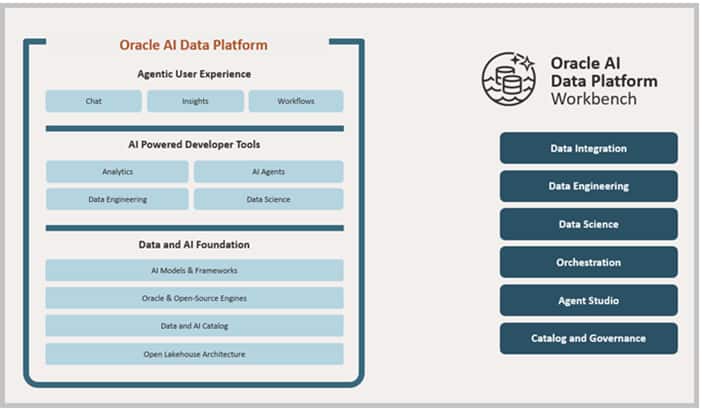
Oracle AI Data Platform represents Oracle’s latest commitment to helping organizations realize the full value of their data. Launched to enable seamless data integration, governance, and AI and ML at scale, this cloud-native platform offers:
- Unified lakehouse architecture for both structured and unstructured data.
- Oracle AI Data Platform supports open formats for managing data in Oracle Cloud Infrastructure Object Storage: Iceberg and Delta Lake.
- Native ingestion and conversion services.
- Built-in governance, security, and lineage tracking.
- Directly enable analytics and machine learning use cases.
Oracle AI Data Platform accelerates the path from raw data to actionable intelligence by centralizing data assets and AI and ML tools.
Use case
At the heart of our solution is leveraging Oracle AI Data Platform to seamlessly integrate financial data from Oracle Fusion AI Data Platform, Oracle E-Business Suite, and Oracle Fusion Cloud Enterprise Performance Management. By integrating these sources, organizations can compare actual revenue and profitability KPIs from Oracle Fusion Applications and Oracle E-Business Suite with planning data from Oracle Fusion Cloud Enterprise Performance Management in a consolidated view. This integration eliminates silos between transactional and planning systems and improves financial transparency and insight. Oracle AI Data Platform provides secure data pipelines, governance, and AI-powered analytics to help harmonize financial KPIs across your systems. Ultimately, this enables organizations to make more informed, data-driven decisions, improving both strategic planning and operational efficiency.
solution approach
Discovery and source evaluation
Identify core datasets from Oracle Fusion AI Data Platform analytical models and related Oracle E-Business Suite modules required for integrated analytics or AI.
Ingest data
The Medallion Architecture is used to logically organize data within Lake House with the goal of incrementally and incrementally improving the structure and quality of the data as it flows through each tier of the architecture (from the tables in the Bronze, Silver, and Gold tiers).
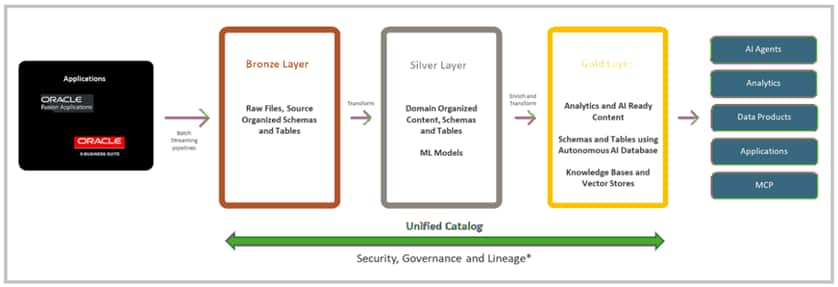
- Oracle E-Business Suite: Data from Oracle E-Business Suite tables is brought into Oracle AI Data Platform as delta tables in the bronze layer. These are refined through Silver and Gold tiers to enable reporting and machine learning use cases.
- Oracle Fusion Application: Oracle Fusion AI Data Platform, along with Oracle AI Autonomous Lakehouse, supports data sharing with external data stores, allowing customers to enhance their analytics by integrating Oracle Fusion AI Data Platform data with external sources. This feature allows you to share complete or incremental datasets to both Oracle Fusion AI Data Platform and external platforms simultaneously. Oracle AI Data Platform acts as one such external data store and leverages this functionality to access selected tables shared from Oracle Fusion AI Data Platform.
Data transformation and harmonization
For integrated reporting across Oracle E-Business Suite and Fusion, past closed transactions from Oracle E-Business Suite (gold layer delta table) are combined with current transactions from Fusion (Fusion AI Data Platform delta table) into a single fact table. E-Business Suite data is combined with customer-provided master data cross-reference mapping tables to reconcile legacy E-Business Suite values and corresponding Fusion Applications configurations. This mapping ensures the consistency and integrity of the unified fact tables, enables integrated analysis across both platforms, and supports seamless migration from Oracle E-Business Suite to Fusion Applications.
AI, analytics and consumption
The consolidated report data is ingested into Oracle Autonomous AI Data Lakehouse along with any additional data points required for analysis. Then leverage Oracle Analytics Cloud to create interactive visualizations and reports on this integrated dataset. Dashboards show actual and variance analysis compared to budget and forecast, giving you a clear picture of your financial performance. Users can filter data by source, chart of accounts segment, or period from either Fusion Applications or E-Business Suite. This supports more informed decision-making and streamlines the financial review process.
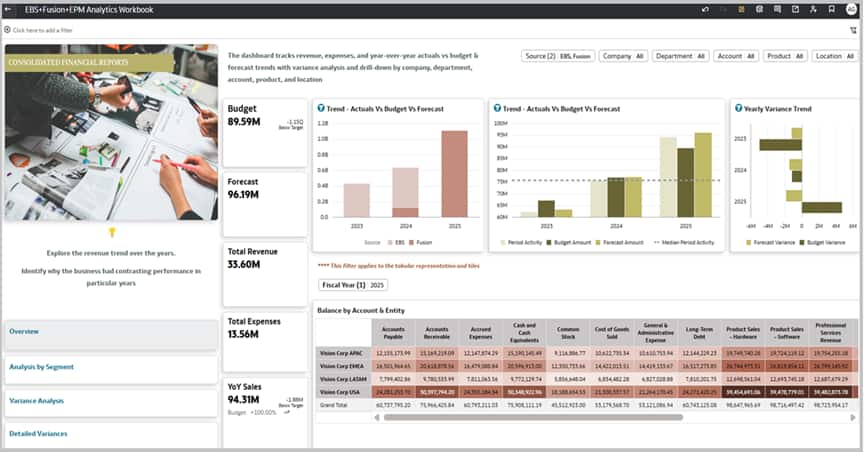
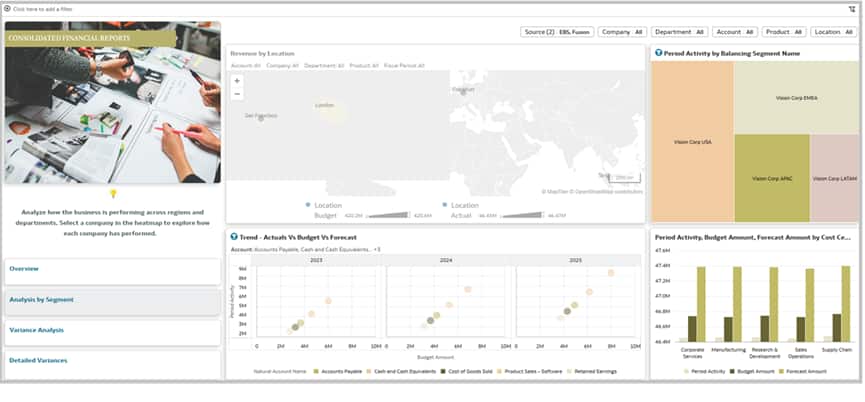
Note: Oracle Analytics Cloud provides native, built-in connectors for Oracle AI Data Platform, enabling seamless integration of analytics and data visualization. You can create datasets directly in delta tables within Oracle AI Data Platform and use them for analysis. This option is also available for ad hoc analysis and provides an alternative to traditional approaches to modeling data using Oracle Analytics Cloud Semantic Modeler.
Data stored in Oracle AI Data Platform can further support advanced AI and ML efforts. Oracle Data Platform provides an integrated suite for building, training, and deploying machine learning models, including prebuilt Oracle Cloud Infrastructure AI services, robust data science services, in-database machine learning capabilities, and the MySQL HeatWave AutoML engine. This architecture ensures a streamlined end-to-end solution for both analytics and AI and ML-driven insights.
Note
To ensure that your integrated reporting solution comprehensively addresses all your business requirements, it is important to incorporate the key considerations outlined in the previous article (https://blogs.oracle.com/analytics/post/unlocking-legacy-ebs-data-for-oracle-fusion-cloud).
Following these guidelines will improve the accuracy, consistency, and reliability of your company’s reporting.
architecture
The general architecture for using Oracle AI Data Platform to integrate data from Oracle Fusion AI Data Platform and Oracle E-Business Suite is as follows:
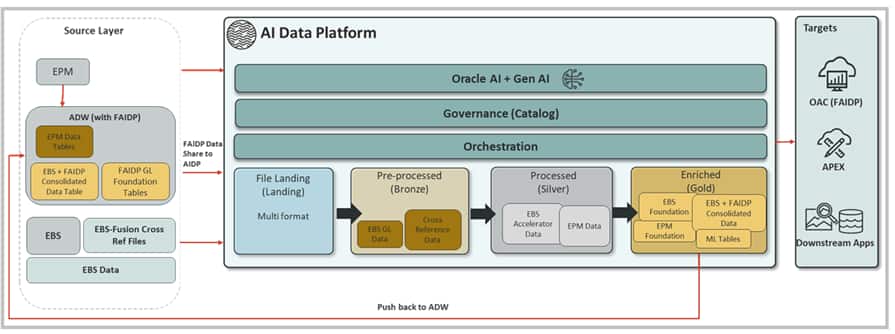
The technology stack includes Oracle Fusion AI Data Platform, E-Business Suite, and Oracle Cloud Infrastructure Object Storage.
conclusion
As a sequel to the previous article on integrating legacy Oracle E-Business Suite data, this article describes how organizations can dramatically enhance their analytics, AI, and ML capabilities by integrating Oracle Fusion AI Data Platform and Oracle E-Business Suite data into Oracle AI Data Platform. Oracle AI Data Platform’s robust integration, governance, and scalability serve as the ideal foundation for data-driven innovation. Stay tuned for future articles sharing implementation patterns, customer stories, and best practices to maximize the value of your Oracle data assets.
call to action
• After reading this article, try it yourself and share your results with the Oracle Analytics community. There you can also ask questions and post ideas.
• For more information about Oracle Fusion AI Data Platform, see the Oracle Help Center.
• For more information about these solution approaches, please contact the CSS Innovation Studio team at css_innovation_data-analytics-studio_in_grp@oracle.com.


