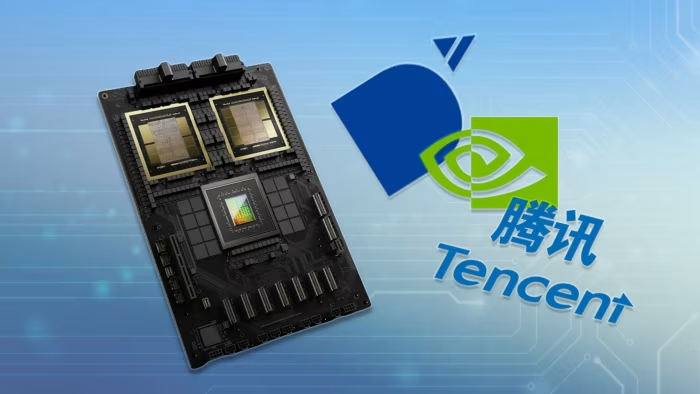
In a data center outside Osaka, Japan, Nvidia's cutting-edge semiconductors are at the disposal of one customer: China's Tencent.
The advanced B200 chip is owned by Datasection, a Japanese marketing solutions provider that made the sudden switch to operating AI data centers last year.
Since then, Datasection has secured more than $1.2 billion in a contract with one large customer to access the majority of 15,000 Nvidia Blackwell processors. That customer is Tencent, which has a relationship with DataSection through a third party, according to people familiar with the matter.
The deal allows the Chinese tech giant to use a legal but geopolitically risky strategy to gain access to advanced AI chips at a time when the U.S. government has restricted exports of Nvidia's top hardware to China.
The setup also makes Datasection one of Asia's largest so-called neoclouds, which has grown rapidly from lending its Nvidia GPUs to the world's largest technology groups, alongside peers such as America's CoreWeave and Europe's Nebius.
“Until six months ago… 5,000 B200 chips were enough to support an AI model,” CEO Norihiko Ishihara told the Financial Times. “But now that's not enough. The minimum requirement should be 10,000. This is crazy business.”
The data section's growth also reflects the accelerating rise of AI data centers powered by Blackwell processors across Asia, as large Chinese tech companies are forced to look for ways to access Nvidia's top-class chips overseas due to U.S. regulations.

Biden-era rules were put in place to close loopholes in the law, but were repealed by Donald Trump in May. The data section then moved quickly to complete the transaction in Osaka.
Earlier this month, the U.S. president approved the sale of lower-performance chips to China, potentially allowing Tencent and others to once again start building their own AI data centers using Nvidia semiconductors.
Bernstein Research analyst Lin Qingyuan said using overseas computing workarounds may be “a more attractive option for Chinese technology groups” than buying Nvidia chips.
Tencent and its peers Alibaba and ByteDance train AI models overseas and sell computing power to other companies, according to people familiar with the matter.
Datasection has plans for an AI data center with over 100,000 Nvidia processors. Most of the first 15,000 chips are in a three-year contract with Tencent, according to people familiar with the matter. Citing confidentiality concerns, Ishihara declined to confirm the contract with Tencent, referring only to Tencent's “major customers.”
Datasection stock is up nearly 185% this year. However, the stock price has halved from its summer peak of over 4,000 yen due to market concerns about over-investment in AI infrastructure and short-selling attacks.

In July, Data Section agreed to pay $272 million for 5,000 Nvidia B200 chips for its Osaka facility, backed by a $406 million, three-year contract with “one of the world's largest cloud service providers.” In August, boxes of servers equipped with Nvidia's latest GPUs arrived in Japan.
The two companies will soon sign a three-year, $800 million deal to build a second AI data center in Sydney, Australia, and will deploy tens of thousands of B300s, Nvidia's latest chip that significantly outperforms the hardware the U.S. group is allowed to sell in China.
Data Section announced this month that the first 10,000 B300s for its Sydney data center will cost $521 million.
It will be “the world's first hyperscale AI cluster using B300 chips,” Ishihara said. The Australian facility will be primarily used by Tencent over the next few years, the people said.
Tencent said it fully complies with all applicable laws and its use of cloud computing services is transparent and legal.
Ishihara said the biggest cost of the setup was purchasing the GPU. He says this cost can be amortized over five years, but customer contracts are typically three years long and can be extended for two years at his discretion.
The agreements are structured through partner companies (in Tencent's case, Tokyo-based tech company Now Now) to protect individual customers' data, the people said. If regulations change again between the US and China and the business becomes unsustainable, Datasection can also terminate the agreement.


However, Japanese companies' strategies have been criticized.
The data section came under attack in October from short sellers who questioned Tencent's relationship with First Plus Financial Holdings, a Singaporean financier brought in by Ishihara as an investor, for violating U.S. export controls.
The company said its projects are “fully compliant with all applicable laws and regulations.” In a presentation after the short report, Ishihara also outlined how approval for GPU use was done by the U.S. Department of Commerce and Nvidia.
Data Section is also seeking to raise 50 billion yen by issuing stock acquisition rights to First Plus, which could dilute existing shareholders by up to 200 percent. The Chinese-owned investment group hopes to keep its stake below one-third, according to the data section.

Ishihara said First Plus did not want to fully integrate the data section into its accounting and also waived its voting rights to avoid scrutiny under Japan's foreign exchange control law, which serves a national security role. First Plus declined to comment.
Datasection plans to move into high-margin cloud services next, with the company aiming to expand into Europe. Last year, it hired Spanish politician Pablo Casado Blanco as chairman and appointed John Ellis Bush Jr., a relative of the American political dynasty, as a director.
Ishihara is confident his company will be able to adjust even if U.S. export restrictions are eased to give Chinese technology groups access to Nvidia's cutting-edge chips. He said it will be easy to find new customers because the demand for GPU capacity is so high.
In the worst-case scenario, “we might have to cancel the surgery for, say, a week,” he laughed. “This is a very sexy asset.”