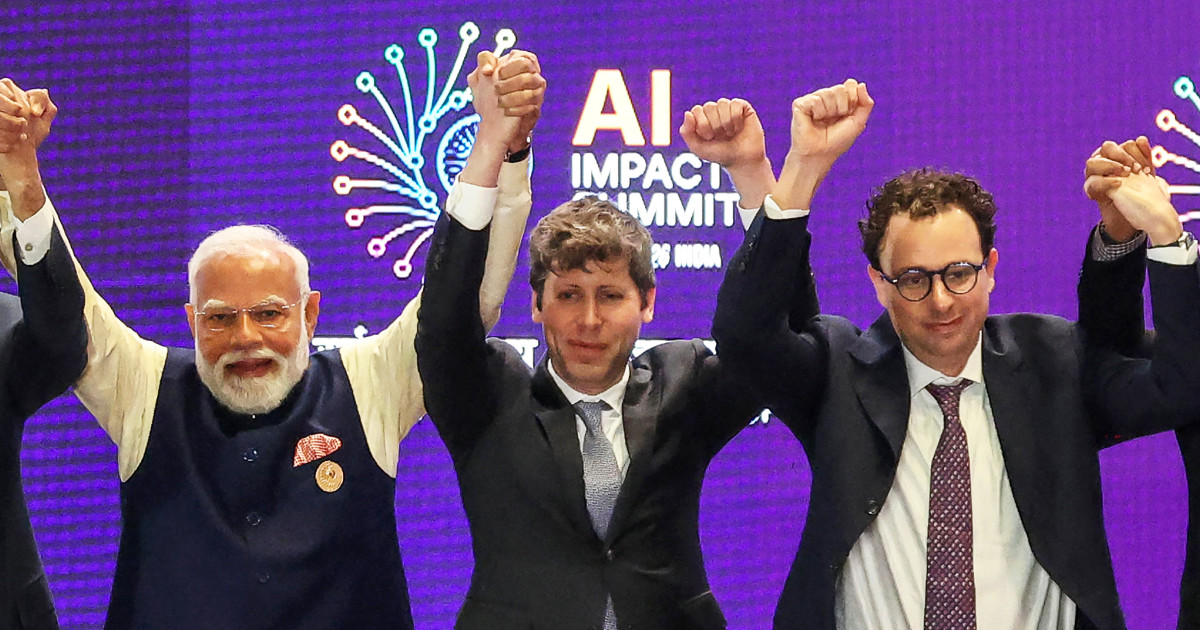
As the United States and China vie for supremacy in artificial intelligence, India this week sought to emphasize that there is another path through the silicon surge.
Billed as the first high-level AI gathering to be held in the Global South, the India AI Impact Summit gave the world’s most populous country a stage to showcase its status as a global AI player, expanding the AI conversation to Latin America, Africa, and beyond.
“In the long term, it’s good for the world that AI is not just seen as a competition between the US and China. I think India is currently the player most confident in saying, ‘We reject this dynamic,'” said Jacob Moukander, director of science and technology policy at the Tony Blair Institute for Global Change.
As the event’s ‘Impact’ branding suggests, the summit highlighted how countries can embrace increasingly powerful AI systems and adapt them to their own needs and industries.
“Every country is going to want to chart its own AI destiny,” Michael Crasios, White House director of science and technology policy and leader of the U.S. delegation to the summit, told NBC News. “They each have their own unique characteristics in terms of culture, language, traditions and how they use AI.”
As part of the event, Kratsios announced a series of initiatives to increase U.S. global engagement in AI, including an AI-focused Peace Corps program and new World Bank funding to help countries purchase AI systems.
The five-day summit hosted by Prime Minister Narendra Modi in New Delhi opened with some confusion. The summit, which has more than 250,000 registered attendees, was plagued earlier this week by complaints of overcrowding, long lines, visa issues and traffic disruptions, as well as major absences, including a last-minute cancellation by NVIDIA CEO Jensen Huang.
Microsoft founder Bill Gates, who has faced questions over his ties to convicted sex offender Jeffrey Epstein, also walked out hours before Thursday’s keynote, saying in a statement that he wanted to “keep our focus on the AI Summit’s key priorities.”

Later that day, American rivals Sam Altman of OpenAI and Dario Amodei of Anthropic held hands with people on both sides, but not each other, at an event that was supposed to be a show of solidarity with Indian Prime Minister Narendra Modi and other technology leaders.
Earlier this week, it was reported that an employee at an Indian university was asked to leave a summit after falsely claiming that the university had developed a robot dog developed by Chinese company Unitree.
“The Modi government is making a global laughing stock of India on AI,” the opposition Congress Party said in a post on X, pointing out that India’s information technology minister shared and later deleted the false report.

However, the summit still yielded some victory for India. India’s largest conglomerates, Reliance and Adani, have pledged to invest a combined $210 billion in AI and data infrastructure in the country (compared to the more than $630 billion that US tech giants are expected to spend this year). OpenAI has signed a partnership agreement with Mumbai-based Tata Group, and Anthropic has announced a partnership agreement with Infosys and opened an office in its home city of Bangalore.
“The solutions presented here – from agriculture to security to disability support to addressing the needs of a multilingual population – are powerful examples of the strength of Made in India and India’s ability to innovate,” Prime Minister Modi said in his speech on Thursday.
Participants noted that while this year’s summit was able to attract far more people than previous summits, there were fewer top government and business leaders to actually formulate policy. The summit was attended by at least 20 heads of state and government, including French President Emmanuel Macron and Brazilian President Luiz Inacio Lula da Silva, as well as technology executives such as Google CEO Sundar Pichai and Microsoft President Brad Smith.

The world’s two largest AI powers, the United States and China, did not send their heads of state. The summit coincided with Lunar New Year, the country’s biggest holiday, which is China’s friendly but contentious relationship with India.
As the highest U.S. official to attend the event, the White House’s Kratsios emphasized the need for countries to avoid strict technological oversight of AI, echoing Vice President J.D. Vance’s remarks at last year’s meeting in Paris.
“AI governance has to be local because it has to focus on the specific needs and interests of specific people,” Kratsios said in a speech Friday. “AI cannot lead to a bright future if it is subject to bureaucracy and centralized control.”
As part of Friday’s speech, Kratsios announced the National Champions Initiative, which aims to help AI companies in partner countries forge closer ties with U.S. AI ventures.
“Just because we say we’re trying to export an American AI stack doesn’t mean it’s 100% American content and nothing else,” Kratsios told NBC News. “There are many countries around the world that have great national champions of AI and are great at specific layers of the AI stack.”

The Trump administration has a vested interest in winning over China, which has long courted international partners on AI. India on Friday formally joined Pax Silica, a US-led international coalition launched in December to build resilient supply chains for critical minerals.
In the U.S.-China competition, countries such as India are wary of being caught in the middle. White House senior policy adviser on AI Sriram Krishnan drew some backlash this week with comments that the U.S. AI stack should be a “foundation” for allies to build on.
Critics say India should build its own fundamental AI models to avoid over-reliance on the US Although India lags far behind the US and China, which jointly control about 85% of the world’s AI computing power, India’s digital public infrastructure – including internet connectivity, digital payments and digital identity – is “better than most developed countries,” said Mokander of the Tony Blair Institute.
“They’re very proud of this. This is like a third way between China’s open source AI and America’s closed source AI,” he said.
The Global AI Summit Series has evolved significantly since its first edition, held in 2023 at Bletchley Park, UK, attended by a small group of government and business leaders. While the first summit focused primarily on the existential risks of frontier AI, this year’s event “takes a much broader view of what safety means,” said Amran Mohanty, a Carnegie India fellow and government advisor on AI policy issues.
“It’s no longer just a matter of malicious use, cybersecurity risk, national security risk,” he said. “The key question is how can we ensure we have enough data on the impact on economic transformation, employment and labor mobility to make useful policy changes?”
Mohanty said that idea was reflected in two voluntary commitments made at the summit. One is to use data to assess the economic impact of AI, and the other is to improve the performance of AI models across different languages and cultural backgrounds.
“To be able to design AI applications to maximize societal benefits and reduce unintended harm, it’s important to understand what works, what doesn’t, and who benefits,” said Global Executive Director Iqbal Dhaliwal. Abdul Latif Jameel Poverty Action Lab at the Massachusetts Institute of Technology.
“The vast majority of the world’s population lives in the Global South,” Dhaliwal said in emailed comments, noting that India accounts for one-sixth of the world’s population. “By hosting the summit here, we were able to focus our discussions on issues and use cases that impact billions of people.”