


Deep learning has excellent data learning and prediction capabilities and is very useful in a wide range of industries. TensorFlow is a popular open source library for deep learning applications because it is versatile, scalable, and can be integrated with other tools. This article shows how to implement a convolutional neural network (CNN) model using TensorFlow.
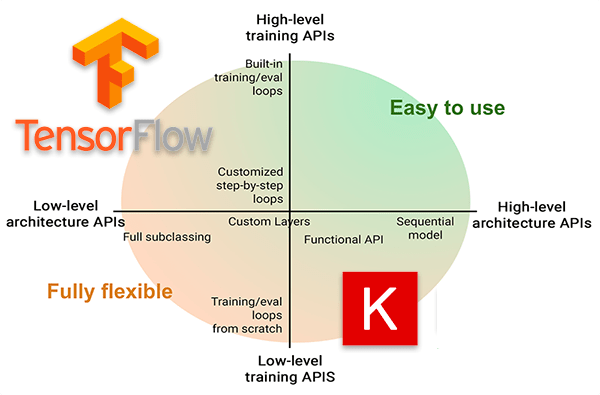
When it comes to developing and training machine learning models, TensorFlow is a very useful and versatile deep learning library. Its popularity and large community also make it a good option for those who want to learn deep his learning and apply it to their work. Figure 1 shows some of the reasons why TensorFlow is a popular deep learning framework.
Comparing TensorFlow, PyTorch, and Keras
Three widely used deep learning frameworks are Keras, TensorFlow, and PyTorch. The Keras application programming interface (API) is a set of high-level building blocks that are intuitive, flexible, and easy to use. TensorFlow provides a low-level interface for creating neural networks and a high-level API (such as Keras) for building models easily and efficiently. PyTorch’s dynamic computation network enables more flexible and efficient model building than TensorFlow.
Table 1 shows a comparison of these three deep learning frameworks. Overall, each framework has its own strengths and weaknesses, and the choice is driven by your use case.
Key Programming Elements of TensorFlow
Tensors, variables, and placeholders are the main programming elements of TensorFlow, making it a powerful platform.
tensor: A Tensor is the fundamental data structure of TensorFlow. These are multidimensional arrays similar to NumPy arrays, but with additional features such as GPU acceleration and automatic differentiation support. The TensorFlow library allows you to create a tensor using the following command.
import tensorflow as tf
# Creating a tensor
a = tf.constant([5, 7])
print (a)
variable: Model parameters, such as neural network weights and biases, are stored in variables and updated. These are created using the tf.Variable() function, which takes an initial value as an argument. You can create a variable in TensorFlow with the following command.
import tensorflow as tf
# Creating a variable
b = tf.Variable(23)
print (b)
Placeholder: When training or inferring a TensorFlow model, placeholders are frequently used to inject input data into the model. You can create placeholders in TensorFlow using the tf.placeholder() function. This function takes two arguments. The data type of the tensor entered in the placeholder and the shape of the tensor (optional). Below is an example of creating a placeholder for a 2D tensor of floats.
import tensorflow as tf
# create a placeholder for a 2D tensor of floats
x = tf.placeholder(tf.float32, shape=(None, 2))
| standard | TensorFlow | pie torch | Keras |
| Developed by | meta (facebook) | ||
| is written in | C++, Python, CUDA | Lua | python |
| compatibility | large dataset | large dataset | small dataset |
| debug function | difficult | good | unnecessary |
| Application selection | Scalability and performance | Flexibility and dynamic nature | Ease of use and simplicity |
| Popular use cases in the industry | image classification, language translation, speech recognition, etc. |
Computer Vision, NLP, Recommendation Systems, etc. | Speech recognition, healthcare, sentiment analysis, text classification |
Implementing a CNN Deep Learning Model Using TensorFlow
CNN deep neural networks are frequently used for image classification, object detection, and other computer vision applications. Figure 2 shows an example of Python code executed in a Google Collab notebook to implement a CNN deep learning model using TensorFlow.
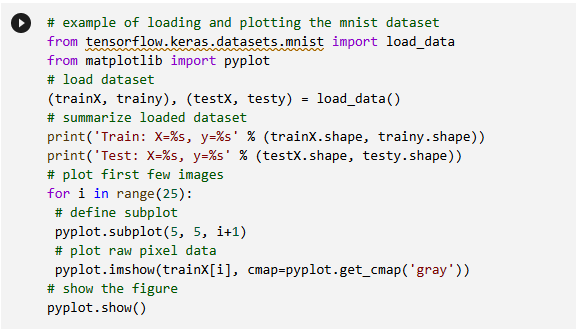
In this example, we used the MNIST dataset to train a CNN model. In the machine learning community, the MNIST dataset is frequently used as a benchmark for image classification tasks, especially for evaluating the performance of deep learning models such as CNNs. It is a popular data set due to its simplicity and accessibility, and is used for various applications such as handwriting recognition, digit classification, and optical character recognition.
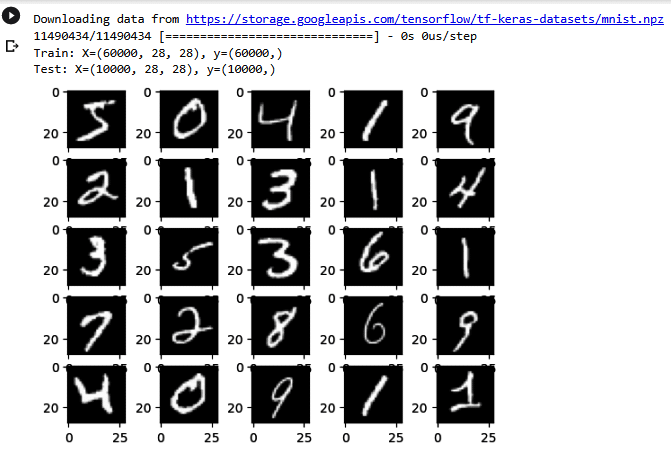
The output of a CNN deep learning model implemented using the MNIST dataset is shown in Figure 3. The dataset consists of 70,000 images, each of which is a grayscale image of handwritten digits from 0 to 9. The image is 28×28. Align the pixels and center them within the 32×32 pixel image.
TensorFlow is Google’s open source software library. It is designed for tasks that require complex numerical calculations and is popular because it supports Python and C++ APIs. It reduces compilation time and supports distributed processing on CPUs and GPUs. Overall, TensorFlow’s flexibility, scalability, and ease of neural network architecture make it suitable for a variety of industry applications.


