Image to Video AI for marketing teams: How to turn static assets into high-performance video content
Most marketing teams are tackling video production opportunities that are much larger than their current workflows can accommodate. Product photos are strong. The brand image is professional. The campaign’s visuals are well-constructed and on-brand. But none of them are videos. And in 2026, the gap between having great static assets and having video content that platforms reward and viewers engage with will be one of the most consistent performance constraints in digital marketing.
Online sales continue to increase significantly during peak commercial periods, and businesses that communicate through professional video content are always well-positioned to capture that growth. Brands that win with paid social, organic reach, and e-commerce aren’t just producing more content, they’re producing content in the formats that algorithms can distribute the widest way and consumers can most easily engage with. Video is the format, and companies that find efficient ways to produce it at scale have a structural advantage over those that don’t.
Image-to-Video AI directly addresses this problem for marketing teams who have strong static visual assets but lack the production infrastructure to convert them to video at the pace their strategy requires.
The role of Image to Video AI in marketing operations
The core feature is to use existing photos as the visual basis for the generated video. This means analyzing the depth, lighting, spatial relationships, and subject matter of the source image to generate motion that is contextually appropriate to what the image actually contains. The result is video content that maintains the visual quality and brand integrity of the source photo while adding motion to make the content work on video-native platforms.
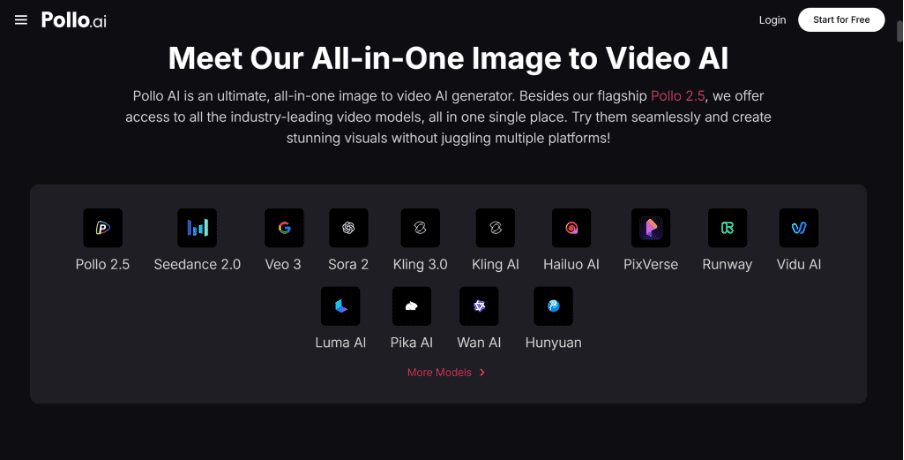
Polo AI’s dedicated image-to-video AI tools within Creative Studio apply this within a multi-model environment. Different generations of models handle different image types and motion goals with different strengths. Product photography benefits from motion processing differently than lifestyle images, and environmental shots respond differently than portrait content. Having access to multiple models in one platform with shared credit means routing each image type to the model that best handles it, rather than accepting a single model’s output ceiling as the limit of what can be achieved.
For marketing teams with established photo libraries of product catalogs, campaign images, brand assets, etc., this transforms existing investments into a video content pipeline without incurring new production costs. Already allocated photography budgets generate video content as an additional output, doubling the return on investment in the original visual content.
Commercial use: from product images to e-commerce to advertising videos
The use cases where image-to-video generation provides the most immediate commercial benefit are consistent across industries. Product videos for e-commerce listings are the most impactful application for product-based businesses. Animated product content on listing pages consistently increases engagement and purchase confidence compared to static images alone, and no additional production infrastructure is required to generate animations from existing product photos.
Paid social ad creative is the second major application. Static image ads have a performance ceiling in the paid social environment, where video consistently outperforms click-through and conversion metrics. Generating video variations from existing campaign images (multiple motion treatments of the same product shot, different animation approaches for different audience segments, etc.) can generate the amount of creative needed for systematic testing without proportionally increasing production costs.
Polo AI’s Commerce Studio extends this further for product-specific visual content, handling product image enhancement, background generation, and e-commerce poster composition within the same platform on shared credits. Marketing teams managing both product images and video advertising content can maintain their complete visual production workflow within one platform relationship, rather than managing separate tools for each content type.
Marketing Studio: From generated videos to campaign-ready creative
The shift to digital tools that are more accessible to businesses of all sizes is reshaping what is operationally possible with lean teams. Polo AI’s Marketing Studio operates this specifically for video advertising. Generate platform-ready ad formats from visual source material tailored to the format specifications and attention dynamics of your paid social campaign, rather than requiring post-production adaptations before deployment.
For marketing teams who use image-to-video generation to create a video from existing photos and then need to adapt that video to multiple platform formats and campaign contexts, performing both steps within the same platform eliminates production handoffs that typically add time and friction between visual content creation and campaign deployment.
Build a visual content stack based on Canva AI and information
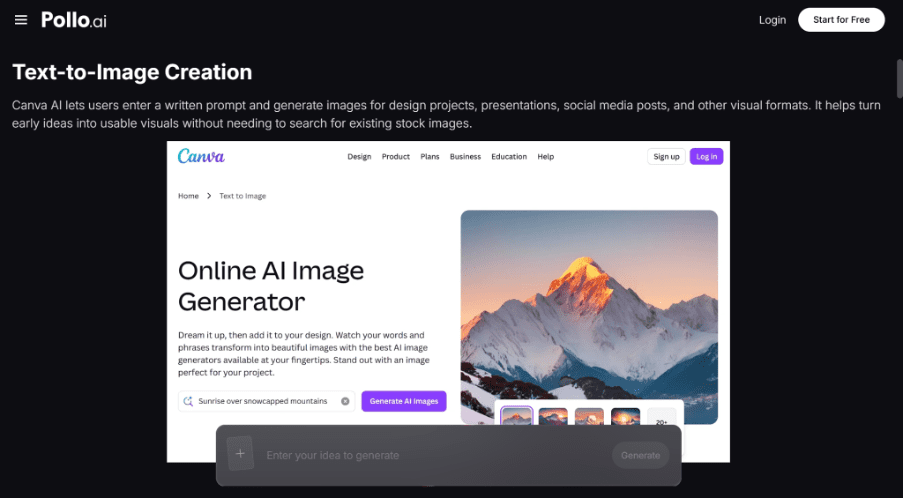
Embracing AI as a core technology beat means understanding the big picture of tools and how they differ. This is equally true for marketers building their content production stacks. Canva AI significantly expands functionality within the Canva design environment, offering AI image generation and animation tools suitable for teams already using Canva for social media graphics, presentations, and brand assets. For workflows where AI generation feeds into graphic design or template-based content, the integrated Canva environment reduces context switching and keeps assets within the tools you’re familiar with.
What makes a purpose-built AI generation platform like Polo AI different is the depth of motion it generates and its multi-model flexibility. Animations in Canva apply predetermined effects to design elements. This is suitable for graphic-based content. AI image-to-video generation generates motion that actually reacts to what’s in the photo, producing more realistic video output for photo-based content. Understanding which approaches fit with which content types can help marketing teams build a more intentional stack rather than defaulting to one tool for all their visual content needs.
Complex cases in image and video integration
The convergence of technology in digital marketing, e-commerce, and business communications is benefiting companies that are early adopters of the tools and build systematic workflows around them. Image-to-video generation has its place in marketing operations when the workflow is systematic rather than occasional, that is, when powerful images are routinely converted to video as a standard step in the content creation process rather than as an ad hoc task for launching a large campaign. zeka design
Companies that systematically build on this in 2026 are building content creation benefits that will grow over time. That means a larger video content library, more creative testing data from your video campaigns, and production workflows that scale your content output without adding production headcount. The investment in photography has already been made. Image-to-Video AI extends its reach to formats that deliver maximum performance across critical channels.