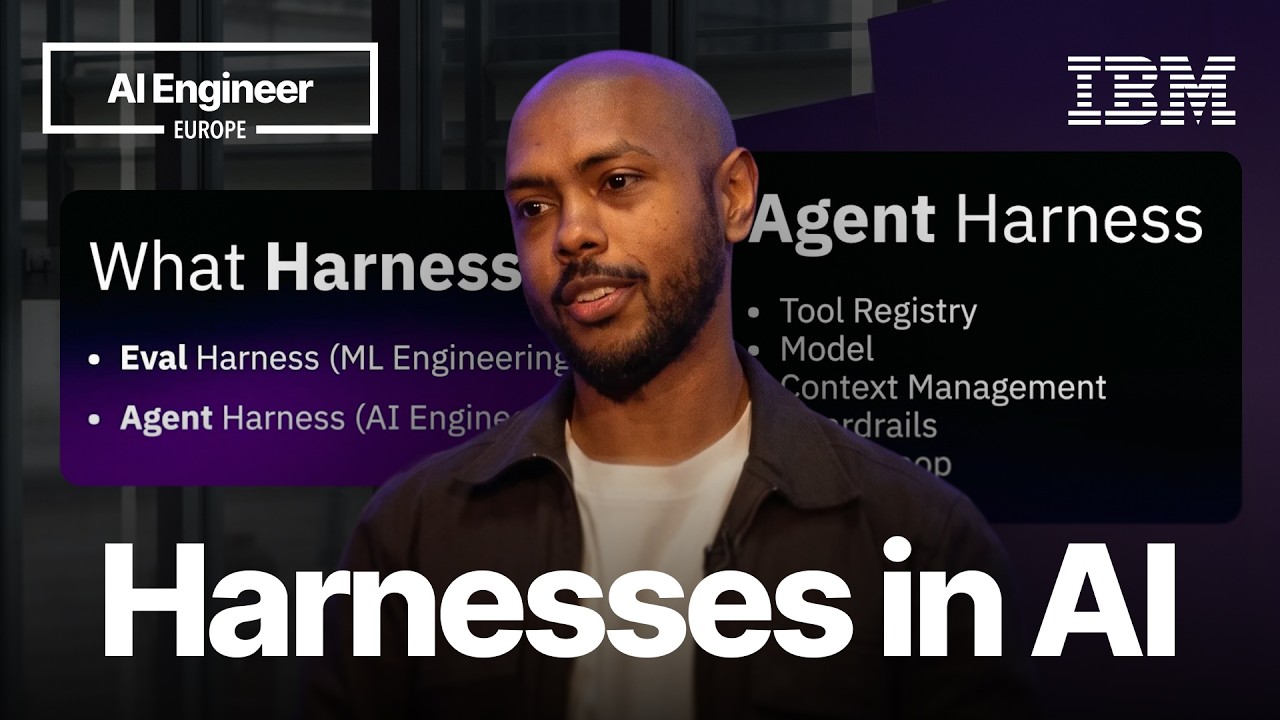
IBM’s Tejas Kumar recently elaborated on the concept of an “AI harness” at the AI Engineer Europe event. Kumar, IBM’s AI developer advocate, emphasized the growing importance of structured approaches to managing and controlling AI models and agents, especially within enterprise environments.
IBM’s Tejas Kumar talks about “AI harness” — From an AI engineer
Visual TL;DR. “Need for Control” leads to the AI harness. The AI harness description includes two harness types. Two harness types focus on agent harness components. The agent harness component enables practical implementation. Practical application will yield highly reliable AI results. AI harness instructions ensure reliable AI results.
AI Harness Explained: A Structured System for Managing and Controlling AI Models
The need for control: The increasing importance of stable and controllable AI environments
Two Harness Types: Two Categories: Eval Harness and Agent Harness
Agent harness components: tools, models, context management, and guardrails are key
Practical applications: Demonstrate real-world use cases and features
The Future of AI: Explore the ongoing evolution and potential of leveraging AI
Reliable AI results: Ensure predictable and reliable results from your AI operations
Visual TL;DR
Understanding the AI Harness: From Principles to Practice
Kumar began by addressing the potential ambiguity of the term “AI harness” and noting its frequent and diverse usage. In the context of his presentation, he clarified that an AI harness refers to a system specifically designed to provide a stable and controllable environment for AI models to perform tasks and ensure reliable results. He emphasized that while the term can be used in many different ways, the core idea revolves around providing a predictable framework for AI operations.
Two types of AI harnesses: Eval and Agent
Kumar outlined two basic categories of AI harnesses: Eval Harnesses and Agent Harnesses. Eval Harnesses are primarily described within the realm of ML engineering as a system for evaluating machine learning models. They act as test suites and test runners, allowing developers to input data and observe model output to assess performance and quality. Agent harnesses, on the other hand, fall under AI engineering and are more complex, encompassing a broader set of components designed to manage and direct AI agents. These include a tool registry of available functionality, the model itself, context management to maintain conversation flow and task state, guardrails to ensure safe and predictable behavior, and an agent loop to orchestrate the entire process.
Building an Agent Harness: Key Components
Kumar delved deeper into the agent harness and detailed the key components. The Tools Registry allows agents to access and utilize a variety of features such as browser navigation, data retrieval, and code execution. Agents also rely on specific AI models, such as GPT-3.5 Turbo, and context management to maintain information across interactions. Importantly, guardrails are implemented to impose limits and ensure responsible operation. These guardrails can include constraints on the number of iterations and the amount of messages processed, preventing runaway processes and excessive resource consumption. The agent loop then coordinates these components to enable the AI to perceive, think, and act within defined boundaries.
Practical application and demonstration
To explain these concepts, Mr. Kumar gave a practical demonstration. He introduced a simplified agent designed to interact with Hacker News for the purpose of upvoting articles. In this demonstration, we used Playwright, a browser automation library, to navigate to a site, log in, and perform an upvote action. He walked through the code and explained how to manage browser sessions, create tools, establish context, and perform agent tasks through run loops. The demo highlighted how guardrails such as trial limits and context trimming contribute to the reliability and safety of agent operations.
The demo revealed a common challenge where agents initially fail due to the login screen. However, we found the harness’s ability to detect this failure, apply a login handler, and retry the action to be important. This iterative process of execution, validation, and adjustment is a hallmark of robust agent engineering, making the behavior of AI systems more reliable and predictable.
The future of AI harnesses
Kumar concluded by highlighting the growing importance of these structured approaches in developing sophisticated AI agents. As AI models become more powerful and integrated into complex workflows, the need for reliable, safe, and controllable harnesses will only grow. He noted that the principles outlined here are the foundation for building the next generation of AI applications, allowing businesses to leverage the power of AI more effectively and responsibly.