
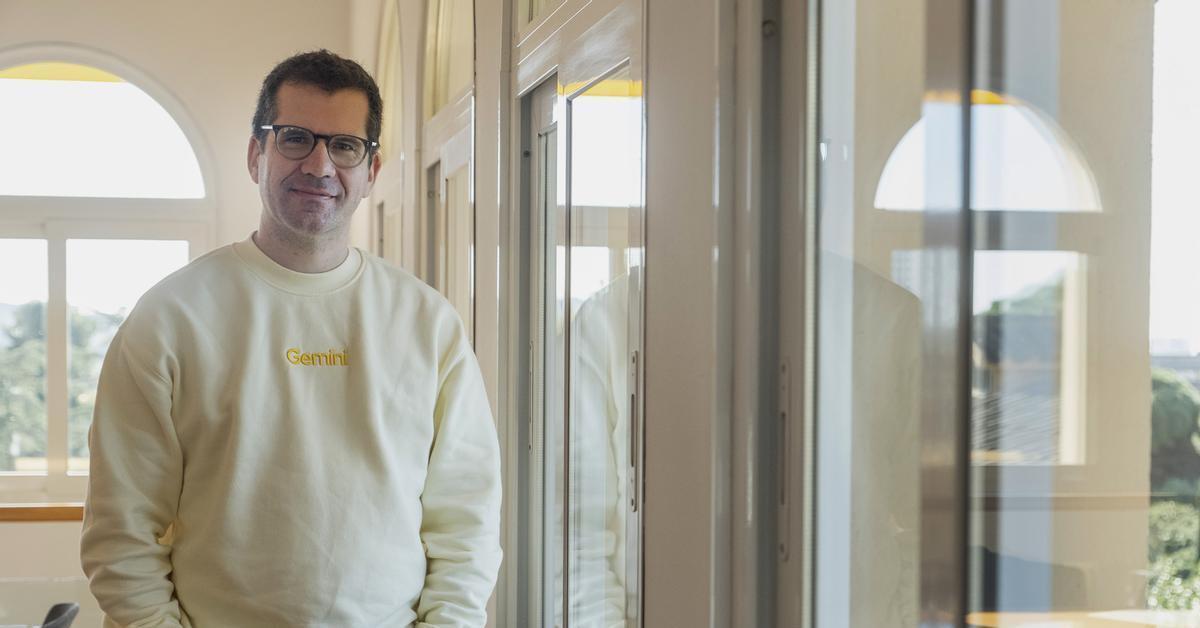
At the Polytechnic University of Catalunya, I don't remember any applause as great as that of Oriol Viñals (Sabadell, 1983), who was awarded his doctorate at the end of November. honor causeA standing ovation lasted for several minutes to honor the graduates of the Telecommunications Engineering and Mathematics dual degree program who have made important contributions to the development of artificial intelligence. In fact, he is among the top 10 most cited AI researchers in the world.
After studying at UPC, he moved to the United States in 2006, where he completed his PhD and joined Google Brain as a researcher. There, he specialized in two areas of AI: machine learning and deep learning. Since 2016, he has been VP of Research and Team Leader for Deep Learning at Google DeepMind in London.
The Sabadell native worked on AlphaFold, an AI system that solved one of biology's biggest challenges: how to predict proteins from amino acid sequences. AlphaFold He won the Nobel Prize in Chemistry in 2024. In addition, he is co-tech director for the development of Gemini, Google's most advanced multimodal AI model.
He just gave a masterclass at his university, UPC, which was attended by over 500 people. Many people were standing at the end because they ran out of space.
— This wasn't the first time I returned to UPC after leaving it, but I didn't expect so many personal feelings to be focused on me this time. What happened yesterday [the ceremony] honor causeIt was very special and emotional, and the people on the right applauded continuously. I couldn't help but think about what I had done to get there. And in fact, that's what I tried to explain in the talk I gave because I thought it might inspire some of the students in the audience.
He returned to his university, where there is now a heated debate about the use of these tools. In most cases, the use of AI penalizes students and returns them to the oral exam.
— All technology has a dual purpose. Here we're focusing on how students at top universities use them, and that's fine. But as a developer, I think about the parts of the world where universities either don't exist or the nearest university is a three-hour drive or more away, effectively blocking access to education. AI provides personalized guidance to these people. Globally, these tools are reshaping access to resources, instructors, and knowledge. That's why we develop these tools. Each company has a different approach, but in that sense, Google tests tools and analyzes potential issues before making them available to the public. In the case of education and AI, Google Education has a very large team looking at these concerns. AI is a tool that will last, and it is important to educate society as much as possible about its use. Perhaps universities need to teach other things.
Which one?
— Skills such as negotiating, speaking, communicating, teaching, and using technology in ways that optimize an individual's overall learning. This will allow you to know the derivative methods and understand how the world works and how to enter a productive society.
However, not everything that AI teaches is correct.
– That's correct. You also can't be critical if you haven't mastered a particular subject, like algebra, or if everything you know is what you learned from the AI. Knowledge is required to be able to question, reevaluate, revise, and criticize what AI says. You won't make mistakes in the future, but you will make them now. That's why having this critical perspective is so important. Professor Ferran Marquez from UPC explained to me that the exam consists of showing students two solutions to an AI-generated problem and finding the mistake. I think this is a very good and constructive way to build and predict the future, as this model will be significantly improved in all aspects.
How can you differentiate between talented people and those who are simply good at using AI?
—We may need to redefine what talent is. Adapting to constant change is now a more valued talent than, say, calculating a 500-digit number. But before calculators existed, being able to do that was extremely valuable. If people today are able to use AI tools well and the results they get are amazing, that's also talent.
Which one is yours?
– my? You'll probably never stop learning. That's one of my constants. I always choose places where they are working in a new field that is unfamiliar to me. At Google Brain, deep learningWhen I went to London to work at DeepMind, I reinforcement learningThat was another new area. You also have leadership talent. For example, I did it with Gemini.
AI creates custom stories for 3-year-olds
Vinyals explains that her daughter is currently not exposed to screens. Like any good scientist, he says that before you introduce technology to your 3-year-old, you first need to understand how it affects them. However, she is exposed indirectly. For example, the day before you fly to Barcelona to participate in an upcoming event. honorary doctorate During the ceremony at UPC, Vinyals went to her daughter's nursery school in London to read a story to her. “I asked Gemini to write an Alphafold story for children this age,” he explains. And this is what he read to children. “It was a success,” he says proudly.
Some believe that AI will trivialize creativity. ChatGPT has opened Pandora's box by allowing you to transform your photos in the style of Japanese animation studio Ghibli, founded by Hayao Miyazaki. There is a lot of debate as to whether it violates intellectual property law.
— We have created laws and systems to protect intellectual property within the framework of what we believe to be the only intelligence on earth. But if you think about it, these tools do the same thing as humans. That is, learning from what has already been done and created to generate new things that change human knowledge. Isn't this what artists do? They study other artists of the past, are inspired by them, learn from them, take inspiration from them and create their own work, where they create a new contribution, their own creativity.
Will algorithms also make new contributions?
— For example, at DeepMind, our mission is to advance scientific progress. We have a system called Co-Scientist that reads research papers in a particular field and tries to find new ideas that researchers can develop. Especially in highly specialized fields such as mathematics, we find many examples of true creativity coming from asking models to do what they do. AI models can be your next partner brainstormingIt is clear that they are not perfect, but experts can identify it and change it. promptI myself use an AI personal assistant.
What kind of work does he do for you?
— I lead a very large team and we share documents and ideas. The Assistant has access and can tell you if a particular channel has good ideas and needs your attention, or if you need to discuss a particular idea with someone on your team. As a result, connections are made. I also read scientific research in my field, summarize the ideas that are most innovative to me, and suggest new avenues of research. We need to rethink concepts like talent and creativity so that these tools can truly accelerate progress.
Will these AI models eventually generate consciousness?
— I am very hands-on with the AI consciousness debate. When I interact with the models, I don't feel that they are conscious, at least not today. The future will depend on where technology goes. They may eventually come to have some level of consciousness, or even existence.
There are already cases of people marrying AI or committing suicide after taking advice from AI. chatbot.
— There is a danger of double use, especially when tools are used on a large scale. Although there will always be a minority who fall into the most extreme cases, it is important to remember that the most common usage is positive.
There are concerns about the presence of Catalan in an English-dominated ecosystem.
— This means that you chatbotAt least for now, it's clear that the best way to get results when asking AI questions is in English. Because English is the dominant language on the internet and the universal language of science. what to do machine learningYou can calculate what would happen if you asked the same question in English or Catalan. Measuring the differences numerically allows us to start optimizing and understand how to integrate languages, which improves our tools. Google's current priority is to ensure that Gemini is accurate in many languages. And we are making great progress! In fact, there are a lot of Catalans working at Google, and there's clearly a lot of interest. Perhaps there are still differences between English and other languages, but with new generations of models they will become less and less noticeable.
Five years from now, what will we be doing with AI that is unimaginable today?
— Our dialogue will become richer and more diverse. For example, it is already possible to ask a model to generate a drawing inspired by a podcast or visualize it with graphics. You can also ask for a video summary of a very long interview to add a visual element. In five years, this will go even further, with personalized video tutors. For example, if you want to know how a nuclear reactor works, the model creates a small simulator, or reactor infographic, that you can interact with. The response will be richer with a graphical interface tailored to us.
AI resource consumption will continue to increase…
— Google is committed to carbon neutrality. The demand for AI is clearly increasing rapidly. Our goal is to make this technology available to everyone, especially those who are underserved. We also want to reduce greenhouse gas emissions, plant trees, and install solar panels in the desert. Increased model speed is directly related to computing power. The chips we make (from generation 2 to generation 6, the wattage required to perform the same calculations) have decreased by a factor of 30. The energy consumed, especially during model training, is reasonable and significantly optimizes the process. Furthermore, we are also trying to discover new fusion materials using this technology. Yes, we use energy, but we are also accelerating advances in superconductivity and nuclear fusion, which will ultimately reduce energy consumption and help fight climate change.

