Mahdi Yahya pitched his early AI venture to hundreds of investors.
Mahdi Yahya’s fascination with data centers began as a child. His father works for a telecommunications company and takes him to the facility, where he first remembers “smells, sounds, noises and extreme cold.”
Mr Yahya’s London-based company Oli Industries has since turned out to be a highly sought-after property. Eight years after launching his AI infrastructure company (“before AI was even sexy,” he says) and knocking on hundreds of investors’ doors, his British cloud computing startup merged last month with Radiant, a new AI infrastructure company owned by global investment giant Brookfield Asset Management.
AI arm Radiant is reported to be valued at $1.3 billion (£970 million), according to Reuters.
read more: I slept in a freezer to pay my staff – you need to do everything you can to be successful
Yahya said Ori, which he started from scratch, had multiple investment offers, but believed Brookfield was the best platform to scale the company.
“Especially when it comes to future AI infrastructure,” he says. “Demand is not slowing down and is always accelerating. Even if we raised hundreds of millions of dollars today, that demand would still be difficult to capture.”
Before Brookfield merged Radiant and Ori, the London start-up had raised around $180m (£135m) in equity and debt. Meanwhile, the February deal marks the end of a whirlwind career for the former CEO of Ori and now president of Radiant.
When we spoke before the merger, Yahya said it would be great to someday experience Patagonia’s wild terrain and fishing. That may have to wait a little longer.
Radiant’s merger with Ori launches global investments in data centers and AI. ·Reuters/Reuters
Born in Lebanon, Yahya taught himself to code as a teenager and fled his homeland when war broke out, moving to the UK in 2006. He took a taxi to Damascus and from there took a plane to London.
A year later, at the age of 20, he founded his first company in the field of data center networking, Sama Telecom. “It wasn’t easy and I thought I knew a lot,” he said. “But I learned everything about how to make things happen in a company.”
Yahya also has a deep interest in the arts and attended drama school at the Drama Center in London for two years after starting Sama. “Drama school was important to me because it taught me business and how to sell. It taught me about people, psychology and character, which really helped my career.”
Wanting to combine technology and art, he later founded Room One and worked on projects such as Fabulous Wonderland, a musical produced by Damon Albarn that featured virtual reality.
read more: “We have the personality and great assets of having a rabbit in our energy drink.”
Yahya, who later became a director of the Royal Court Theatre, attests that although he did not praise Room One as the best business financially, it had many positive aspects. “Getting people talking and having some of the largest organizations working together was a success, and it definitely laid the foundation for what would come later in this field.”
Yahya’s early journey into AI infrastructure started in 2018, and he says no one was listening at the time.
“We knocked on every investor’s door and spoke to hundreds of investors across the UK, Europe and most of the US.It usually takes one door to open. [London-based venture capital firm Episode 1 Ventures] That’s how we started.
“It’s very difficult to build on the assumption that something might happen in the future. You have to be resilient and flexible and build with the times.”
Mahdi Yahya says attending drama school helped him rise in the business.
Yahya and his team believed that the world’s infrastructure was being transformed. “We had two use cases: edge computing, like robotics, and layering machine learning on top of that. [early AI iteration] We had to build a new infrastructure platform,” he says.
“This was a bet, and it was based on vision, not data or reality. We felt strongly about taking that bet and building a company around it. It became clearer that it was AI and LLM. [large language models] In its first form. ”
Ori’s core product was a software platform that gave customers access to their infrastructure. Its customers range from two AI startups running models to large Fortune 500 companies.
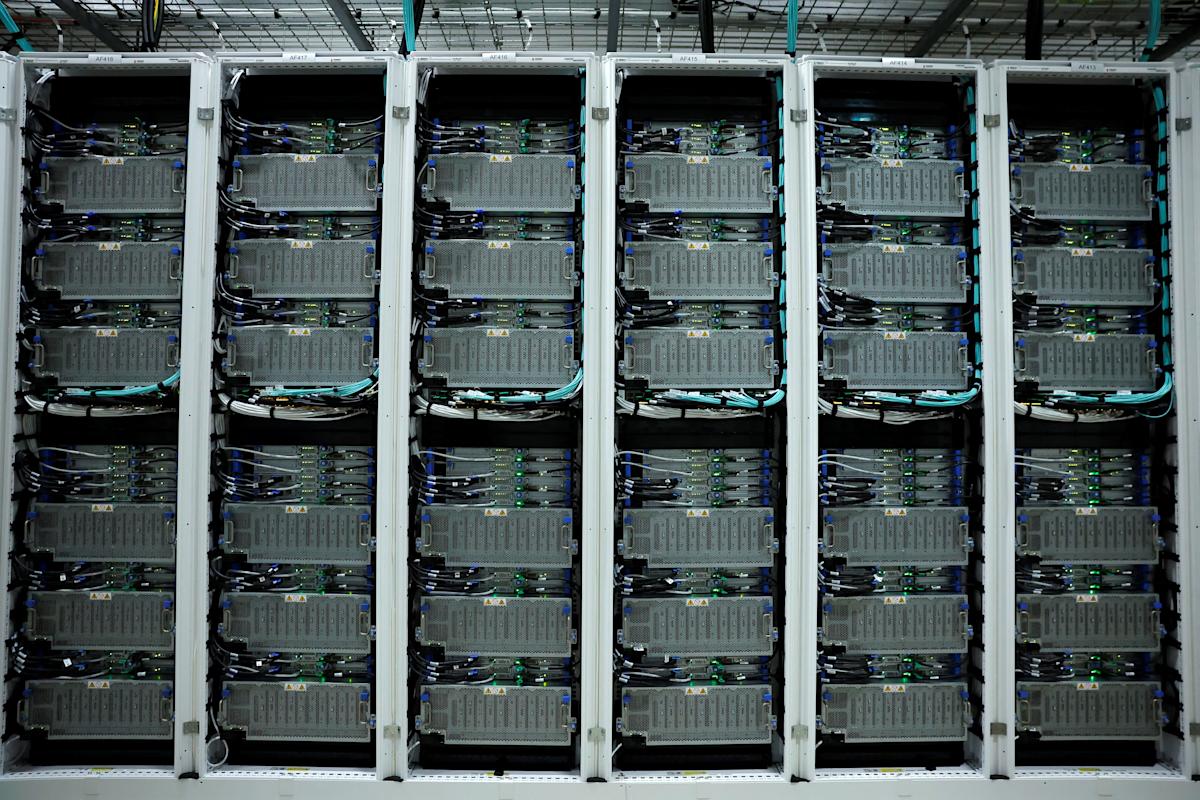
We have two major centers in London and Texas, and 20 centers around the world. The investment involved retrofitting and building in-rack cooling systems and power density to host AI workloads. “Currently, the industry is moving towards liquid cooling systems and the power requirements are increasing,” Yahya adds.
read more: ‘Acne was debilitating to me so I set up a £40m business to help others’
Last year, a poll conducted by the Tony Blair Institute for Global Change and Ipsos suggested that 39% of UK adults are more likely to see AI as an economic risk than an opportunity. But Yahya is now at the forefront of an industry where AI infrastructure is expected to grow to more than $400 billion by 2030.
“It saves me time. It’s not that AI will replace me, it’s that it will enable me to do a better job,” he says.
“If we believe that AI is not going anywhere, then the infrastructure that powers AI is not going anywhere either. No matter what form AI takes, the infrastructure needed to power AI will always be needed, whether for personal or business purposes.”
Especially now that new players are entering the market.
Utilize AI for business
Organizations that succeed with AI are those that transform their internal workflows. How you apply it and the workflows you build will fundamentally transform your business and reduce overhead and costs.
leadership
Since I started my company very young, I had to rely on people much older than me. It’s always about the people.
Building a company is chaotic, and your role as a leader is to create calm within the chaos, thereby creating focus and reducing noise.
My style is to directly recruit the best people who can operate within my environment and create the right environment to produce their best work.