
insider brief
- At CES 2026, Hyundai Motor Group announced its AI Robotics Strategy, outlining a human-centric roadmap for physical AI built around the large-scale deployment of robots across manufacturing, logistics, mobility, and service environments.
- This strategy is underpinned by three pillars. We are deploying robots that collaborate alongside humans, building an end-to-end AI robotics value chain with Boston Dynamics, and partnering with leading AI companies like Google DeepMind and NVIDIA to accelerate training, simulation, and safe commercialization.
- Hyundai said it plans to mass produce and deploy the Atlas humanoid robot across its global facilities starting later this year, supported by new robot manufacturing capabilities, physical AI application centers, and a robotics-as-a-service model aimed at expanding adoption across industries beyond automotive.
Hyundai Motor Group announced that it will invest $26 billion in the United States over four years starting in 2025 to expand partnerships in humanoid robotics, AI, autonomous driving, and related technologies, as well as build a new robotics facility with an annual production capacity of 30,000 units.
Outlining its new AI robotics strategy at CES 2026, the company indicated that the investment is aimed at strengthening U.S.-Korea industrial relations, supporting economic growth, and positioning its U.S. site as a production base for its future mobility and robotics strategies. The company said its plan positions robotics as a core extension of its manufacturing, logistics and mobility operations, rather than a standalone technology bet.
The strategy focuses on what Hyundai calls physical AI – systems that combine hardware, real-world data and software to make autonomous decisions in operational environments. Hyundai said it intends to apply this approach across its value chain, using its factories, logistics hubs and sales operations as both robot deployment sites and ongoing training grounds.
Hyundai's roadmap is based on three pillars. The first focuses on collaborative robots designed to work alongside humans, initially in manufacturing settings where the majority of tasks are repetitive, dangerous, or physically demanding. The second pillar formalizes the integration with Boston Dynamics, combining Hyundai's manufacturing scale with Boston Dynamics' robotics to create an end-to-end robotics value chain. The third pillar extends externally through partnerships with AI leaders like Google DeepMind and NVIDIA to accelerate training, simulation, and adoption.
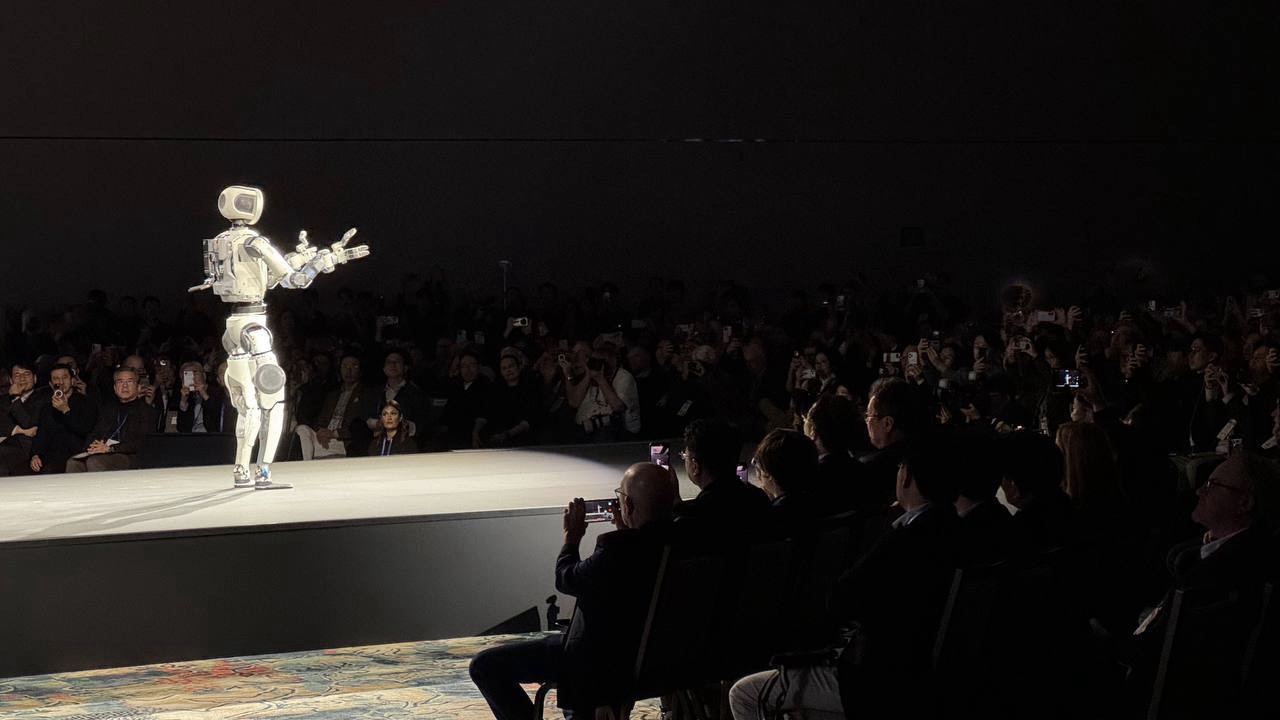
At the center of this strategy is Boston Dynamics' Atlas humanoid robot. Hyundai says Atlas is being developed as a general-purpose industrial system that can sequence materials, support assembly, and manage machinery within existing factory layouts. The company plans to introduce it in phases, starting with rigorously validated tasks such as part sequencing in 2028 and expanding to more complex assembly tasks by 2030. The Atlas robot will first be installed at Hyundai facilities, including Hyundai Motor Group's Metaplant America in Georgia, and will then be introduced more broadly commercially.
Hyundai signaled that it is building a group value network that brings together robotics, components, logistics and software to support scale. This includes a data-driven “software-defined factory,” a U.S.-based robotic Metaplant application center scheduled to open in 2026, and standardized components supplied by affiliates such as Hyundai Mobis. Hyundai says the structure is designed to shorten development cycles, improve reliability and enable mass production similar to car manufacturing.
The company also said it plans to expand its robotics through a service-based model that provides ongoing software updates, maintenance and remote monitoring. Boston Dynamics' existing deployments of spot and stretch robots in logistics and inspection are being used as a reference point for broader deployments into energy, construction, and facilities management.
Hyundai said the strategy reflects its view that humanoid robots will become a key area of industrial automation, with long-term applications extending beyond car manufacturing.
Image courtesy of Hyundai


