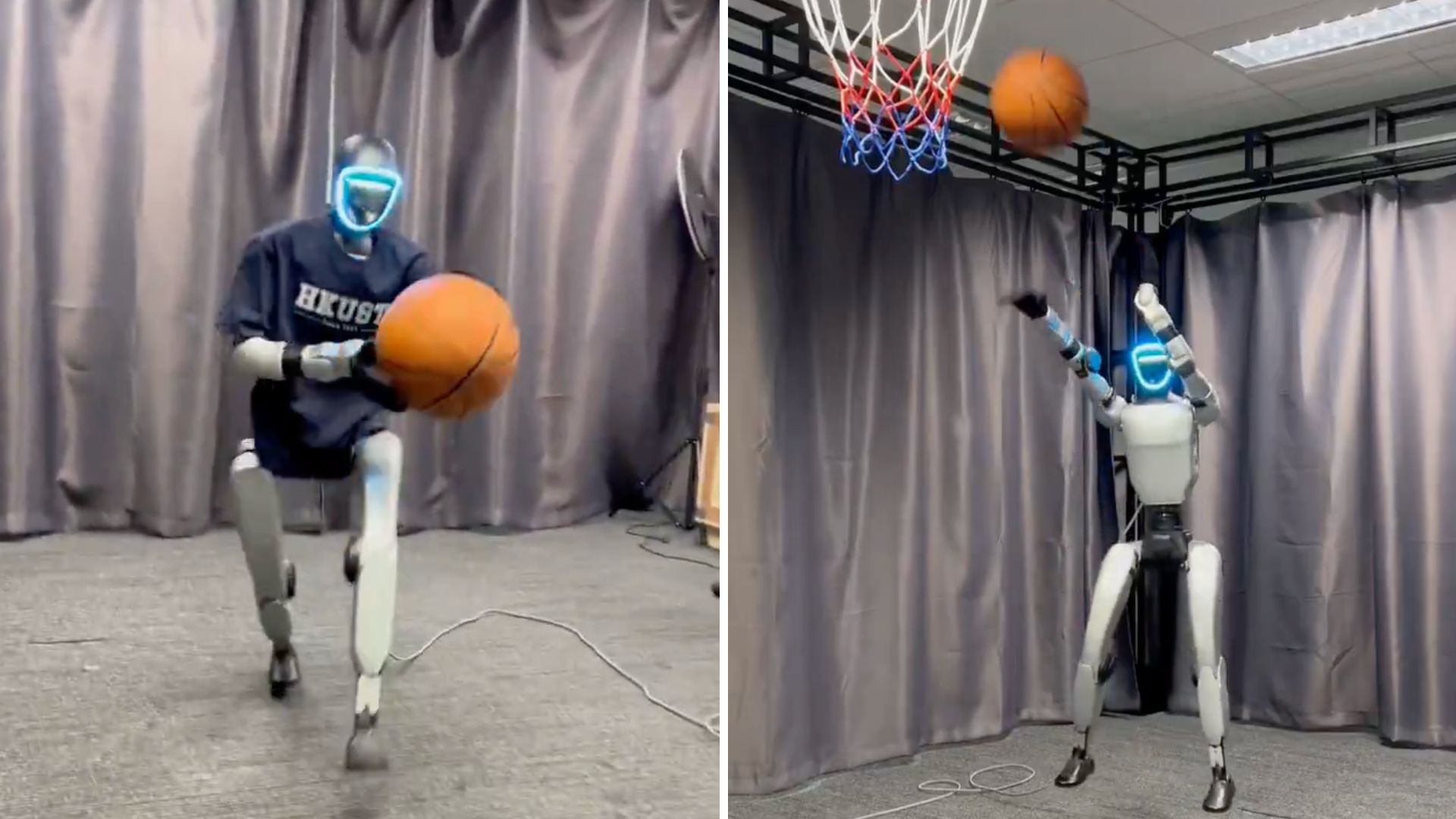
Unitree G1, nicknamed “Little Potato,” cleanly lands a three-step layup, marking a remarkable leap forward in humanoid robot athletic ability.
In a recent laboratory demonstration at the Hong Kong University of Science and Technology (HKUST), the compact humanoid robot moved with remarkable fluidity, dribbling, passing, and sinking shots after thousands of simulated drills.
The robot’s abilities come from SkillMimic, an AI framework that studies human demonstrations captured through video and motion-tracking suits and refines those movements with virtual training until they are stable enough for the real world.
This approach allows a single policy to be trained to learn multiple skills, allowing for smooth skill switching even if these switches are not present in the reference dataset. High-level controllers can easily reuse skills acquired through SkillMimic to accomplish complex basketball tasks, the researchers said in their research brief.
Basketball becomes robotized
A video from the HKUST lab shows the compact Unitree humanoid gliding across the court and sinking shots with amazingly natural speed and control. The research team claims this is the world’s first demonstration of a robot performing basketball actions in a real environment.
During the demo, G1 even attempted a layup, only for the researcher to brush it away. Still, the robot quickly regained its balance and continued playing, highlighting how stable its learned movements were.
SkillMimic-V2 is the system behind recent advances in humanoid basketball. This addresses a major challenge in reinforcement learning from demonstration. Actual movement data is often messy. Human demonstrations can be sparse, noisy, and lack the smooth transitions needed for robots to learn complex skills. Rather than trying to collect perfect data, the researchers argue that even flawed recordings can contain enough useful information if processed properly.
This system works through three main ideas. The first is the Stitched Trajectory Graph (STG), which finds and connects similar body positions across different skills like dribbling and layups. This creates a new migration path that the robot has never seen directly. bread daily.
The second is a state transition field (STF), which trains the robot by starting it from a slightly different point each time, such as a masked intermediate state. This forces the robot to learn how to recover from mistakes. The third is adaptive trajectory sampling (ATS). This gives extra training weight to the more difficult moments of motion data, ensuring that the robot doesn’t fail during long action sequences.
Together, these tools allow robots to learn smoother, more reliable, and more general skills in simulation, such as consistent layups and natural transitions between dribbling and shooting.
simulation power skills
The researchers tested the system on four advanced tasks using a single “interaction skill” policy trained on seven basic movements, including different types of dribbles, layups, shots, and picking up the ball. This policy was trained on SkillMimic using approximately 4.5 billion simulated samples.
In the next stage of training, the basic skill policy remained fixed and only the high-level controllers were updated. Simple tasks like throwing and circling required about 400 million training steps, while more difficult scoring tasks required about 1.2 billion training steps.
To measure how well their approach worked, they compared it to three standard methods. Systems trained from scratch or using older motion-first techniques often struggled and failed tasks because they lacked strong ball interaction skills.
Even methods that used both body and object movement didn’t work well because low-level controllers couldn’t learn precise ball manipulation. In contrast, SkillMimic produced much better results by equipping robots with powerful, reusable interaction skills, according to the researchers.
The researchers say there is still more to explore, including teaching a single policy to handle many different objects, learning from small datasets, and eventually having real humanoid robots perform these skills outside of simulations, including entire basketball games.