
AI presents real challenges, but it also provides a roadmap for creating a culture of innovation.

Article Contents
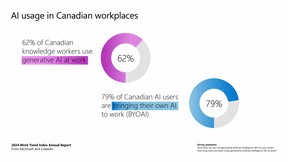
Canadians use AI in the workplace every day. Even in companies that don't have a clear plan or process for how AI will be used, employees are attracted to the benefits AI can bring and are experimenting with their own tools. According to the latest data from the 2024 Work Trend Index, a joint report by Microsoft and LinkedIn, including time savings, increased creativity and job satisfaction, 62% of Canadian knowledge workers are using generative AI at work, and 79% of AI users bring their own AI tools to the workplace, creating a new “Bring-Your-Own-AI (BYOAI)” trend across the country.
Ad 2
Article Contents
Statistics like these show how interested and curious Canadians are about generative AI. In a country that has historically been slow to adopt new technologies, this is encouraging news. It shows that Canadians are eager for tools that will free up their time from mundane tasks to focus on the work that really matters. But despite the enthusiasm, there is also some anxiety. Nearly half (47%) are reluctant to admit that they use AI for some of their most important jobs. They fear they will be seen as replaceable.
Fears about adopting AI in the workplace are a major challenge for Canadian businesses. At best, it's hindering AI adoption and economic growth. At worst, emerging BYOAI trends are putting corporate data at risk in an environment where cybersecurity and data privacy are leaders' top concerns going forward.
Ad 3
Article Contents
A culture shift is needed in Canadian workplaces to transform fears about using AI into a culture of innovation. Movement has begun, but there is still much to be done. While 74% of Canadian leaders recognize that AI is important to their competitiveness, 59% are concerned that they don't have a plan for adopting AI. But with or without a plan, employees are starting to use AI, creating an urgency to develop these strategies now.
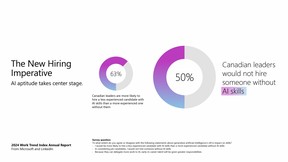
There are signs that organizations are thinking about AI, even if they are just beginning their journey. This is especially true when it comes to upskilling their workforce. Canadian leaders recognize the importance of AI literacy, with 6% of Canadian leaders being more likely to hire a less experienced candidate with AI skills over an experienced candidate without AI skills. And 50% say they would never hire someone without AI skills.
Ad 4
Article Contents
While the concerns and challenges around AI are real, data shows that employees are looking for change and clear guidance. In fact, Canadian companies, especially those with access to training on prompt writing and how to use AI in specific roles and functions, are seeing the rapid emergence of so-called “AI power users.” These power users are 124% more likely to experiment with different ways of using AI because they understand how to use it and feel supported to do so without any bias or fear. As a result, they are spending more time at work to create greater impact, driving innovation and ultimately growing their companies. For example, 5% of the most frequent users of Microsoft Teams used Copilot to summarize an 8-hour meeting in March, which equates to a full day.
Ad 5
Article Contents
For Canadian businesses, there are lessons here. While the fears and challenges surrounding the adoption of AI are real, there is a clear roadmap for creating a culture of change and innovation. First, senior management must regularly discuss the importance of generative AI with employees. Companies that get the most benefit from AI are 65% more likely to have heard their CEO talk about AI. Second, improving AI skills is important at every level of the company. While the pace and complexity of helping organizations understand AI can seem overwhelming, it is important for senior management to focus on building their own AI skills and provide similar training opportunities for their staff. Recently, LinkedIn made 50 AI learning courses available to everyone for free to help employees at all levels, from entry-level to data scientists, improve their AI skills. The biggest factor in making an organization successful is building a culture of continuous learning.
Ad 6
Article Contents
When it comes to AI in the workplace, there's no room for a “wait and see” attitude. Even without clear guidelines, employees are already using AI. But this independent experimentation also introduces security risks, especially when employees bring their own AI tools to the workplace. While embracing employees' curiosity and enthusiasm about generative AI, you also need to provide them with the resources they need to leverage it responsibly. Companies that channel employee experimentation into an intentional strategy will undoubtedly gain a competitive advantage. Companies that do nothing will be left behind.
*Based on Work Trend Index global findings. Canada-specific data not available.
This story is Microsoft Canada for commercial purposes.
Article Contents