
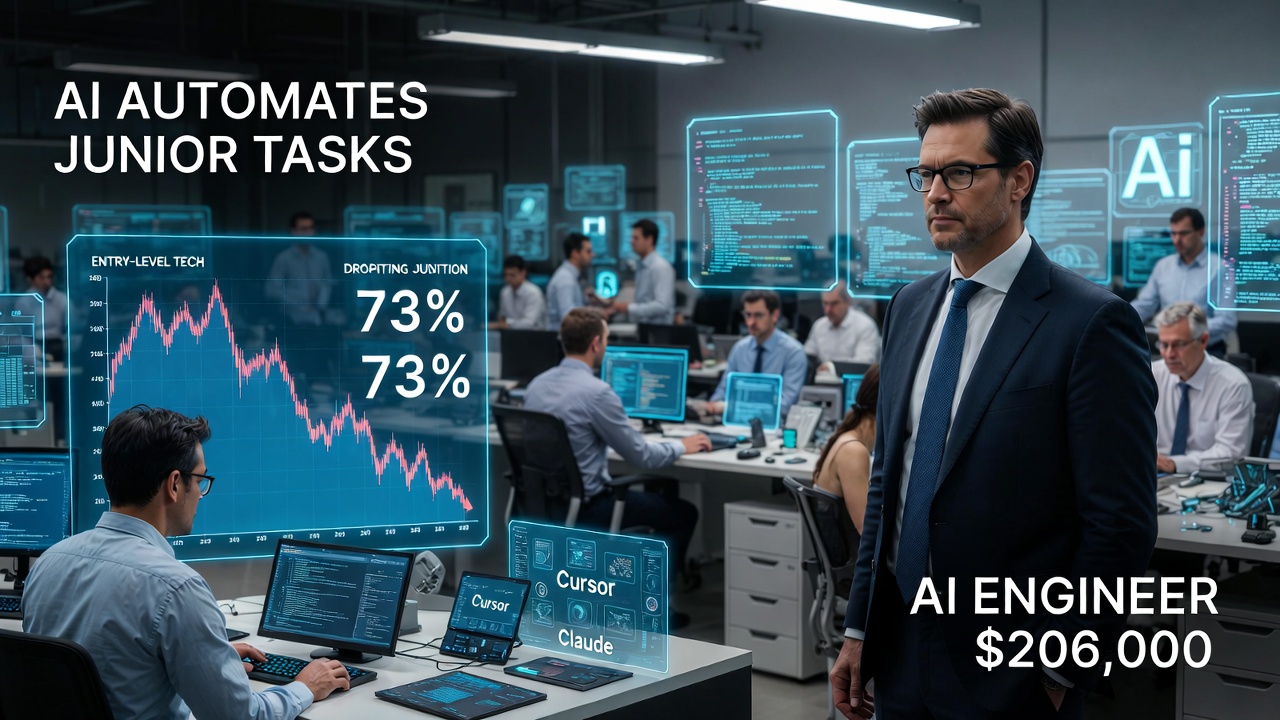
dramatic 73% decrease in entry-level technical jobs The temporary employment freeze and economic downturn of the past year are not just temporary; radical restructuring How to run software teams powered by generative AI.

- Hiring entry-level technicians (often classified as P1 or junior roles) 73.4% Year over year, according to Ravio’s 2025-2026 Technology Job Market and Compensation Report. This is much higher than the overall employment decline across seniority levels of about 7%.
- in contrast, AI-related roles AI/ML jobs are booming 88% In 2025, it will increase year-on-year (Ravio 2026 compensation trend), and AI engineer positions will occupy a large share.
- average salary of AI engineer I’m wandering around America now. $206,000 — Approximate jump $50,000 Data from 2024 levels from multiple sources including Glassdoor aggregates, Second Talent reports, and industry analysis.
On the surface, this looks like a typical market shift. Companies chase high-demand skills and pay a premium. But if you dig deeper, you’ll find that A.I. Automate much of the execution layer That used to define junior work.
Old model and new reality
Traditionally, companies have built engineering organizations that:
- Hire juniors (new graduates or boot camp graduates).
- Invest 1-2 years in training such as code reviews, pair programming, and basic task assignments.
- Promote to mid-level and then senior level and build a sustainable talent pipeline.
That ladder is broken.

- Create boilerplate code from specifications.
- Simple feature implementation.
- Fix bugs in existing code.
- Refactoring of small modules.
- Generating tests.
What your junior colleagues once did – converting tickets into pull requests – is increasingly being done by instructing AI in natural language or partial code. Senior engineers are now prompting, reviewing, and integrating 3 to 5 times faster without requiring as many people.
The remaining high-value work is architectural.
- System design decisions.
- Assessing trade-offs (scalability vs. speed vs. cost).
- Security and compliance reasoning.
- Strategic prioritization.
- Debug complex and interdependent failures.
These require deep context, experience, and judgment, areas where current AI still lags or requires intense human oversight. Result: Companies Hire Experienced senior (or AI-savvy mid-level executives) with AI tools to achieve team-level outcomes that previously required more people.
The results are already visible
This pivot creates a cascade of long-term effects.
- No clear entry route for new entrants. Bootcamps, CS degrees, and self-taught developers face tough obstacles. If AI covers the “learning on the job” stage, companies will hire fewer young people. Research from Stanford University’s Digital Economy Lab (2025) shows that employment of software developers between the ages of 22 and 25 is almost in decline. 20% The peak in roles with high AI exposure will start in late 2022 and will be much steeper than in older cohorts.
- University and bootcamp are separate. While curricula still emphasize fundamentals such as algorithms and syntax, the market is rapidly demanding engineering, AI tool proficiency, systems thinking, and domain expertise. New graduates enter a job market with significantly fewer entry-level jobs.
- Future shortage of seniors. If young talent doesn’t fill the pipeline, the supply of experienced engineers could become tight in five to 10 years. Today’s older workers, many of whom are in their 30s and 40s, will not be well-replaced unless companies rethink their training models, perhaps through structured AI-enhanced apprenticeships or in-house upskilling.
- Expanding talent gap. Companies that break in (through internships, open source, or in rare cases junior-friendly companies) gain an advantage. Everyone else faces long-term unemployment or a transition to an adjacent field (such as AI ethics, products, or non-technical roles).
Why companies double anyway
Get short-term incentives:
- cost efficiency. Paying one senior + AI tools at $200,000 or more often exceeds the overhead of 3 juniors + training.
- Speed to production. AI reduces iteration time. Teams ship faster with fewer people.
- Risk reduction. Fewer juniors means less code debt and fewer security failures due to lack of experience.
Many leaders openly admit that AI allows them to do more with less. Ravio et al.’s report shows that automation is clearly deprioritizing management and junior roles.

What this means for the future
For ambitious developers in 2026:
- Specialize early (AI/ML, security, cloud architecture, or niche areas).
- Master AI tools as core skills. Cursors, Claude, etc. are not options.
- Build a portfolio that shows complex problem solving, not just the amount of code.
- Look for a role with a company that continues to invest in growth, such as a start-up in a specific industry or a company with a strong apprenticeship culture.
For businesses:
- Current optimization is reasonable but short-sighted. If we don’t rebuild our pipeline, there will be a serious talent shortage.
- A hybrid model, i.e. AI + structured junior programs, could emerge as a sustainable path.
The 73% drop is proof that it’s not “just a market” and that AI is already rewriting the rules for software engineering careers. Execution has become commoditized. Judgment is at a premium. The winners will be those who adapt to this new reality the fastest.


