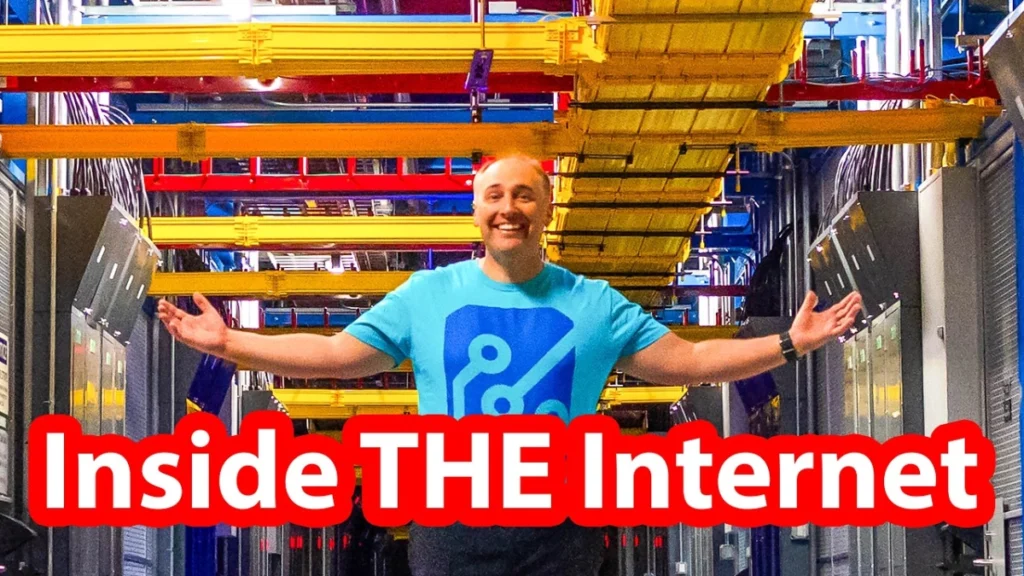
The fundamental architecture that supports the global Internet is undergoing a major transformation, driven not by the exponential growth of data packets, but by the enormous energy demands of artificial intelligence. This shift is clearly on display as digital infrastructure giant Equinix bridges the gap between traditional connectivity hubs and a new generation of high-power liquid-cooled equipment purpose-built for AI. The story is one of evolution, moving from maximizing fiber density and interconnect to optimizing thermal management and power delivery on an unprecedented scale.
This video provides an exclusive look inside two facilities on the same Silicon Valley campus: the historic SV1 and the state-of-the-art SV11, built to house large-scale AI clusters. [The host] Inside the new facility, we spoke with Charlie Boyle, NVIDIA's vice president of DGX Systems, to highlight the engineering required to support the Grace Blackwell superchip architecture. In operation for a quarter of a century, Equinix's SV1 is a huge, caged building famously known as the West Coast's “Heart of the Internet” and a symbol of the Internet's past.
The historical importance of SV1 lies in its high concentration of network carriers. Equinix pioneered a carrier-neutral colocation model that enables hundreds of service providers to serve customers in one location, facilitating efficient traffic exchange and reducing latency. This density was the basis for early internet innovation and financial connectivity. The facility continues to play a vital role today, being a “living, functioning fossil” supporting everything from financial institutions to hyperscalers. This high density of interconnection points is critical. “More than 90% of all Internet traffic on the West Coast passes through this building.” The ability to connect through multiple different pipes and service providers ensured efficiency and redundancy and defined the first era of digital infrastructure.
However, the demands of training large AI models, such as large language models and complex simulation workloads, have made traditional air-cooled, space-optimized data center designs obsolete. The challenge has shifted from maximizing the number of racks per square foot to maximizing power and cooling efficiency per rack. The raw computing power produced by modern GPUs creates a huge heat load that standard air cooling cannot handle.
This need led to the creation of the SV11 facility, a blueprint for a future where thermal management dictates design. SV11 focuses on supporting dense AI clusters, such as NVIDIA DGX SuperPOD. NVIDIA Vice President Charlie Boyle explained that Equinix is serving as a model deployment partner, explaining, “Equinix is our global deployment partner, deploying SuperPODs everywhere. We wanted to build exactly what our customers would get anywhere in the world in an Equinix facility.” This standardization allows customers to deploy the same proven infrastructure worldwide.
The DGX SuperPOD's architecture reveals the severity of the power issue. The system links 72 GPUs together to act as a single giant GPU and requires liquid cooling to function. Boyle emphasized that the power density of the system necessitates this approach. “Due to the sheer density of the system, we couldn't build the GB200 without liquid cooling.” This liquid cooling is provided through a special infrastructure of large pipes and cooling distribution units (CDUs) that circulate fluid to a huge chiller on the roof, far beyond the capabilities of traditional air handling units.
The need for power and cooling extends beyond just the server racks, fundamentally reconfiguring utility infrastructure throughout the facility. Equinix is actively investing in alternative energy sources to meet rapidly growing demand.
This includes deploying large-scale on-site fuel cells and advancing contracts with next-generation nuclear power providers. This diverse approach reduces potential power constraints and supports sustainable growth. Rauf Abdel, Equinix's executive vice president of global operations, said in a recent announcement: “Round-the-clock access to electricity is essential to support the infrastructure that powers everything from AI-driven drug discovery to cloud-based video streaming.”
Beyond power generation, the physical security and access controls of these new facilities reflect the high-value nature of the assets they house. Strict protocols such as biometric scans and “mantraps” (secure vestibules that allow only one person or vetted group to enter at a time) ensure that only authorized personnel have access to data holes, often requiring multiple layers of verification before reaching customer cages. Moving from SV1 to SV11 is more than just an upgrade. This is a structural reprioritization, with energy resilience and thermal efficiency becoming the ultimate determinants of digital dominance. Facilities that can overcome the challenges of high-density power will define the next decade of AI innovation.