
Cells have always been the body’s innate intelligence systems, sensing, adapting, repairing, and communicating with incredible precision. Today, artificial intelligence is beginning to reflect the same biological brilliance, transforming the way we diagnose and treat disease.
Stem cell therapy, once defined by painstaking laboratory research and slow trial-and-error experimentation, is now undergoing a major transformation. AI-native platforms are beginning to reshape the way scientists design, test, and manufacture herbal medicines. At the forefront of this change is cellular intelligence.
Boston-based TechBio, co-founded and led by Israeli entrepreneur Dr. Micha Breakstone, aims to transform stem cell research and bring innovative solutions to devastating diseases that affect millions of people around the world.
Breakstone, which previously co-founded Israeli technology company Chorus.ai, has positioned Cellular Intelligence (previously known as Somite AI) at the intersection of computational modeling and regenerative medicine.
The company’s scientific foundation was built in collaboration with academic researchers such as Professor Alon Klein of Harvard Medical School, developmental biologist Professor Olivier Pourqui, and Dr. Nuno Mendonca, who heads the clinical advancements Parkinson’s disease program.

The company’s platform integrates high-throughput multiplexing techniques and underlying models trained on a large number of cellular perturbation conditions.
The system is designed to incorporate data generated during clinical and manufacturing processes, creating a feedback loop aimed at improving predictive accuracy over time.
The aim is to support the development of cell therapies that can be produced consistently and at scale, addressing one of the major challenges limiting the field.
Cellular Intelligence says that by combining large-scale cellular data with AI, the company is “deciphering the rules of cell signaling and transforming biology from observation to predictive engineering.”
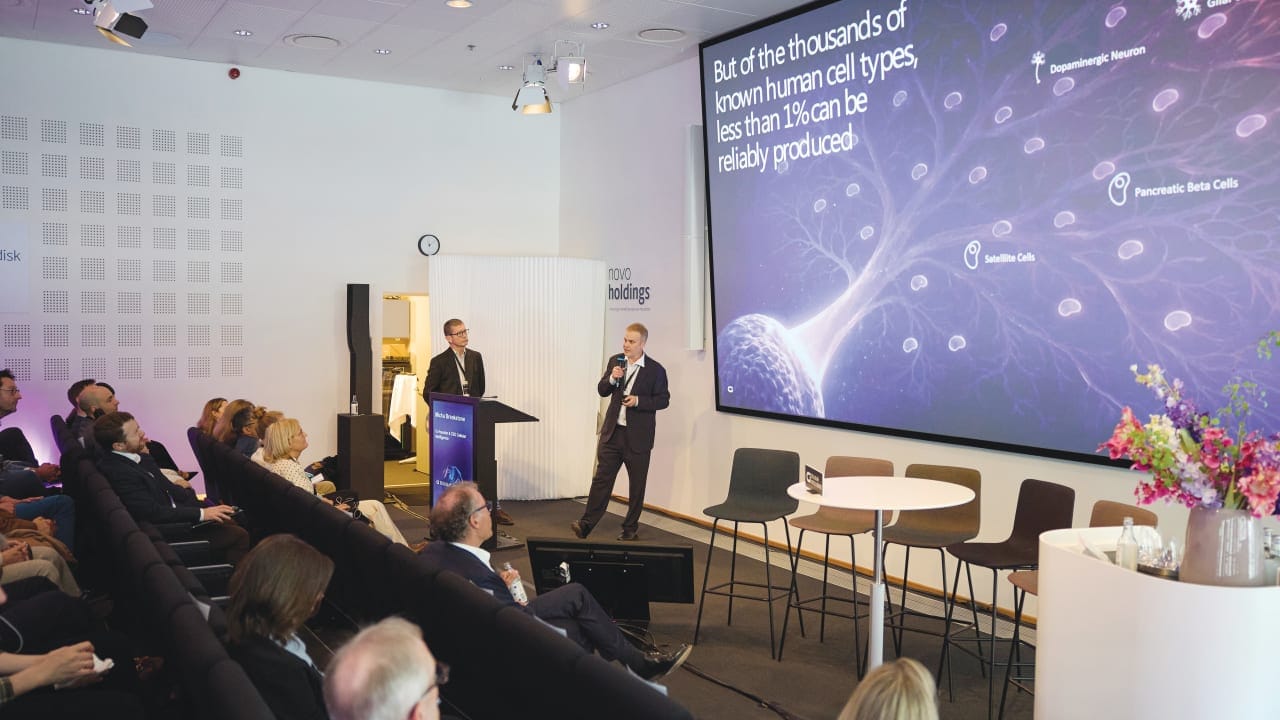
The use of AI is exciting scientists, and just one day after acquiring worldwide rights to Novo Nordisk’s clinical-stage cell therapy program for Parkinson’s disease, Cellular Intelligence held an expert symposium on the convergence of artificial intelligence and biology at the Novo Nordisk Foundation headquarters in Copenhagen.
The day-long event in mid-May brought together 28 experts in the fields of AI, biology, regenerative medicine, venture and company formation for a day-long symposium on cell fate engineering that Breakstone believes will be the next AlphaFold moment in biology.
“We are using AI to understand how cells communicate and create new tissues,” Breakstone said in a conversation with Olivier Pourqui at the symposium.

In a conversation with Pourquie, Breakstone cited Parkinson’s disease, type 1 diabetes, epilepsy, and macular degeneration as other diseases that could be helped by its technology.
Parkinson’s disease affects millions of people around the world, and current treatments primarily focus on managing symptoms rather than replacing neurons lost in Parkinson’s disease.
STEM-PD therapy is designed to introduce new dopamine-producing cells and offers a fundamentally different regenerative approach than existing therapies.
“Bringing AI into this world has been difficult. We’re trying to create noise in the room to create a concept of urgency in this ecosystem,” Breakstone said. magazine At the symposium.
He said much of the technology to incorporate AI into the field of biology already existed. “The problem is not convincing people, it’s implementation,” he said.
danish house
The Danish capital has a long history of success in therapeutics, and Breakstone explained that the company “landed in the perfect home” when it signed the deal with Novo Nordisk. “We are injecting AI into the culture of the ecosystem here in Copenhagen.”
The biology is so complex that finding a cure for the debilitating disease has taken decades and cost millions of dollars. In recent years, significant advances have been made in the application of AI to the field, allowing scientists to predict how cells will respond to external cues.
Cellular Intelligence will leverage Novo Nordisk’s clinical-stage cell therapy program to apply AI-based models trained on millions of cell perturbation conditions to accelerate the development and manufacturing of therapeutics for commercialization.
The company says its platform can shorten traditional cell therapy timelines and reduce production costs, which are key barriers to commercializing complex regenerative medicine products.
Progress on this program will be closely watched as researchers and industry leaders evaluate the potential of an AI-assisted development pipeline to accelerate the arrival of next-generation treatments.
“It can speed things up,” said Jens Nielsen, CEO of the BioInnovation Institute (BII) in Copenhagen, Denmark, and a professor of systems biology at Chalmers University of Technology in Gothenburg, Sweden.
When you talk to magazine Nielsen said on the sidelines of the symposium that AI can help reduce “preparation, analysis, and development time and costs.”
Cellular intelligence is “injecting technology into very complex biology,” he said.
BII is a life science and deep tech innovation institute located in Copenhagen. Together, we support over 130 startups that have raised over €1 billion in external funding.
Nielsen said: “Israel has great innovation and drive, and we want to bring that to Copenhagen as well. The combination of our history and its technology will enrich the ecosystem.”
Nielsen, who has visited Israel many times and spoken to key stakeholders, explained that while there are many biotech companies in Israel, there are few health tech companies. He said Denmark “despite its small size, has a lot to offer in terms of drug development capabilities.”
it’s personal
For Breakstone, finding a cure for Parkinson’s disease is personal. But it’s not just Parkinson’s disease that Cellular Intelligence hopes to find a cure for.
“Cancer is really interesting. We have some initial ideas about this disease and are optimistic about learning how cancer evolves and behaves.”
Numenos CEO Vitaly Formin also wants to use AI to match drugs to biology, thereby “treating cancer and everything else.”
The company says its CURE platform integrates and analyzes clinical trial data to uncover valuable insights to guide decision-making and patient stratification.
With a diverse team of entrepreneurs, biologists, physicists, and AI experts, the company specializes in detecting biomarkers early in clinical trial development, enabling the design of cheaper and more successful Phase 3 clinical trials.
Formin pointed out that Numenos aims to match drugs to a person’s biological characteristics and predict what the drug will cause.
“We look at humans as whole biological systems. We find laws for one disease and apply them to other diseases,” he said on the sidelines of the symposium. “Cancer is a life process. You can take data from a specific cancer and apply it to other diseases. The data is interconnected.”
Formin believes that with the help of AI, patients can spend more time talking with their doctors. “We want every patient to earn a PhD in their disease field,” he said.
“The future of biotechnology will change the revolution of humanity,” Formin said.
Designed, not fate
AI-native platforms not only accelerate stem cell treatments; They are currently redefining what is scientifically possible. Cellular Intelligence’s convergence of computational power, biological insight, and global collaboration marks a tipping point where biopharmaceuticals can be developed with the same intent as other technologies.
What was once a reliance on dull intuition is moving toward predictive, data-driven design, opening the door to scalable, precise, and personalized treatments.
The growing momentum in Copenhagen, Boston, and Israel shows that this is not an isolated trend, but the emergence of a new biomedical construct.
It is a field where regenerative medicine is guided by algorithms that learn, adapt, and improve. Success in this field could make diseases long thought incurable treatable and conditions that have been managed for decades finally cured.
Just as cellular intelligence guides the body to heal, AI is leading modern medicine to a future where care is smarter, kinder, and more effective.
As Breakstone says, “Biology is no longer destiny, it’s design.”
The author participated as a guest at the symposium.


