Researchers at the University of Waterloo have developed two innovative artificial intelligence (AI) systems that significantly improve the way hockey games are analyzed using video footage without the need for expensive equipment.
This research leverages Waterloo’s strengths in computer vision and system design to advance the evolving field of automated sports analysis. The new tools address long-standing challenges in tracking fast-moving game action, such as obstructed views and motion blur commonly seen in broadcast feeds.
“These improvements in detection accuracy could change the way coaches, teams and broadcasters analyze game dynamics, leading to better strategic decision-making and more engaging fan experiences,” said Dr. David Krausi, professor of systems design engineering at the University of Waterloo.
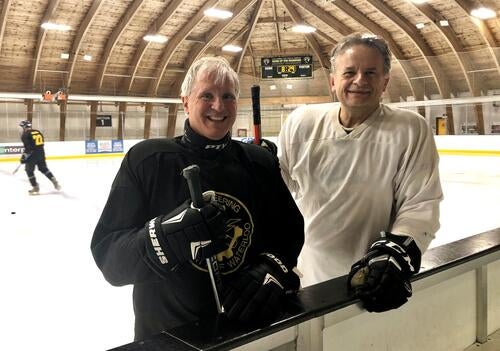
Engineering professors Dr. David Clausi (left) and Dr. John Zelek play pickup hockey together and are leading research at the University of Waterloo into how to better track and analyze games using AI tools. (University of Waterloo)
In one study, researchers took advantage of the fact that players typically keep their eyes on the puck during a game to develop a model that helps them infer the puck’s location based on body position and line of sight.
The AI-based system, called PLUCC (Puck Localization using Contextual Cues), improved puck location accuracy by 12 percent and reduced localization errors by more than 25 percent compared to existing technology.
The researchers expect the system to be particularly useful for small organizations and amateur teams, as it provides a low-cost alternative to more sophisticated and expensive tracking technologies such as Hawk-Eye.
“Our goal was to achieve puck tracking that didn’t require a million-dollar setup,” said graduate student Liam Salas, lead author of the study. “If coaches can analyze games using only video, it would be a huge win for accessibility in sports analytics.
“Finding the puck in broadcast video is one of the most difficult problems in sports vision, so it was extremely rewarding to see our system use contextual cues to accurately predict its location. It was like giving the computer a real game feel.”
The second study involved the development of an AI-based framework called SportMamba that improves the way multiple players are tracked as they move within sports videos. The model dynamically predicts player movement during the game, taking into account rapid movements, blocked camera angles, and camera shifts.
When tested on soccer, basketball, and hockey footage, SportMamba outperforms existing tracking methods by up to 18% in accuracy and efficiency, allowing teams and broadcasters to perform real-time, data-driven performance analysis without the need for expensive sensor systems or fixed camera setups.
“It’s relatively easy to track down hockey players,” said Dr. John Zerek, also a systems design engineering professor and co-director of the Vision and Image Processing (VIP) Institute at the University of Waterloo.
“It’s much more difficult to track and distinguish between players participating in a scrum along the boards or in front of the net. SportMamba takes care of these difficult situations and tells us, for example, who deflected the puck and scored.”
The research papers “Ice Hockey Puck Localization Using Contextual Cues” and “SportMamba: Adaptive Nonlinear Multi-Object Tracking Using State-Space Models for Team Sports” were recently presented at the 2025 IEEE/CVF Conference on Computer Vision and Pattern Recognition Workshops.
Featured image: Liam Salas, a master’s student in the School of Engineering at the University of Waterloo, has developed an AI-based system to improve puck detection when analyzing game video. (University of Waterloo)
/Open to the public. This material from the original organization/author may be of a contemporary nature and has been edited for clarity, style, and length. Mirage.News does not take any institutional position or position, and all views, positions, and conclusions expressed herein are those of the authors alone. Read the full text here.