TL;DR
- Free access: Google Vids provides Google account holders with up to 10 free AI video clips per month via Veo 3.1.
- Music generation: Lyria 3’s integration allows users to create music tracks from vibe prompts, with paid tiers unlocking longer songs.
- AI avatar: Directable AI avatars in realistic and cartoon styles are now available in eight languages for paid Workspace accounts.
- Competitive pressure: Google is positioning Vids against Synthesia and HeyGen by bundling video, music, and avatar creation with Workspace integration.
Google Vids currently produces AI video clips, custom music, and commandable avatars, and anyone with a Google Account can create up to 10 AI video clips per month for free. This update, published on April 2, 2026, makes Vids one of the first major productivity tools to bundle AI video generation, music creation, and controllable avatars into one platform with a free starting window. This release coincides with OpenAI discontinuing its Sora video tools and the separate launch of Google’s own Veo 3.1 Lite.
AI video generation and music creation
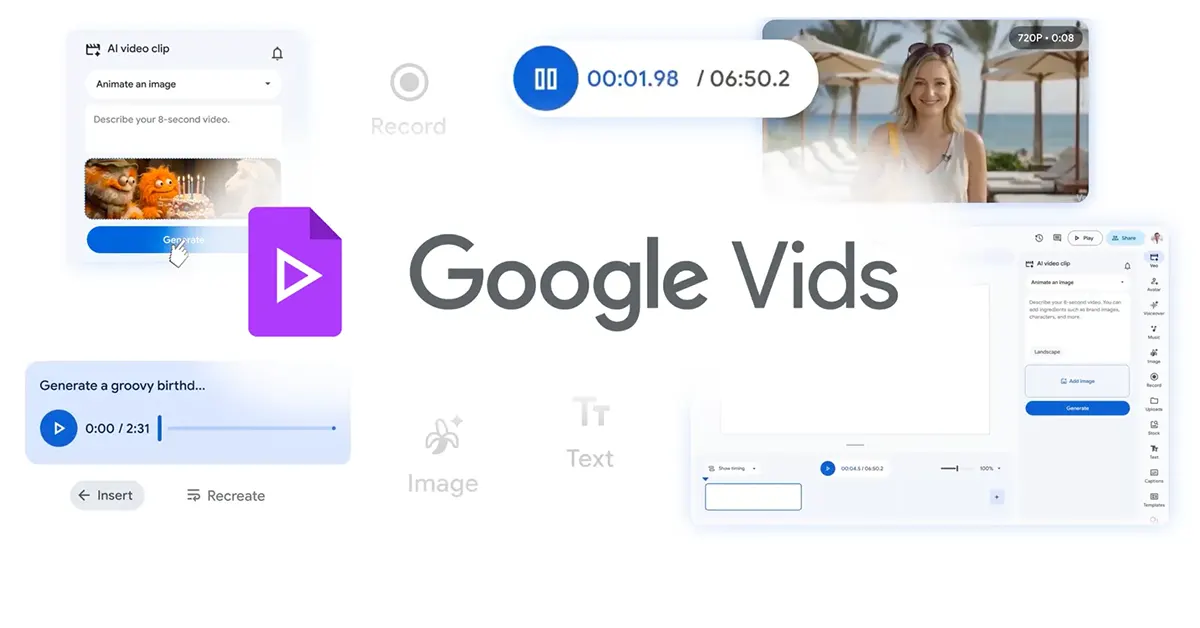
Vids uses Google’s Veo 3.1 model to generate 8-second clips at 720p resolution from both text prompts and uploaded photos. Free users can receive 10 generations per month, while AI Pro subscribers can generate 50 videos and AI Ultra subscribers can receive up to 1,000 videos. Veo 3.1 has since been integrated into YouTube Shorts, Google Photos, the Gemini app, and the dedicated Flow editing tool.
Building on this, this update integrates Google DeepMind’s flagship music generation models Lyria 3 and Lyria 3 Pro, allowing you to create music from vibration prompts without entering lyrics. Lyria 3 gives you control over style, vocals, and tempo, and allows AI Pro and Ultra subscribers to generate tracks from 30-second clips to up to 3-minute productions.
All generated tracks include a SynthID watermark to indicate that AI was involved in their creation.
Free tier restrictions limit regular usage. 8-second clips at 720p and a limit of 10 per month leave little room for repetitive production work and drive serious creators to paid subscriptions. Resolution caps also limit output quality for professional use cases, where 1080p is a fundamental expectation.
Directable AI avatars and workflow tools
This update introduces realistic cartoon style preset AI avatars powered by Veo 3.1. Users can direct their avatars to interact with uploaded objects such as products and props against custom backgrounds, customizing appearance, costumes, and backgrounds while maintaining a consistent voice and identity across scenes. Avatar features are available in paid Google Workspace accounts worldwide in eight languages: English, French, German, Italian, Korean, Portuguese, Spanish, and Japanese.
David Nachum, group product manager at Google Vids, described the platform as an intuitive video editing suite designed to help users turn ideas into sophisticated stories. In addition to Avatar, Google has added a Chrome extension that records screen or camera video from anywhere on the web and sends recordings directly to Vid for editing. You can now publish your videos directly to YouTube. Export defaults to private.
The result is a pipeline that combines screen recording, AI generation, and direct publishing to keep your entire video workflow within Google’s ecosystem. For Workspace teams already using Google Docs and Slides, Vids eliminates the need to switch between separate recording, editing, and hosting tools.
competitive environment
Google first announced Vids in 2024 for enterprise content creation. In 2025, the company enabled AI avatars and consumer access to the platform. In February 2026, 2D and 3D cartoon-style avatars and seven new voiceover languages were added, and in March, Lyria 3 Pro integration began rolling out.
By combining video, music, and avatar tools into a single platform that’s free to get started, Google is positioned to compete in a crowded field. Vids competes with Synthesia, HeyGen, D-ID, and Lemon Slice in the AI avatar space, and Synthesia alone was valued at $4 billion in January 2026. Google’s advantage lies in ecosystem integration. Vids connects directly to Workspace, YouTube, and Chrome, reducing friction that standalone tools can’t match.