

At Google I/O 2023, the search giant finally unveiled its latest general-purpose large-scale language model, PaLM 2. PaLM 2 is the foundation upon which multiple Google products are built today, including Google Generative AI Search, Duet AI in Google Docs and Gmail, and Google Bard. But what exactly is the Google PaLM 2 AI model and is it better than GPT-4? Are plugins supported? To answer all your questions, please refer to the detailed description of the PaLM 2 AI model released by Google.
What is Google’s PaLM 2 AI model?
PaLM 2 is the latest Large Language Model (LLM) released by Google, with advanced features in: Advanced Reasoning, Coding, Mathematics. It is also multilingual and supports over 100 languages. PaLM 2 is the successor to the previous Pathways Language Model (PaLM) launched in 2022.
The first version of PaLM was trained with 540 billion parameters, making it one of the largest LLMs. But in 2023 Google came up with PaLM 2, which is much smaller in size but faster and more efficient than its competitors.


In their 92-page technical report for PaLM 2, Google doesn’t mention the size of the parameters, but according to some sources, tech crunch reports, one of which PaLM 2 model is trained with only 14.7 billion parametersThis is much less than PaLM 1 and other competing models.Several researcher Twitter states that the largest PaLM 2 model will likely be trained with 100 billion parameters, but still far fewer than competing models.
For reference, OpenAI’s GPT-4 model is said to be trained with 1 trillion parameters, which is just amazing. The GPT-4 model is at least 10 times larger than PaLM2.
How did Google make PaLM 2 smaller?
Google says on its official blog that bigger isn’t always better, and that research creativity is the key to creating good models. By “research creativity” here, Google may be referring to reinforcement learning from human feedback. (RLHF), Compute Optimized Scalingand other novel techniques.
Google hasn’t disclosed what kind of research creativity it’s employing with PaLM 2, but it looks like the company may be using it. LoRA (Low Rank Adaptation)instruction tuning, and high-quality datasets yield better results despite using relatively small models.
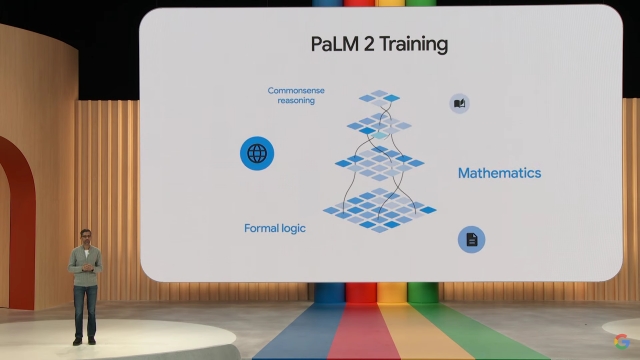
Overall, PaLM 2 is an LLM model that: Faster, relatively small, and cost effective Because it provides few parameters. At the same time, it brings features such as common sense reasoning, better reasoning, advanced mathematics, multilingual conversation, and coding proficiency. These were the basics of the PaLM 2 model. Now let’s take a closer look at its features.
What are the highlights of PaLM 2?
As mentioned earlier, PaLM 2 is faster, more efficient, and has lower service costs. Apart from that, it also offers some advanced features. First, PaLM 2 is very good at common sense reasoning. In fact, Google states that PaLM 2’s inference capabilities are: Competes with GPT-4. When tested on the WinoGrande Common Sense Test, the PaLM 2 scored 90.2, while the GPT-4 scored 87.5. In the ARC-C test, GPT-4 scored a notch higher, achieving 96.3, while PaLM 2 scored 95.1. In DROP, StrategyQA, CSQA, and several other inference tests, PaLM 2 outperforms GPT-4.
Not only that, but PaLM 2’s multilingual capabilities allow it to understand idioms, poems, nuanced sentences and even riddles in other languages. It goes beyond the literal meaning of the word, understand vague and figurative meanings behind the words. This is because PaLM 2 is pre-trained on parallel multilingual texts in different languages. Additionally, a corpus of high-quality multilingual data makes PaLM 2 even more powerful. As a result, translation and other applications work much better on his PaLM 2.
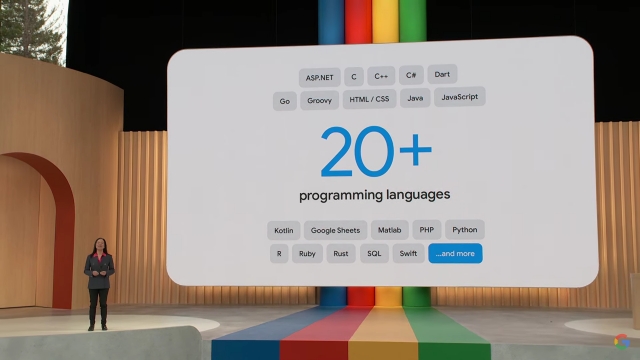
Now let’s talk about its coding features. According to Google, PaLM 2 was again trained on a large corpus of high-quality source code datasets available in the public domain. As a result, we support 20+ programming languages, This includes Python, JavaScrupt, C, C++ and even older languages like Prolog, Fortran and Verilog. You can also generate code, provide context-aware suggestions, translate code from one language to another, add functions with just comments, and more.
What can the PaLM 2 model do?
First of all let me say that PaLM 2 is built to be adaptable to a wide variety of use cases. Google announced that PaLM 2 will come in four different models. gecko, otter, bison, unicorngeckos are the smallest and unicorns are the largest.
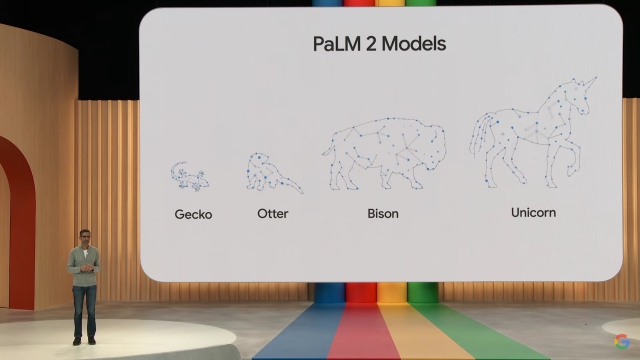
Gecko is so lightweight that you can even run it on your smartphone completely offline.can Process 20 tokens per second About 16 words per second on a flagship cell phone. It’s amazing. Imagine AI-powered on-device applications that can run on your smartphone without the need for an active internet connection or powerful specs.
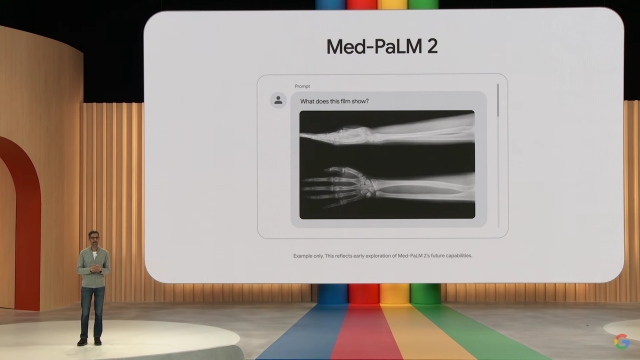
Apart from that, PaLM 2 can be fine-tuned to create domain-specific models straight away. Google has already created Med-PaLM 2. This is his medical-focused LLM, fine-tuned based on PaLM 2, with an ‘Expert’ level competency in the US Medical Licensure Exam format questions.it has achieved 85.4% accuracy in USMLE test, even higher than GPT-4 (84%). Keep in mind, though, that GPT-4 is a general-purpose LLM, not fine-tuned for medical knowledge.

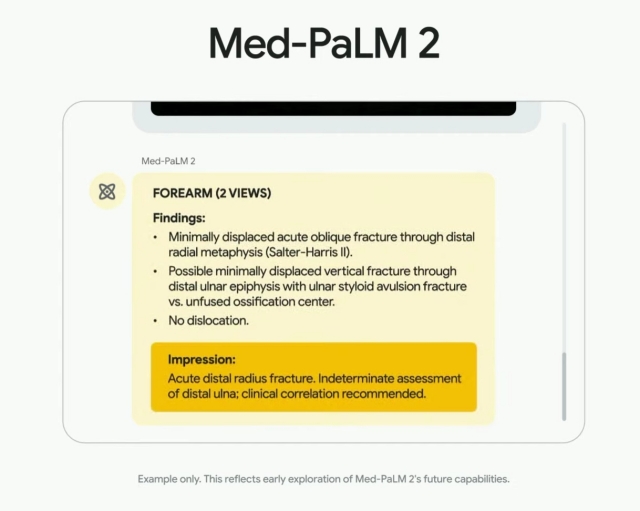
Going further, Google has added Multimodal function to Med-PaLM 2. Analyze images such as X-rays and mammograms and draw conclusions in line with expert clinician opinion. This is very notable as it can bring much-needed medical access to remote areas around the world. In addition, Google has developed Sec-PaLM, a specialized version of PaLM 2 for cybersecurity analysis and instant detection of malicious threats.
Google products with PaLM 2
These are all different use cases for PaLM 2 in different fields and industries. For individual consumers, you can experience his PaLM 2 in action through Gmail, Google Docs, Google Bard in Google Sheets, Google Generative AI Search and Duet AI. Google recently migrated Bard, a conversational AI chatbot, to his PaLM 2, opening up access to: 180 countries. You can learn how to use Google Bard now by following our article.

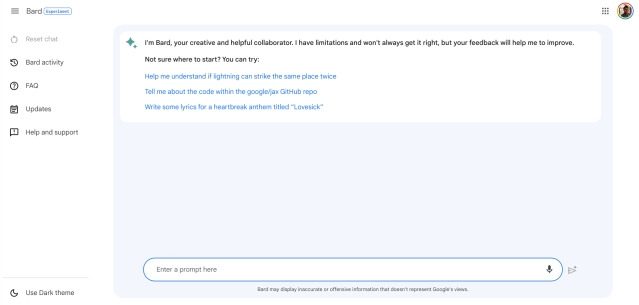
If you use PaLM 2 with Gmail, Google Docs, or Sheets (Google calls it Duet AI for Google Workspace), you’ll need to join the waitlist to take advantage of AI-powered features. Finally, for developers, Google Released PaLM API It is based on the PaLM 2 model. Sign up now to use the PaLM API in your product. It can generate over 75 tokens per second and has a context window of 8,000 tokens.
PaLM 2 and GPT-4: How do AI models compare?
Before comparing features, one thing is clear that PaLM 2 is fast. This means it responds quickly to queries, even complex reasoning questions. Not only that, but he is offered three drafts at a time, in case the default response doesn’t satisfy him. So in terms of efficiency and computing, Google is a step or two ahead of his OpenAI. Check out all the new features in Google Bard AI here.
As far as functionality is concerned, we tested the inference skills of both models and the one powered by PaLM2. Google Bard really shines in such a test. Of the three reasoning questions, Bard got all three of his questions correct, while ChatGPT-4 got only one correct answer. In one instance, Bard’s assessment was wrong (it was like hallucinating) but somehow gave the correct answer.
Separately, regarding the coding work, I asked Bard to find bugs in the code I provided, and he gave me a lengthy reply to fix the problem, which turned out to be completely wrong. But ChatGPT-4 immediately identified the coding syntax, found the error, and fixed the code without further prompting.
We also assigned both models the task of implementing Dijkstra’s algorithm in Python. Error-free code generated. I compiled both and none of the functions threw an error. That said, ChatGPT-4 produces clean code with some examples, while Bard only implements barebones functionality.
Limitations of Google PaLM 2
Well, we’ve reached the limit, but we already know that the ChatGPT plugin is powerful and can immediately enhance GPT-4 functionality by miles.By itself code interpreter plugin, users can do much more with ChatGPT. In fact, Google has announced “tools” similar to plugins, but they haven’t been published yet, and third-party support seems lackluster at this point. At the same time, developer support for OpenAI is huge.
Second, GPT-4 is a multimodal model and can analyze both text and images. Multimodality has many interesting use cases. You can ask ChatGPT to explore graphs, tables, medical reports, medical images, and more. Yes, this feature hasn’t been added to ChatGPT yet, but I’ve seen early demos and was very impressed. on the other hand, PaLM 2 is not a multimodal model For dealing with text only.
The search giant has tweaked PaLM 2 to create Med-PaLM 2, which is indeed multimodal, but it is not available to the public and is limited to the medical field only. According to Google Next-gen model called Gemini will be multimodal It has groundbreaking features, but is still in training and will be months away from release. Google has promised Bard to provide support for Lens, but that’s not the same as an AI-powered visual model.
Finally, compared to GPT-4, Google Bard often hallucinates (See example hereHere, Bard believes the PaLM AI model was created by OpenAI). Instantly make up information and confidently reply with false information. GPT-3 and GPT-3.5 had similar problems, but OpenAI managed to reduce his hallucinations by 40% with his GPT-4 release. Google needs to tackle the same hallucination problem “boldly and responsibly.”
Conclusion: PaLM 2 or GPT-4?
In summary, Google’s PaLM 2 AI model has improved in several areas such as advanced reasoning, translation, multilingual capabilities, mathematics, and coding. It also has the added benefit of running small models with fast performance and low service costs. However, to achieve feature parity with GPT-4, Google added multi-modality third-party tools (plugins) to address the hallucination problem and make AI models as developer-friendly as possible. must be

