

GM uses AI to design new cars
How General Motors is using AI to speed up its engineering and design efforts.
The creation of a new General Motors car always begins with a sketch. But then the Detroit automaker turned to artificial intelligence to accelerate development.
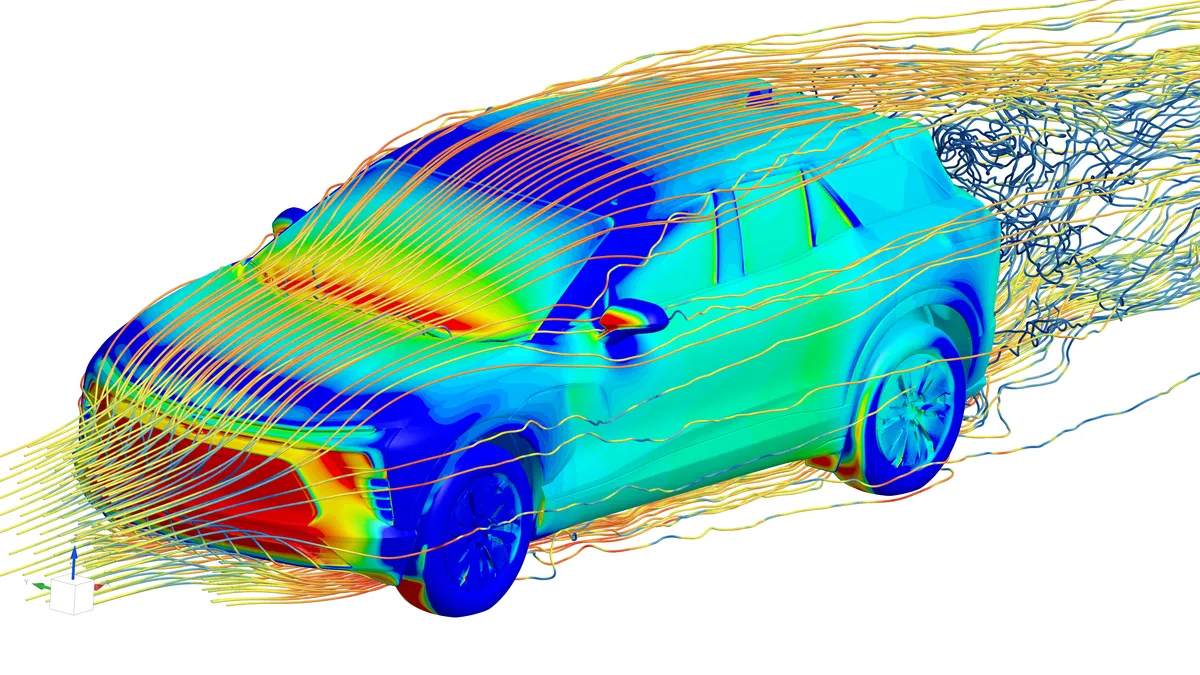
What once took months to turn concept car sketches into realistic animations now takes days, and there’s no need to sculpt clay models one after another to check aerodynamics. GM design leaders say AI will save time, and analysts warn there is little time left as the U.S. automaker races to catch up to China’s lightning-fast production speeds.
“We’ve found that without a common philosophy and strategy for how to use AI, the wave is coming too fast, and we’re just going to be swept along by it and left behind,” said Brian Stiles, GM’s director of design innovation and technology.
GM’s rivals Ford Motor Co. and Stellantis NV are also implementing AI.
In April, Stellantis announced a partnership with Microsoft Corp. to bring AI to sales, customer care, and operations. Examples include tools that help improve product development and validation, predict maintenance needs, and introduce new digital capabilities to vehicles faster.
Ford dealers use platforms like streaming services for AI-powered training on products, competitors, service repairs, sales, and more. The automaker’s commercial vehicle division, Ford Pro, also recently launched an AI chatbot for users of its vehicle telematics systems to help them find information faster, identify maintenance needs sooner, and offer cost-saving ideas.
“This is an arms race,” said Dan Ives, an analyst at investment firm Wedbush Securities. “It’s going to be a differentiator for the Big Three, especially in the global competition.”
Clay models and virtual wind tunnels
Starting with designer sketches, GM now employs user interface design programming to create 3D renderings and advertising-style animations to pitch concept models. Vehicle exterior designer Dan Shapiro said short videos “have become a standard method of communication in the design studio.”
“Years ago, going from a sketch to a truly photorealistic 3D animation like this would have taken months and multiple teams including design, sculpting, and visualization.
“With AI tools, a video like this can now be created by a single designer in less than a day,” Shapiro added. “It allows us to work faster, consider more ideas, and ultimately come up with a better design.”
Once a design concept is finalized, designers sculpt a model that is passed to engineers for drag and aerodynamic analysis, said Scott Parrish, laboratory manager at GM Research and Development.
“If it doesn’t meet the stated goals, we go back to the sculpture and design, tweak the design, and go back and forth,” Parrish said. “And these are handovers that cost us a lot of time and money.”
GM is currently developing internal tools to almost completely digitize its processes.
“Imagine a digital sculptor sitting next to an aerodynamicist, practicing these models and getting immediate results,” said Rene Strauss, who leads GM’s virtual engineering program. “This used to take about two weeks, but being able to get feedback now is invaluable to our process.”
Mr. Shapiro added: “Our designers, sculptors and digital modelers are still shaping every millimeter of the surface, but this gives us a huge head start to refine clay models, perform rapid prototyping and even begin initial aerodynamic analysis.”
AI and work
Criticism of the use of AI in industry has primarily focused on potential job losses as algorithms and robots begin to outperform humans in both design and manufacturing, a concern cited by the United Auto Workers Union and others.
Stiles said the Detroit automaker’s goal is to “augment and accelerate, not replace” workers. This goal is likely to be tested by automakers and other industries as AI tools become more widely used in a myriad of applications.
Industry experts explained that AI is a productivity multiplier. “That means individual autoworkers are producing more output,” Gus Faucher, senior economist at PNC Bank, said on a Detroit PBS panel last month. “Certainly, it causes job losses and is a problem for the Detroit area.
“But having more productive workers also means that living standards will improve over time,” he added. “So I think AI might be like that too.”
The UAW declined further comment on the increased use of AI in early vehicle designs. But union president Sean Fein and other labor advocates are asking U.S. lawmakers for protections to ensure AI doesn’t lead to job losses.
“Greedy corporate power brokers today want us to believe that eliminating millions of jobs in the name of AI is a good thing,” Fein said at a rally with Sen. Bernie Sanders last month. “The working class knows better.”
Ives said exactly how AI will shape jobs is happening in real time.
“The jury is still out on whether it will have a significant negative employment impact or potentially positive employment impact,” Ives said. “It all depends on robotics and how quickly it can help from a manufacturing standpoint. This is an opportunity, but also a potential risk for autoworkers.”
sballentine@detroitnews.com