
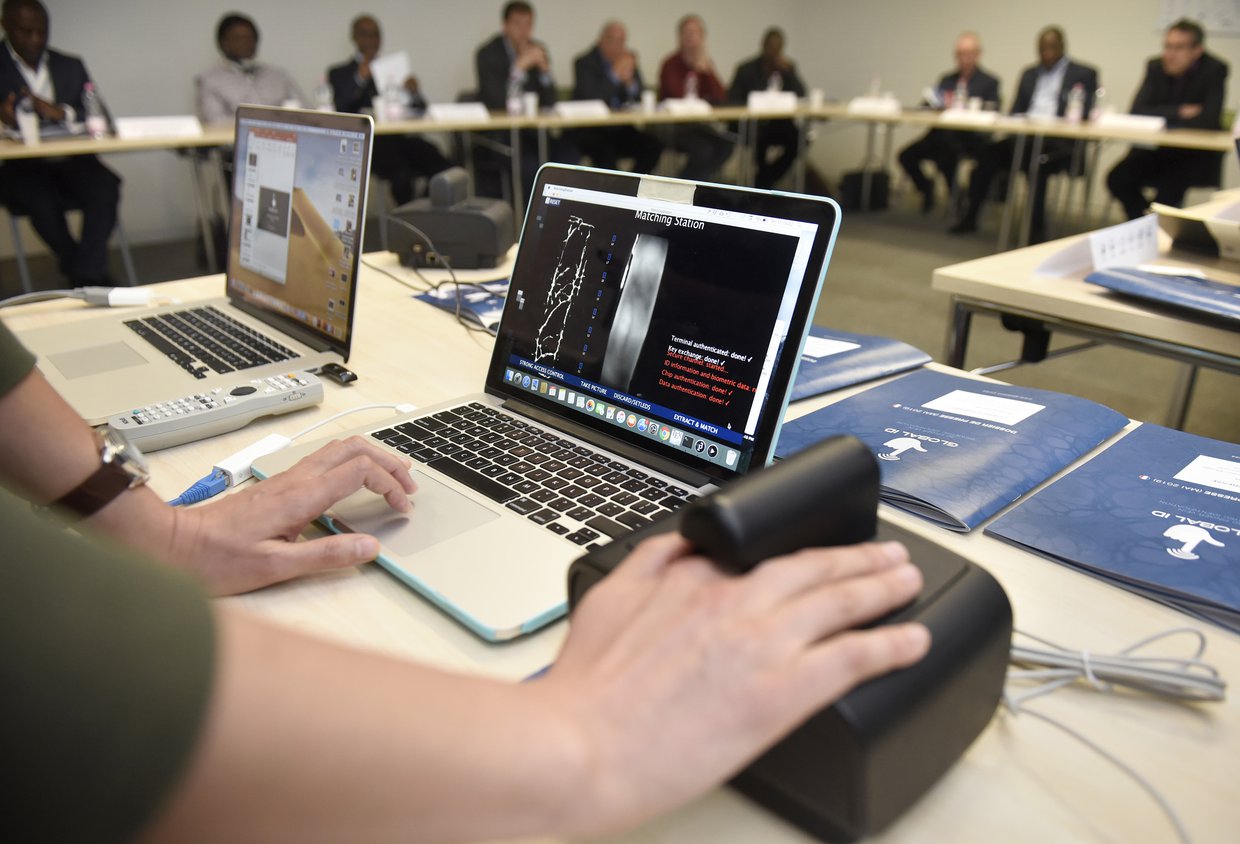
Swiss startup Global ID has announced the launch of a new project with Idiap Research Institute aimed at improving finger vein authentication (FVA) using machine learning.
The initiative, named “KIDOLEH,” will focus on industrializing Global ID’s F2 finger vein imaging device by introducing a new data processing system that meets the speed and security needs of high-security environments, the company announced last week.
The goal is to enable the use of finger vein biometrics in high-stakes environments such as hospitals, government, and secure infrastructure. Healthcare is a particular target because this technology can help match patients with medical records, strengthen access controls for medical staff, and prevent fraud.
“KIDOLEH enables us to provide ultra-secure biometric solutions that meet the demands of modern healthcare and other sensitive sectors,” said Lambert Sonna, CEO of Global ID.
The new data processing pipeline will be evaluated offline using data captured from Global ID’s F2 devices. The goal is to enable template comparisons that are accurate and fast enough for practical deduplication, the company said in a release.
Global ID and Idiap have a long history of collaboration on finger vein biometrics.
Sonna helped develop the technology in collaboration with an interdisciplinary team from Idiap, EPFL (École Polytechnique de Lausanne), the Swiss Center for Electronics and Microtechnology (CSEM), and HES-SO Valley Wallis. The team created biometric technology based on multi-view vein scans called BioID and BioLocker.
Global ID was established as a spin-off from EPFL in 2016. The startup has developed a device that captures biometric data by taking multi-view images of finger veins. The scan is converted to a cryptographic representation and the original image is removed to ensure data security.
In 2020, Idiap and Global ID launched the CANDY project (Contactless Finger Vein Recognition and Presentation Attack Detection on the Fly), which aims to provide a mobile contactless scanner that reads veins as biometric identifiers. This scanner was created to identify people in medical settings without having to clean the scanner for potential coronavirus contamination.
The project, funded by Swiss innovation agency Innosuisse, delivered a contactless biometric sensor platform that scans both palm veins and palm prints. The sensor platform has collected new datasets for research on vein biometric accuracy and fraud attacks.
Global ID has partnered with humanitarian organization Project HOPE to introduce finger vein authentication for health and emergency response interventions in 2024. The technology was introduced in Namibia as part of a PEPFAR and USAID-funded project aimed at reducing HIV infections and improving healthcare.
Earlier this year, Global ID was awarded a new U.S. patent for its BioID security protocol, following another U.S. patent granted to the company in March 2025.
“Unlike fingerprints or facial recognition, vein biometrics relies on analysis of blood vessel patterns inside the hand or fingers. This biological marker is considered one of the most reliable to date because it is invisible to the naked eye, unique to each individual, and extremely difficult to replicate,” the company said in an announcement.
Article topics
Biometrics | Biometrics | Finger Vein Global ID | IDUP | Patient Identification | Swiss Biometrics Research and Testing Center | Vein Biometrics


