Just imagine. You’re a Gen Zer in your 20s looking for a job in the current climate. There are job listings on job sites, but there are very few ideal jobs available. There are endless interviews, but very few feel legitimate. AI poses a growing number of sinister obstacles. Stress is constant, but optimism is temporary.
“The entry-level job market is certainly collapsing right now, and Gen Z is being hit the hardest,” said Ian Skjabem, CEO of Smart Investors Daily.
According to a study by Revelio Labs, the average age of new hires in 2025 will be 42 years old, up from 40 years old in 2016. Meanwhile, employer hiring announcements decreased by 34% in 2025.
If you’re 22 or 23, your career prospects are bleak.
In today’s job market, “Gen Z is in a unique position unlike any generation before them,” said Melissa Elders, vice president of marketing for Artistry Restaurants. food research institute.
“The problem isn’t that Gen Z employees aren’t willing to start at the bottom; the problem is that there’s no longer a bottom to start at,” says Eric Kingsley, partner at Kingsley Zamet employment lawyers.
How did we get here?
Gen Z’s employment struggles are due to several factors. For one thing, older employees are working longer hours than ever before.
“Baby boomers are working longer hours for economic reasons. Due to inflation, the median home price in the United States is over $410,000, and many cannot afford to retire,” Skjabem said. “Until the wave of older workers passes, entry-level recruitment will remain a bottleneck.”
He noted that between 2019 and 2025, employment inflows to workers aged 65 and older are projected to increase by almost 80%.
AI is making some entry-level jobs obsolete (more on that later). And many businesses teeth Recruiters often seek employees with 2-5 years of experience.
“Many Gen Z candidates face intense competition for entry-level roles,” said Craig Dunaway, COO of East Coast Subs in Pennsylvania. “Gen Z, new entrants to the market, are being squeezed out by those with some experience.”
Gen Z should expect to be operating in this environment for at least the next three to five years, Skjervem said.

How AI will impact the workforce
Many business leaders have no idea about it. Artificial intelligence is providing them with real and invaluable efficiencies.
“One thing is clear: AI is here to stay and is a great tool to help businesses and industries of all types and sizes work smarter, including the hospitality industry,” Elders said.
AI expert and CEO Oisin Hanrahan has a unique perspective on the impact of technology on human workers.
“We’re on the brink right now and it’s going to make people rethink what they’re going to do” for long-term employment, Hanrahan said. F.I..
“Overall, what’s expected of people has changed a lot. And I think it’s important to look at your role and your skill set and think, ‘What am I particularly good at, what makes my job particularly unique?’
Going forward, employees of all experience levels will need to benchmark their skills against the limitless possibilities of AI, the Keychain CEO added. It’s a daunting task, to say the least.
“The mistake is to think that AI will only do a small part of the job,” Hanrahan added. “A more forward-looking approach is to assume that AI can do a lot of your work, and then figure out what percentage of what you’re trying to do is truly unique. That doesn’t mean it won’t add a lot of value. Perhaps the most important part is this human side where it can actually add value and exercise human discretion.”
But Hanrahan agrees with experts who feel that much of traditional manual labor is disappearing forever.
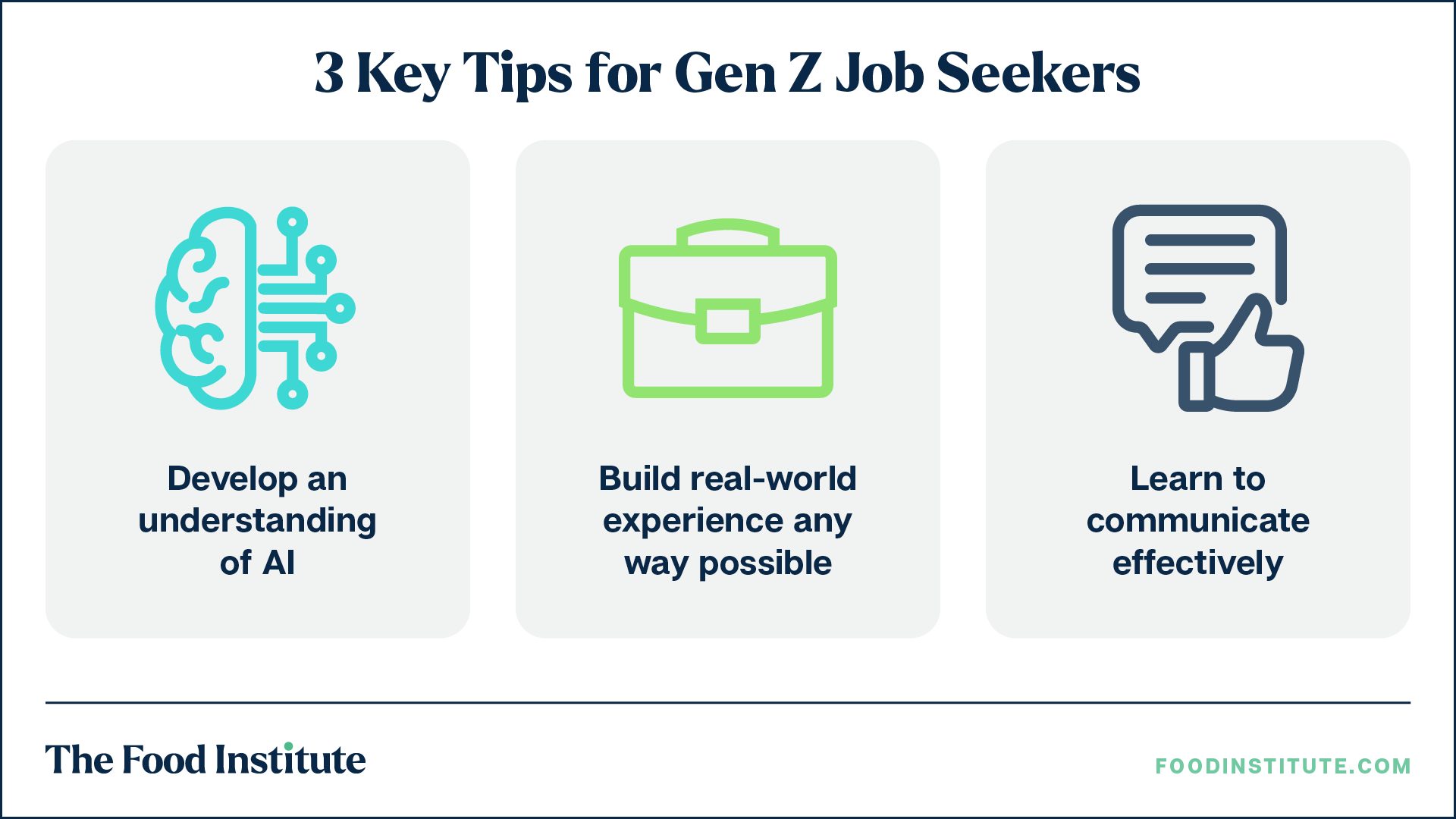
3 top tips for Gen Z job seekers
Of nearly 12 industry experts food research institute When we spoke to them for this article, we came to a virtual consensus on tips for young job seekers in 2026. Their main suggestions are:
- build an understanding of A.I.
- build real world experience In any way possible (e.g. internship, part-time job, certification, or apprenticeship)
- learn communicate effectively
In the age of smartphones, text messages, and endless streams of TikTok videos, that last one isn’t always easy. But the uncomfortable truth still remains. Today’s young “digital natives” need to feel safe when speaking face-to-face.
“Communication is important in business. You can’t just hide behind a keyboard or smartphone and communicate. You have to be available and able to participate in one-on-one and group conversations,” Dunaway said.
“Soft skills, such as the ability to communicate effectively, show empathy, problem solve and adapt, and work as a team, are the skills that make candidates most employable,” Elders said.
Also, today’s young job seekers must have an open mind.
“You need to be willing to look at entry-level work as a skills lab, not a dead end,” says George Forrester, director of operations at Descoo. “Managing busy hours at a restaurant on a Friday night develops high-stakes problem-solving skills and emotional intelligence more than most entry-level roles in an office.”
What employers can do
Companies looking for great entry-level employees should learn TikTok. …and Instagram. …and Discord. Companies need to meet talented young job candidates on social media.
“We regularly celebrate our team members on social media for everything they do,” Elders said. “In doing so, we not only recognize our talented team members, but we also tell more authentic stories about what it’s like to work in a restaurant. When those stories are shared, they go a long way in attracting new talent.”
It is also your responsibility as a business owner to demonstrate that young workers may have a long-term professional future if they apply for your job.
“Employers need to position entry-level roles not just as jobs, but as career launchpads,” Dunaway said.