

Written by Rachel Zinn, Russell Myers, Alifiya Sadiqari, Casey Mondu
Important points
- Agentic AI systems plan, reason, and act autonomously across enterprise environments, introducing unprecedented capabilities and risks by breaking the traditional software paradigm of human-driven execution.
- The introduction of agent AI changes cybersecurity priorities and requires organizations to go beyond traditional defenses and implement new governance strategies that address the autonomous and adaptive nature of these systems.
- TrendAI™ introduces the Agenttic Governance Gateway to enable organizations to discover, observe, understand, discover, and enforce governance over agenttic AI behavior, ensuring secure and reliable deployment of autonomous AI.
The existence of agent AI means that for the first time, software can make decisions and act invisibly. Agentic AI systems can now plan, reason, decide, and ultimately make decisions across enterprise environments. Software, which previously could only produce output, can now do new things on its own, such as calling APIs, accessing sensitive data, triggering workflows, and interacting with other systems.
This has great potential to simplify and automate workflows and processes, but it also introduces new types of risks. Cybersecurity is built on the simple premise that software will do what humans decide to do. With agent AI, that assumption no longer holds true.
Agenttic AI systems differ from traditional software in that they are not completely deterministic. They operate through iterative loops, adapting to new inputs, tool outputs, and changes in context. They are designed to adapt autonomously, so their actions can evolve beyond their original instructions without direct human supervision at each step. This can have consequences that are difficult to predict, track, and control.
While this change in the way systems operate creates unprecedented capabilities and possibilities, it also introduces new types of risks that need to be addressed.
Agentic AI security gap
Agent systems disrupt traditional attack chains because a single manipulated instruction through prompt injection, tool misuse, or data poisoning can cause a disproportionate impact. Agency allows malicious intent to quickly cascade from initial access to data exfiltration and broader system compromise.
Software like OpenClaw accelerates this reality by being able to deploy within minutes and granting access to data, APIs, and enterprise workflows from day one. The NVIDIA GTC keynote demonstrated how agents can be easily installed and orchestrated complex multi-step workflows across multiple systems in real time.
The combination of ease of deployment and widespread access makes agent systems both extremely powerful and extremely risky. The accessibility and rapid adoption of agent AI has exposed critical gaps. In other words, you’re giving software the power to take action without giving your security team visibility into how that action will unfold.
Why existing security models break?
In the agent era, control points have changed. Modern approaches seek to extend familiar controls.
- Protect your model
- Protect your application
- Protect your endpoints
However, agent systems do not operate within a single boundary. Agentic AI operates throughout the interaction. Risk currently resides in:
- How agents communicate
- how decisions are communicated
- how intentions are translated into actions
The primary security control point is no longer the endpoint or the application. TrendAI™ identifies this new type of control point as a checkpoint for how agent systems interact, exchange information, and perform actions. This interaction layer is a communication fabric between agents, tools, models, and data. I/O checkpoints in autonomous systems include where instructions are passed, context is exchanged, intent is formed, and actions are triggered.
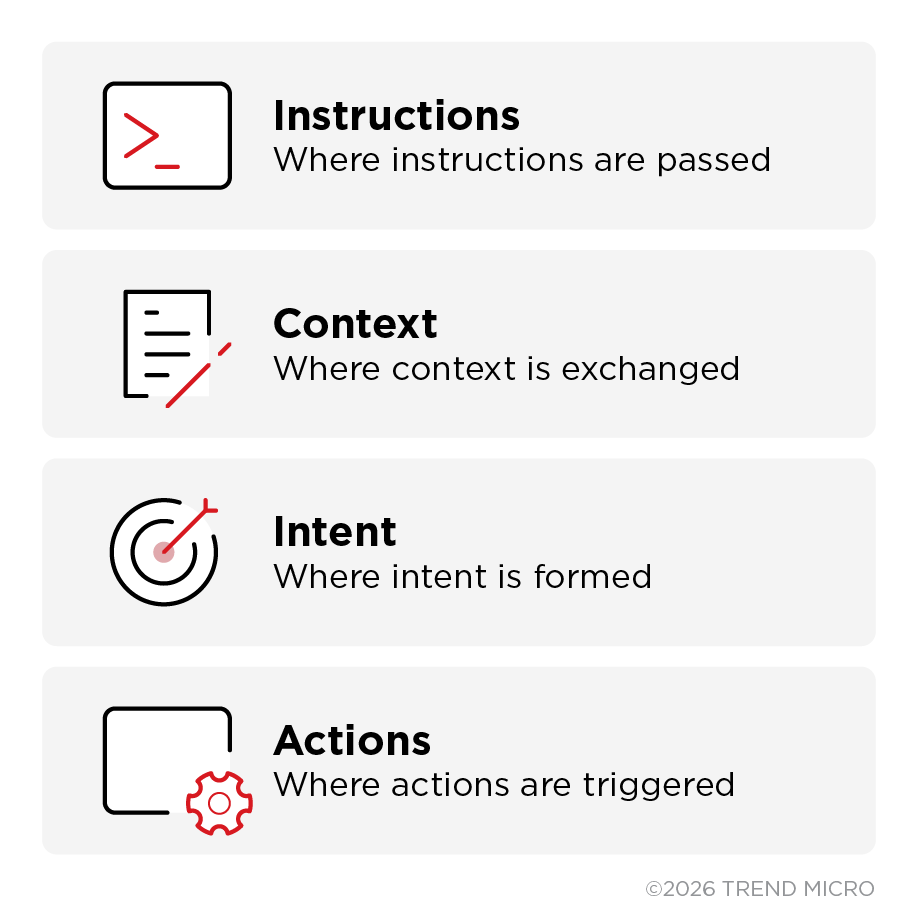
Currently, that layer is largely unmanaged. If security cannot recognize and control this layer, it cannot effectively control the behavior of the agent system.
While advances such as confidential computing have allowed organizations to trust the environment in which AI runs to ensure that their data is protected, a new version of the shared responsibility model is emerging. Infrastructure can protect the environment, but organizations are responsible for managing what autonomous systems do with their data.
This means organizations need to ask a few simple questions, and the answers will determine how well they can manage their autonomous systems.
- Does your organization know and have visibility into what its agent systems are doing?
- Can their actions be trusted?
- Is intervention possible? How quickly can it be done?
Due to the gradual changes in productivity and functionality of agent systems, it is not advisable to slow down deployment. The only way forward is to recognize that accepting responsibility for managing these systems is just as important as deciding to deploy them. This is the gap that Agent Governance Gateway is designed to address.
From security to agent governance gateways
TrendAI™ introduces an Agentic Governance Gateway that allows organizations to manage actions at the point they are created. Agentic Governance Gateway allows you to:
- See where your agents are and what they can access
- Observe how systems interact
- Understand the context and intent behind those interactions
- Detect when behavior deviates from intended results
- Enforce policies and stop risky behavior
- Introduce human approval at key decision points
Think of it like large-scale air traffic, where each flight makes decisions, changes direction, and interacts with other flights in real time. Systems work not because each individual component is safe on its own, but because everything is coordinated. Without a control layer, even if you have a powerful system running, you won’t have a clear picture of where it’s going, how it’s interacting with it, and what happens when its paths collide.
Years of responding to ransomware and containing breaches have built powerful capabilities in visibility, detection, and response. Agent systems are modified where these features need to be applied. If AI agents can reason, invoke tools, access data, and take actions without human approval, governance must operate at the interaction layer where intent is implemented and actions are triggered. The Agentic Governance Gateway builds on your existing control layer to provide visibility, coordination, and intervention at the point where decisions turn into actions.
Turn governance into results
TrendAI Vision One™ extends its long-standing strengths in threat investigation, endpoint, network detection and response, and AI-driven analytics to the interaction layer where agent systems operate.
The platform builds on decades of insights and leadership in cross-layer detection from Zero-Day Initiatives (ZDI) and applies proven capabilities to autonomous AI.
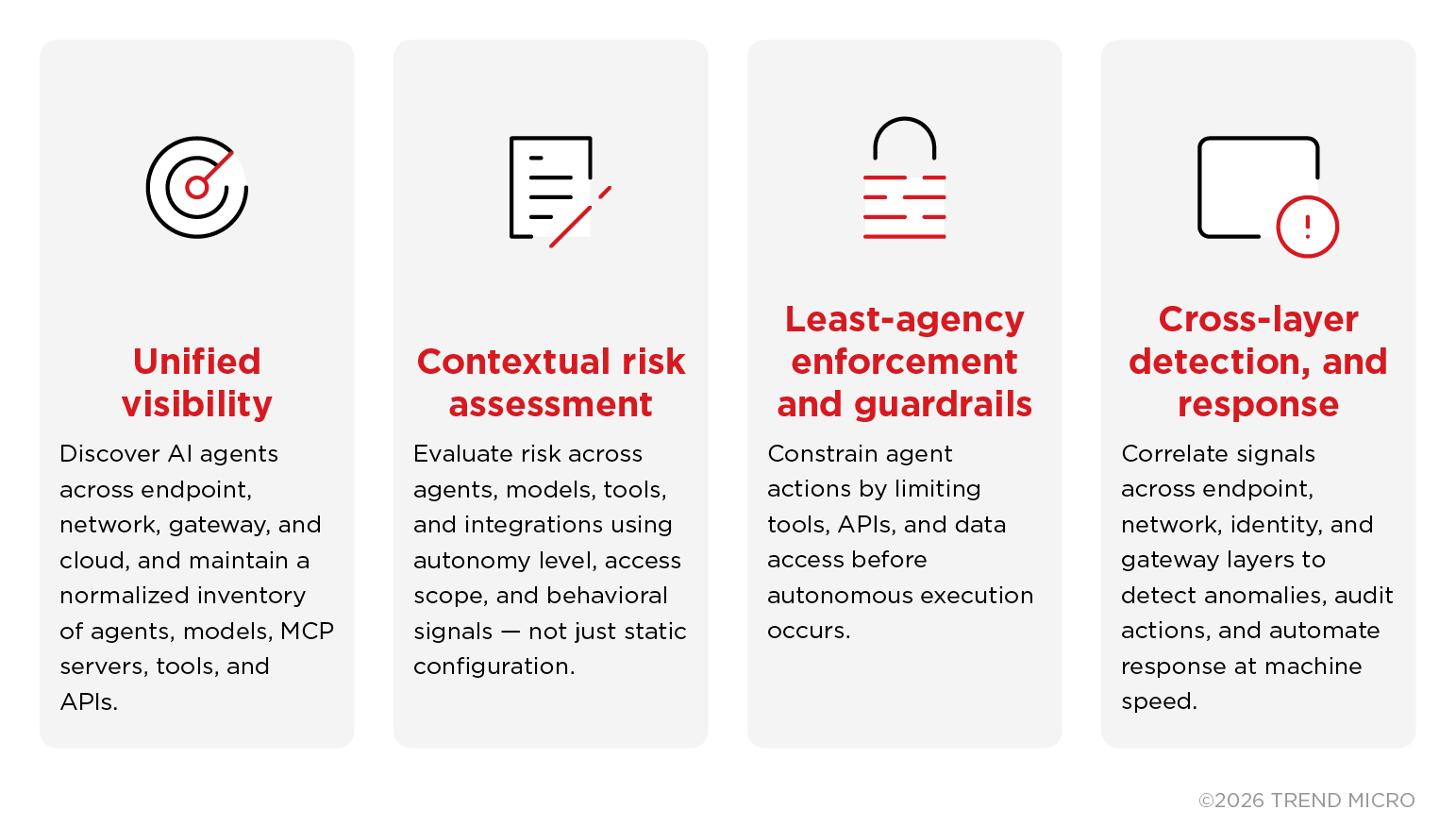
Governance works by extending these familiar security capabilities to manage decision-making systems, not just human-driven activities.
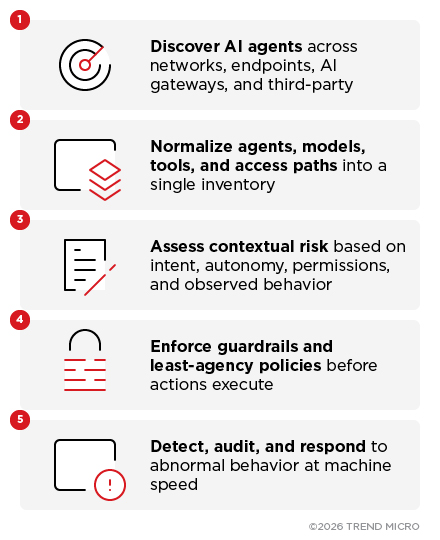
Using an integrated platform approach like TrendAI Vision One™, organizations can begin operating agenttic governance gateways by extending proven security controls to autonomous systems.
What CISOs should do now
Agentic AI brings fundamental changes to the way software works. We are moving from a protection system that produces decisive results to a management system that makes decisions. Agent systems are decision-making entities that operate throughout an environment. Security must evolve accordingly.
The transition to agent systems is already underway and accelerating. To begin managing autonomous AI at scale, CISOs should focus on:
- Build an inventory of your AI agents and understand what they can access and do
- Enforce least privilege and least agency policies by default
- Treat agent tools, skills, and extensions as supply chain risks
- Monitor interactions and communication flows, not just endpoints
- Introducing guardrails or authorizing high-impact autonomous actions
These steps mark the transition from protecting AI components to managing autonomous behavior, and are the foundation for deploying agent AI with confidence and control.
AI fearless
The future of AI will not be determined by how fast it moves alone, but by how securely and confidently organizations can use it. The new frontier introduced by the introduction of agent AI can be deployed with confidence. Agentic Governance Gateway enables organizations to understand what their systems are doing, trust how they work, and control outcomes when it matters most.
Please move forward. Control and manipulate. Deploy AI without fear.
hide
Did you like it? Add this infographic to your site.
1. Click the box below. 2. Press Ctrl+A to select all. 3. Press Ctrl+C to copy. 4. Paste the code into your page (Ctrl+V).
The image will be displayed at the same size as above.


