
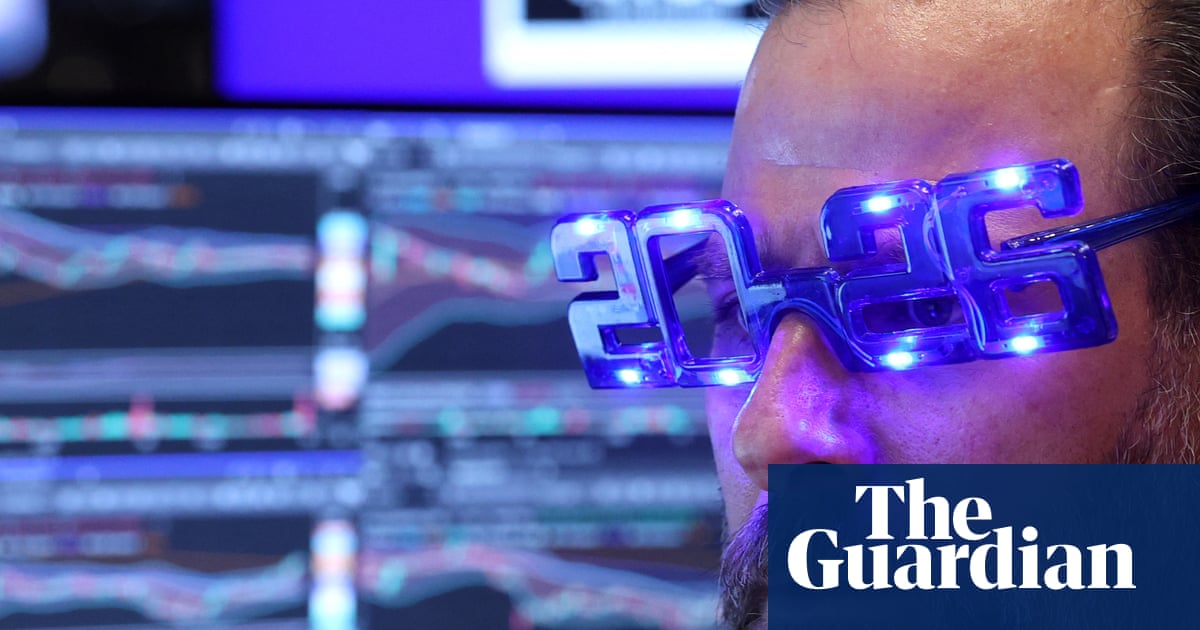
Investors expect global stock markets to continue rising in 2026, despite fears of an AI bubble bursting and fears of turmoil involving the US central bank.
Wall Street strategists largely expect the S&P 500 index of U.S.-listed companies to continue rising over the next 12 months, but said this could be a volatile year unless geopolitical tensions rise and inflation declines.
Biggest threats: AI concerns, Fed chaos, private credit
A Deutsche Bank survey of 440 investors, economists and analysts found that 57% believe a sharp decline in technology valuations or a decline in enthusiasm for AI is the biggest risk to market stability in 2026.
Never before have investors been more aligned about the biggest market risks in the year ahead: Deutsche Bank survey. “The risk of an AI/tech bubble towers above everything else.” The next biggest risk is loss of Fed independence and a crisis in private credit. pic.twitter.com/RO4q1IAwZP
— Lisa Abramowicz (@lisaabramowicz1) December 18, 2025
The second biggest concern is that Donald Trump will appoint a new Federal Reserve chairman who will aggressively lower interest rates, causing market turmoil.
The president said on Dec. 17 that he would soon name the next Fed chair, and that it would be someone who believes in lowering interest rates “substantially.”
Respondents' third most important concern was the crisis in private capital markets, including private equity, venture capital, and private debt.
A survey of fund managers by asset management firm Quilter found that stress in private credit markets is the most underestimated risk, despite warnings from global policymakers about the dangers lurking in the shadow banking sector.
Swiss bank UBS advised clients that the market “could face new challenges” if advances in AI slow, inflation picks up again or debt problems resurface.
Will the UK stock market continue to rise?
Analysts and retail investors are confident the UK stock market will continue to perform well in 2025, with further gains in 2026 after the FTSE 100 blue-chip index breached the 10,000-point mark for the first time on Friday.
Russ Mould, investment director at AJ Bell, said there were now pretty good signs, with analysts expecting FTSE 100 earnings growth to be 14% in 2026. Mold reports that total dividend payments on the FTSE 100 are expected to set a new record of £85.6bn in 2026, finally surpassing the peak of £85.2bn set in 2018.
UK retail investors are optimistic about the year ahead, with 53% confident the current bull market will continue through 2026, according to a poll by trading firm eToro.
UK bonds could do well
Robert Timper, chief global fixed income strategist at BCA Research, said this could be a strong year for British bonds (gilts) if the Bank of England cuts interest rates faster than other central banks.
“British government bonds will move from being number two to being the best-performing bond market,” he predicted. [in 2026]Financial concerns have eased with support from the dovish Bank of England. ”
Global market expected to rise
UBS forecasts that “strong economic conditions will support global equities, which are expected to rise by around 15% by the end of 2026,” with gains likely in the United States, China, Japan and Europe.
Wall Street is predicting double-digit gains. Under UBS's base case, the US S&P 500 index would end 2026 at 7,700 points, up 12.5%.
Deutsche Bank has a year-end S&P 500 target of 8,000 points (+17%), while Oppenheimer Asset Management is even more bullish, predicting 8,100 points at the end of the year.
U.S. stocks will rise if U.S. growth is above consensus next year and headline inflation is below consensus, according to consultancy Oxford Economics.
UBS also recommends Chinese stocks. “China's technology sector stands out as the world's biggest opportunity,” the paper said. “Strong liquidity, retail flows and earnings are expected to rise to 37% in 2026, sustaining momentum in Chinese stocks.”
Ostrum Asset Management predicts that European stock markets will remain positive in 2026 due to a return to profit growth. However, he cautioned that this was dependent on companies' ability to meet high expectations.
However, investor Michael Burry, who appeared in the film The Big Short, is less optimistic, saying the next few years will be “bad years”.
Impact of artificial intelligence
After a year in which hyperscalers invested hundreds of billions of dollars in AI infrastructure, the technology sector is likely to shape long-term macroeconomic outcomes in 2026.
Investors will be watching to see whether the big AI companies justify their huge valuations and deliver the productivity gains policymakers expect following a strong stock market rally in 2025. Otherwise, valuations may decline.
While many argue that investments in AI are still in the early adoption stages, there are concerns that some players are intertwining with their own suppliers and partners. This cyclicality obscures the true financial picture and creates vulnerabilities that could be divisive if AI optimism fades.
While much of the AI focus in 2025 has been on chatbots, UBS chief investment officer Mark Hefele said capital investment in this area could focus on agent AI (systems or “agents” that can perform knowledge tasks with little or no human guidance), physical AI (such as robots and self-driving cars), and AI video.
UBS predicts that approximately $4.7 trillion will be spent on AI capital investment worldwide by 2030, based on more than 40 announcements this year. That's about double the $2.4 trillion already planned.
economic outlook
The global economy is expected to avoid recession in 2026, despite trade barriers rising in 2025. Kathleen Brooks, UK research director at brokerage firm XTB, said there was little chance of a global recession and predicted the global economy would remain resilient.
Analysts at Goldman Sachs told clients that the main risks to global growth in 2026 are that a weak job market triggers recession fears or that stock markets question the value of AI-related revenues.
Goldman forecasts “solid global growth of 2.8% in 2026,” and expects the U.S. economy to “significantly outperform” as the drag from tariffs and tax cuts eases and financial conditions ease. We also expect China to remain strong as strong exports outweigh sluggish domestic demand.
UBS believes the global economy is poised to accelerate in 2026 due to improved business confidence and consumer confidence and additional fiscal stimulus in some developed countries.
Dutch bank ING said it “remains relatively optimistic” about the U.S. economy and expects easing financial conditions to support growth in 2026.
Deutsche Bank indicated that the U.S. midterm elections scheduled for November could influence policy early in the year, as Republicans seek to avoid losing seats.
merchandise
Oil prices will be highly sensitive to geopolitical developments in 2026, including the Russia-Ukraine war and progress toward ending the Middle East conflict. Expectations of oversupply could also push prices down.
Advisory firm Oxford Economics forecasts that Brent crude oil will reach $58 a barrel by the end of 2026, down from $60 last month, and further decline to $55 in 2027.
MeCopper prices may rise due to shortages. Deutsche Bank expects the copper market to be in a “clear deficit” in 2026, with prices expected to peak in the second half of this year.
Central banks and interest rates
Money markets are pricing in two U.S. interest rate cuts by December 2026, but this outlook depends on the outlook for the U.S. economy and Mr. Trump's choice of the next Fed chairman.
Richard Carter, head of fixed-rate research at asset manager Quilter Cheviot, said the market is “very wary of eroding the Fed's independence.”
The UK is fully priced in for one interest rate cut in 2026, but several economists expect the Bank of England to cut rates at least twice.
What could go wrong?
Experienced city voices know that the market consensus is definitely wrong. The question is which direction to go.
Dario Perkins, an economist at forecasting firm TS Lombard, suggested the situation may be stronger than expected.
“The consensus is that 2026 will be similar to 2025,” he told clients. “Stable growth in the global economy, some disinflation, and monetary policy returns to neutrality and remains that way indefinitely. Zzzzz.”
He added: “What's wrong with the consensus? Our bet is that economic activity will recover more strongly, which will stimulate inflation and the debate will begin.” [in the second half of the year] Regarding monetary tightening. ”
But “the risks of failure are accumulating,” said William Davis, global chief investment officer at Columbia Threadneedle Investments.
He warned: “Growth has proven surprisingly sustainable, inflation has eased (albeit unevenly), and markets continue to rise. But behind the scenes, imbalances are increasing. We believe that next year will be determined by how well policymakers and investors navigate the path of contraction.”


