

The new AI video model, called Kling, appears to offer many of the same features that distinguished OpenAI's Sora, which was first announced earlier this year.
Developed by Chinese video platform company Kuaishou, the app features longer video generation, improved movement, better prompt tracking, multi-shot sequences, etc. Unlike Sora, Kling appears to already be available to users via a waiting list.
OpenAI launched Sora in February and a growing number of creators are starting to use it, including five award-winning filmmakers who will premiere short films made with it at the TriBeCa Film Festival next week. Nevertheless, it's not yet widely available to the public.
Among the clips Kling shared were longer ones of a boy riding a bike, a horse in the desert, a man eating noodles and a realistic video of a boy enjoying a burger.
What do we know about Kling?
China's new DiT video AI generation model[KLING]open access! Generate 120-second videos at 30 FPS 1080P to better understand physics and accurately model complex movements Prompt: Travel by train and look at different scenery from the window. https://t.co/hTwIEHRza2 pic.twitter.com/nBvnAsqd1OJune 6, 2024
Kuaishou says Kling can generate up to two minutes of video at 1080p and 30 frames per second from a single prompt, and can “accurately simulate real-world physics,” something most AI models struggle with.
This is the same diffusion transformer model as Sora, with a unique model that can support a variety of aspect ratios and shot types.
In addition to its generative capabilities, the company explains on its website that Kling is capable of advanced 3D facial and body reconstruction, allowing it to perfectly reproduce facial expressions and limb movements in videos.
What remains to be seen is whether Kling, or China's other big AI video model, Vidu, will be released outside of China, which could be OpenAI's saving grace in the West.
What does a Kling video look like?
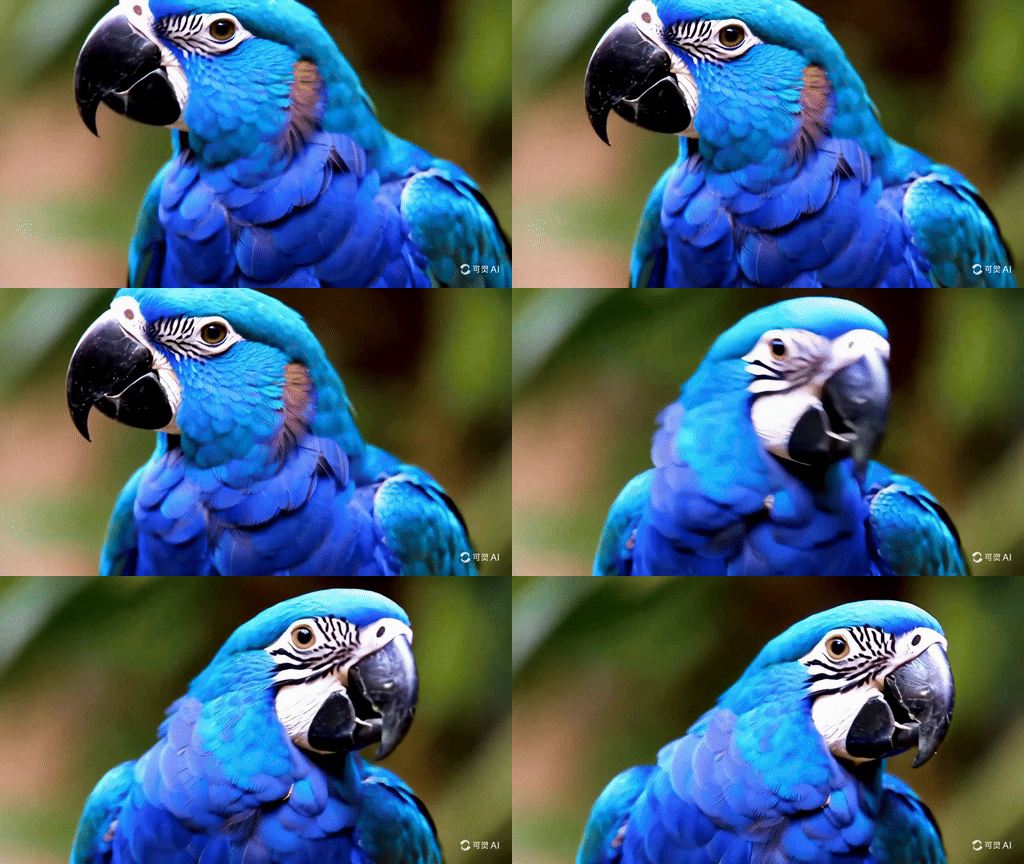
The most striking part of this video is the photorealism: Some clips exhibit a similar blurriness seen in other AI videos, though not on the same scale.
There's one clip of a parrot that's hard to tell isn't real, and we're still not sure if the burger video is fake.
One video I've played a bunch of times involves pouring liquids, and while most of the videos struggle, Kling at least seems to get it right in the demo of pouring milk into a glass of coffee.
Overall, Kling seems capable of creating accurate movements, better modeling real-world movements and physics, and creating a photorealistic depiction of the world.
What does this mean for Sora?

Competition is good for creativity and innovation, so we hope the company will consider a broader release to make it available outside of China. We hope that this release will encourage OpenAI to release Sora sooner than currently planned.
OpenAI also faces competition from established players like Runway and Pika Labs, both of which are stepping up their game, as well as new entrants like Haiper, LTX Studio and Higgsfield, each with a different approach to AI video, and Google's new Veo model.
In reality, OpenAI's delays aren't a matter of technical availability, but rather a matter of safety: The company said it wants to ensure that its models aren't used for misinformation or malicious purposes before releasing them to the public. It also needs to make its models faster and cheaper.
More articles from Tom's Guide

Back to MacBook Air


