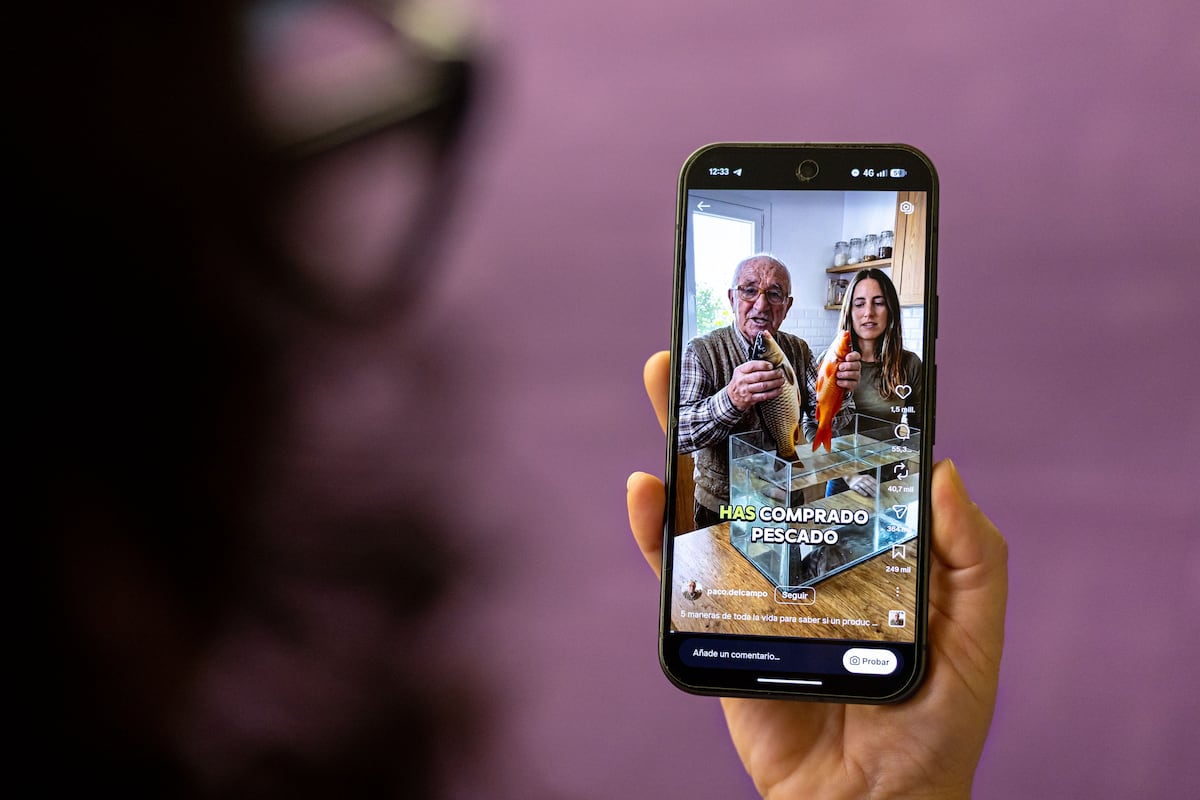
“When you buy fish at the market, put it in water. If it sinks, it’s fresh; if it floats, it’s bad.” So begins the video, which has already been viewed by more than 25 million people. The main character is Paco del Campo, an elderly man with an attractive appearance who gives advice on diet and health. This is not a special case. Very similar videos have proliferated in recent weeks, racking up millions of views. Three examples can be cited. Eduardo, a middle-aged man who describes himself as a “holistic health expert and nutritionist,” warns of the dangers of pangasius, tilapia and salmon in a video that begins, “If you don’t want to die tomorrow, don’t eat these three fish…”
Or Sophia, a woman who shares her “holistic health tips” and warns about the supposed dangers of pesticides allegedly in apples: “Never buy an apple without checking this first…” The third example is also the most surreal. Manuel Del Campo, an elderly man with Amish appearance, displays two pieces of salmon on the asphalt of a supermarket parking lot. One appears to be wild and is therefore infested with ants, while the other is farmed and has no insects, but “it’s full of toxins,” he says.
All of these videos have received millions of views, thousands of likes, and hundreds of comments from people concerned about their health and diet. But most people don’t realize two things. That means the message is false and that Paco, Eduardo, Sofia and Manuel don’t even exist. They are characters created by artificial intelligence. But that’s not all.
clone video
A quick search of these profiles reveals that they all post nearly identical versions of the same videos, word for word, with the same settings and the exact same messages. One about three fish, one about apples, one about salmon…
Moreover, if you continue to search across social networks, you will find that Paco, Eduardo, Sofia and Manuel are not the only people who appear in these videos. There are hundreds, perhaps thousands, of variations with the same presentation and the same message, but with different protagonists: different ages, professions, nationalities, ethnicities, religions, and languages. There’s something for every audience – a kindly elderly woman, a Tibetan monk, a farmer, a doctor, a shaman – and it’s tailored to a variety of people, eliciting empathy and winning trust.
They all follow the same formula. Profiles with health-related names (healer, natural, holistic, wellness, etc.), sensational videos about everyday topics, and scripts explicitly written to touch our emotions.
In this article, we analyzed 150 Instagram profiles with these characteristics. Together they have over 23 million followers. 75% are English, 20% Spanish, and the remaining 5% are other languages such as French, German, and Russian. But there are many more profiles not only on that social network, but also on other networks such as TikTok, X, Facebook, etc.
Create hoaxes on a large scale to order
This type of video can be placed within a broader phenomenon known as AI slop. AI slop is a colloquial term to describe the avalanche of low-quality content generated by artificial intelligence.
The obvious goal is often to monetize user attention by getting millions of views or to drive viewers to your product, course, or e-book.
But behind all this there is something more important than a few viral videos. It’s a total paradigm shift. First, AI has made it possible to create misinformation on an industrial scale with little time, effort, or high-level expertise. In fact, near-autonomous AI accounts (some researchers call them “agent AI accounts”) that can automatically generate content already exist. They detect the most interesting health and food topics at the moment, generate scripts, create videos that fit each of the aforementioned profiles, publish content, analyze which posts perform best, and iterate on a formula that works.
In other words, humans don’t even need to produce each video. Their role may be limited to starting and monitoring the system.
You won’t believe it until you see it…
But the revolution doesn’t stop there. There is a second, deeper change. It means we can no longer trust what we see.
For more than a century, we have considered photographs, and later videos, as reliable evidence of reality. If we see it with our own eyes, it must be true.
However, generative AI has severed the link between images and reality, as it can generate non-existent hyper-realistic figures in non-real settings.
There are often details that are immediately obvious to have been generated by AI, such as slightly unnatural movements or unrealistic lighting. However, it is very likely that in the near future those images will become virtually indistinguishable from reality.
The threat of false rumors created by AI
As you can imagine, this phenomenon poses a threat. A flood of misinformation spreads false beliefs about food and health that can influence our behavior and dietary choices.
In some cases, these hoaxes are actually harmless. For example, some claim that the flavor of a pepper is related to the number of protrusions on its base. But there are others that are much more dangerous, such as those that claim that eating the fruit with honey can treat serious illnesses.
They can put not only our health at risk but also our wallets. For example, many of the profiles mentioned in this article sell e-books with false “natural” treatments similar to the claims in the video, which may also be created with AI.
The effects of this phenomenon are not limited to the personal sphere. Such misinformation can endanger public health and jeopardize the reputation and survival of products, companies, or entire sectors. They can go further. For example, if these videos focused directly on political issues, they could influence election results.
How can we spot these hoaxes?
Detecting misinformation can be complicated, especially when specific knowledge about the subject matter addressed by the misinformation is lacking. But now it’s much more difficult, as the use of hyperreal images makes images more reliable.
It’s also much harder to debunk them. It has always been more expensive because it takes much more time and effort than creating it. But now that they are produced on an industrial scale, that has become an almost impossible mission.
Social media moderation mechanisms are also ineffective in preventing the spread of these types of posts, as they do not require clear labeling when content is generated by AI. In fact, some of these profiles even come with a verification badge.
Therefore, in the era of generative AI, our eyes are no longer good enough to distinguish between reality and fiction. That’s why it’s wise to exercise your critical sense before sharing your videos. Check who posted it, the evidence the video provides, and whether the information is backed up by reliable sources. When in doubt, keep in mind that if a message is too good to be true, or too bad, it probably isn’t true.
register to our weekly newsletter Get more news coverage in English from EL PAÍS USA Edition