

Former NSA hacker David Kennedy joins “Mornings with Maria” to discuss the Scattered Spider hacker group targeting the airline industry and the CIA’s declassification of its review of the 2016 Russian election interference investigation ahead of the Fourth of July weekend.
Artificial intelligence company Anthropic has announced the discovery of what it believes to be the first major cyber attack carried out primarily by AI, claiming the operation was the work of a Chinese state-backed hacking group that used its proprietary tools to infiltrate dozens of targets around the world.
Anthropic said in a report released this week that the attack began in mid-September 2025 and used its Claude Code model to carry out espionage operations targeting approximately 30 organizations, including major technology companies, financial institutions, chemical manufacturers, and government agencies.
The company said the hackers manipulated the model to perform aggressive actions autonomously.
Anthropic described the campaign as a “highly sophisticated espionage operation” that represented a turning point in cybersecurity.
North Korean hackers use AI to forge military IDs

Artificial intelligence company Anthropic has announced the discovery of what it believes to be the first major cyber attack carried out primarily by AI, and blamed the operation on a Chinese state-backed hacking group using its own tools. (Jack Silva/NurPhoto via Getty Images/Getty Images)
“We believe this is the first recorded instance of a large-scale cyber attack carried out without substantial human intervention,” Antropic said.
The company said the attack marked a disturbing turning point in U.S. cybersecurity.
“This campaign has profound implications for cybersecurity in the era of AI ‘agents,’ systems that can run autonomously for long periods of time and complete complex tasks with little reliance on human intervention,” the company’s press release said. “Agents are valuable to day-to-day operations and productivity, but in the wrong hands they can significantly increase the likelihood of large-scale cyberattacks.”
Former Google CEO warns that AI systems can be hacked and turned into extremely dangerous weapons
Founded in 2021 by former OpenAI researchers, Anthropic is a San Francisco-based AI company best known for developing the Claude family of chatbots, a rival to OpenAI’s ChatGPT. The company, which is backed by Amazon and Google, has built its reputation around the safety and reliability of its AI, and the revelation that its models had been turned into cyberweapons was particularly alarming.
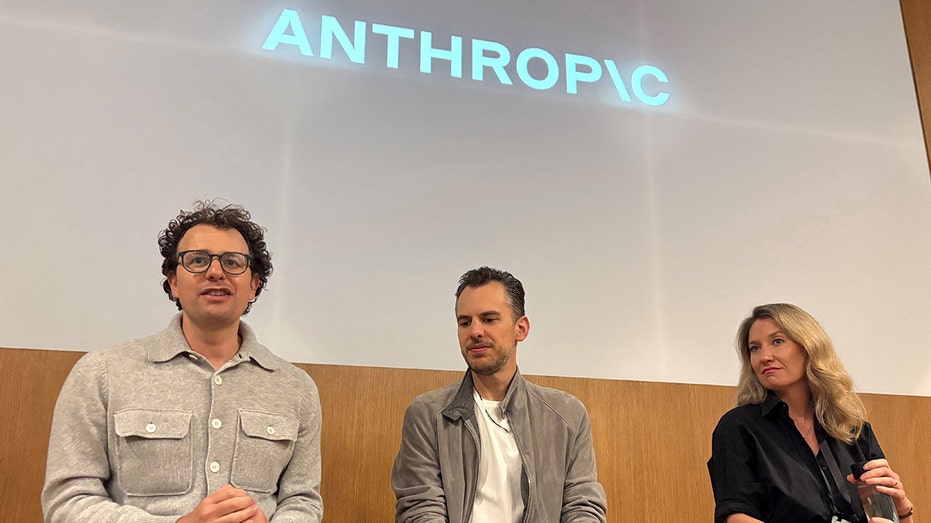
Founded in 2021 by former OpenAI researchers, Anthropic is a San Francisco-based AI company best known for developing the Claude family of chatbots. (Julie Jammot/AFP/Getty Images)
By jailbreaking the model, the hackers reportedly bypassed Claude Code’s protections and disguised the malicious command as a benign request, leading the hackers to believe it was part of a legitimate cybersecurity test.
Once compromised, the AI system was able to identify valuable databases and use code to exploit their vulnerabilities, harvest credentials, and create backdoors for deeper access and data exfiltration.
Anthropic said the model performed 80 to 90 percent of the work, with human operators only intervening for a few high-level decisions.
The company said only a few intrusion attempts were successful and that it acted quickly to close compromised accounts, notify affected organizations and share information with authorities.
Antropic assessed with “high confidence” that the campaign was supported by the Chinese government, but an independent agency has yet to confirm that attribution.
Chinese embassy spokesperson Liu Pengyu said China’s attribution was “baseless speculation.”
“China firmly opposes all forms of cyberattacks and cracks down on them in accordance with the law. The United States must stop using cybersecurity to slander and slander China, and stop spreading all kinds of disinformation about the so-called Chinese hacking threat.”
Hamza Chaudhry, Head of AI and National Security Future Life Research Institutewarned in comments to FOX Business that advances in AI will allow “increasingly unsophisticated adversaries” to carry out complex espionage operations with minimal resources or expertise.

Antropic assessed with “high confidence” that the campaign was supported by the Chinese government, but an independent agency has yet to confirm that attribution. (Reuters/Jason Lee)
Chaudhry praised Anthropic’s transparency about the attack, but said questions remain. “How did Anthropic become aware of the attack? How did it identify the attacker as a Chinese-backed group? Which government agencies and technology companies were attacked as part of this list of 30 targets?”
Chaudhry argues that the Anthropic incident exposes deeper flaws in America’s strategy for artificial intelligence and national security. While Anthropic argues that the same AI tools used for hacking can strengthen cyber defenses, he says that decades of evidence show that the digital realm overwhelmingly favors attacks, and AI will only widen that gap.
Click here to download the FOX News app
By rushing to deploy increasingly sophisticated systems, Washington and the tech industry are empowering adversaries faster than they can build safeguards, he warns.
“The strategic logic of rushing to deploy AI systems that clearly empower adversaries, with the hope that those same systems will help defend against attacks using their own tools, appears fundamentally flawed and deserves reconsideration in Washington,” Chaudhry said.


