
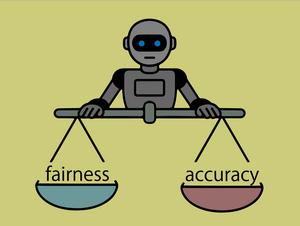
Although AI is not intentionally biased, it can inherit biases from the data it is fed, learning and iterating until the system is inherently unfair. This is complicated by the problem of identifying where an AI system has introduced bias, since most AI systems display the final decision without indicating the steps that made the final decision. Unfair patterns can go unnoticed simply because they are difficult to identify.
To solve these problems, the Computational Intelligence Research Group, led by Professor Yusuke Nojima at the Osaka Metropolitan University Graduate School of Informatics, has evolved a number of “fuzzy” systems that balance the tradeoff between accuracy and fairness.
Fuzzy systems are a type of AI that uses rules similar to human reasoning to make decisions. Unlike strict yes/no rules, fuzzy systems allow for degree (somewhat high, very high, etc.) of agreement, allowing them to deal with the gray areas encountered in the real world.
The researchers used a technique called “multiobjective fuzzy genetics-based machine learning.” This learning system evolves many candidate models designed to make decisions fairly. Unlike previous studies that mainly focused on prediction accuracy and evaluated fairness only after training the model, their study included fairness directly in the training process.
Each evolved model was judged on accuracy and fairness, and the algorithm looked for the best tradeoff to balance the two.
To evaluate their method, they used four commonly used fairness benchmark datasets that tend to make particularly biased decisions based on factors such as gender and race. That is, whether they earn more than $50,000 a year, whether they are a high credit risk, whether they make a bank deposit after seeing a marketing campaign, and whether the defendant reoffends within two years using a real-world dataset.
Lead author Takeshi Konishi, a graduate student, says, “The model we designed achieved greater accuracy and fairness than other models.”
Analyzing the internal mechanisms helps understand the mechanisms by which tradeoffs between accuracy and fairness are formed during the optimization process by looking at the decision-making factors and tradeoffs that the AI balances. Based on the results of this research, the group aims to build more accurate and fair AI systems in the future.
Professor Nojima said, “The results of this research will promote the development of AI that emphasizes not only accuracy but also transparency and fairness.” “I hope that research like this will lead to the realization of a society where AI can be trusted and used safely for delicate decision-making.”
This research IEEE Transactions on Fuzzy Systems.
###
About OMU
Founded in Osaka as one of Japan’s largest public universities, Osaka Metropolitan University is committed to shaping the future of society through the fusion of knowledge and the promotion of world-class research. For more research news, visit https://www.omu.ac.jp/en/ and follow us on social media. ×Facebook, Instagram, LinkedIn
Disclaimer: AAAS and EurekAlert! We are not responsible for the accuracy of news releases posted on EurekAlert! Use of Information by Contributing Institutions or via the EurekAlert System.


