

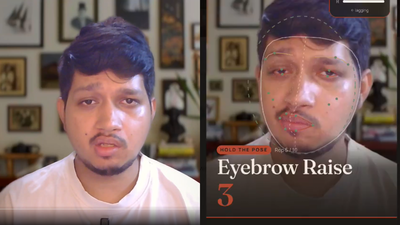
A senior developer advocate with experience in machine learning and AI found himself suffering from sudden paralysis on the right side of his face after being diagnosed with Bell’s palsy. In a post shared online, Ali Mutufa described the experience as hitting “rock bottom” and said he initially wondered how he would recover. Rather than relying solely on traditional tracking methods, Mustufa decided to build his own AI-powered recovery app. The tool uses facial tracking to guide rehabilitation exercises, monitor facial symmetry in real time, and record daily progress during recovery.
AI recovery app Built using Claude, OpenAI Codex
Mustufa, a senior developer advocate with experience in machine learning and AI, quickly built a mobile-first web application called “Mirror” to support Bell’s palsy rehabilitation. The browser-based app uses your device’s camera as an interactive mirror for guided facial exercises and recovery tracking.At the heart of the system is Google’s MediaPipe Face Landmark technology, which can detect hundreds of facial landmarks in real-time directly within your browser. The app first captures a neutral facial baseline before tracking your movements during exercise, such as raising your eyebrows, smiling, or closing your eyes. It then compares the movements of the left and right sides of the face to generate a real-time facial symmetry score.Mustufa said that OpenAI Codex played a central role in building the app’s core systems, including landmark processing, facial symmetry calculations, motion logic, and movement analysis. Claude AI, on the other hand, was used to generate the UI components, layouts, and mobile-friendly interface of the app. The system provides live visual feedback through overlays, percentage-based symmetric scores, and progress indicators. Mustufa described the process as “vibecoding” the app during recovery to make rehabilitation more structured, measurable, and motivating.
Support from the developer community
The project quickly attracted the attention of online developers and AI enthusiasts. Many users praised Mutufa’s response to the diagnosis and shared messages of encouragement. Others discussed their own experiences with Bell’s palsy, physical therapy, and recovery timelines.


