


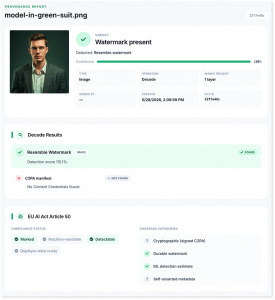
Resemble Watermark now embeds invisible tamper-proof marks across all content modalities, providing a verifiable chain of custody for AI output.
MOUNTAIN VIEW, CA, USA, June 24, 2026 /EINPresswire.com/ — Resemble AI, a generative AI security platform, today expanded Resemble Watermark from audio-only watermarks to full multimodal coverage, adding images, video, and text. This expansion is powered by PerTh Multimodal, which rebuilds the model behind the company’s existing audio watermarkers from the ground up and is also available as open source. PerTh Multimodal allows businesses and creators to include invisible tamper-evident marks on all content types they produce. This update comes as the synthetic media threat reaches an inflection point and organizations face increasing pressure to prove the origin and authenticity of the content they create and distribute. In a June 2026 report, Gartner named deepfakes as one of the four critical threats that enterprises are least protected against, giving attackers the upper hand.
Identity theft and fraud are now core business risks
The risk is that bad actors can do this with synthetic media. This means deepfaking assets and impersonating brands, executives, and talent to commit fraud and damage reputations. As documented in the 2025 Resemble AI Deepfake Threat Report, brand and reputation attacks generated 156.3 billion impressions last year, more than all other attack categories combined. Across all categories, synthetic media generated 296.4 billion impressions. That’s about 53 of all internet users on the planet. This means the damage that scammers can do is widespread and as fast as accessing social media.
What makes the fight difficult is the combination of proof of ownership and the ability to remove unauthorized content. When brand and executive fakes go viral, most organizations have no way to tell which content is authentic and which isn’t. A study presented at ACM 2025 found that only about 38% of AI content generators adequately watermark their output, meaning most AI-generated assets do not have a verifiable chain of custody. While deepfake detection detects fakes created by others, watermarks prove the authenticity of the content created, so you can tell real assets from fakes, and the questions of who created something and whether it has been modified are answered by the content itself.
Resemble Watermark: An authentication layer for AI-generated content
A Resemble Watermark is a declaration of ownership placed within the content itself. First proven in audio, this update extends the same imperceptible marks in the signal to images, video, and text, allowing a single product to cover all content types that businesses generate. Whereas metadatabase approaches can delete files the moment they are re-uploaded, compressed, or re-encoded, Resemble Watermarker embeds marks directly into the content.
A properly watermarked asset can answer four questions at any point in its lifecycle:
– Who published this content?
– Is it AI-generated, AI-modified, or real?
– Has it been tampered with since it was created?
– Are other provenance marks present, such as SynthID or C2PA credentials?
Resemble Watermark reads SynthID and C2PA markers and writes and signs C2PA credentials, providing both layers that regulators focus on: a provenance manifest that compliance tools can read, and an in-signal watermark that persists even when metadata is removed. Assets can also be marked with explicit attribution marks that encode the publisher’s ID, content date, and authenticity status. Support for on-device, VPC, and air-gapped deployments allows enterprises to do so within their own environments.
“A watermark is a declaration of ownership that ideally is placed within content at the time of its creation, so questions about who created something and whether it was modified can be answered by the file itself, rather than the channel or handle it came from,” said Zohaib Ahmed, CEO and co-founder of Resemble AI. “Deepfake detection reveals whether content is AI-generated or tampered with, and watermarks prove who the content belongs to. This is a fundamental authentication layer that all organizations need.”
Built for upcoming regulations within and outside the EU
Resemble Watermarker is designed to directly address the obligations enterprises face as AI content rules move from rule creation to enforcement. The transparency obligation in Article 50 of the EU AI Act will come into force on 2 August 2026, requiring AI-generated and manipulated content to be machine-readable and subject to fines of up to €15 million or 3% of global annual turnover.
The EU does not work alone. China’s mandatory labeling regulations came into effect on September 1, 2025, requiring all AI-generated content to have both a visible label and an embedded watermark or metadata identifier. This is the same two-tier pattern that the EU currently follows. More jurisdictions are expected to follow as this approach becomes the global default. Resemble Watermarker generates the machine-readable markings these rules require across all four modalities through a single API, giving compliance, legal, and trust and safety teams an authentication layer that travels with the content itself.
availability
Resemble Watermark powered by PerTh Multimodal is currently available through likee.ai’s self-service API, and audio watermarking continues to be available as open source. Enterprise licenses, including VPC and on-premises deployments, are available through Resemble AI’s Enterprise Sales team. Resemble Watermark integrates with Resemble AI’s extensive generative AI security platform, including Resemble Detect for deepfake detection.
About Resemble AI
Resemble AI is generative AI security that gives organizations the tools to examine, detect, and respond to synthetic media attacks and fraud wherever they occur. Resemble is built on foundational models and provides a layered trust stack that turns model output into decisions that enterprises can understand, audit, and defend against. Founded in 2019, Resemble AI is trusted by global enterprises and government agencies to protect the entire lifecycle of synthetic media across audio, video, images, and text. For more information, please visit like.ai.
clint bagley
Similar to AI
clint.bagley@resemble.ai
Legal disclaimer:
EIN Presswire provides this news content “as is” without warranty of any kind. Our company does not assume any responsibility or liability
The accuracy, content, images, videos, licenses, completeness, legality, or reliability of the information contained herein;
article. If you have any complaints or copyright issues related to this article, kindly contact the author above.


