

In the not-too-distant future, online salespeople and customer service representatives who greet customers with a warm smile will appear every bit as human, but will exist solely in the digital realm.
Companies test digital humans on their websites and business applications for marketing, employee training, and answering questions about their products and services. Models trained only on task-specific data prevent the AI avatars from responding off-topic.
Experts say digital humans offer several business benefits: They're cheaper than hiring staff to do the same tasks, they can interact with many more people at once than a single human could, and they're particularly well-suited to serving the needs of B2B customers.
According to a Gartner survey, three-quarters of B2B customers would prefer to skip time-consuming meetings with salespeople to order consumables, schedule maintenance or discuss comparative products — all tasks that can be easily handled by an AI avatar.
“Part of the driver for digital humans isn't necessarily technology,” said Marty Resnick, an emerging technologies expert at the analyst firm. “We're hearing from people that they want experiences that don't involve a human.”
As a result, the analyst firm predicts that the percentage of B2B buyers who interact with a digital human during the buying process will increase from less than 5% this year to 50% by 2028.
Still, experts say using digital humans carries legal risks and companies could face public outrage if they hide their use of customer-facing avatars, fail to maintain the accuracy of the information they provide or give the impression that digital humans are replacing employees.
Mitre, a nonprofit that conducts research on behalf of the federal government, found that of 2,063 U.S. adults surveyed in 2023, only 39% believe AI technology is safe and secure, down nine points from 2022. Fears of losing jobs and media reports about deepfake photos and videos of celebrities contributed to the decline in trust.
Despite public concerns, companies continue to experiment with the technology. Synthesia, one startup with an online platform for creating and deploying digital humans, claims that 15,000 businesses have created 4.5 million videos featuring its AI avatars. The company's success has seen its valuation rise to $1 billion.
“We believe that over time, custom avatars will become the norm,” said Alexandre Boyka, Synthesia's head of corporate affairs and policy.
Other startups competing in this market include Hour One, Touchcast and UneeQ.
Customers of Touchcast's AI avatar-building platform include Australia's Macquarie Bank, consulting firm Accenture and professors at Imperial College London, where the AI clones are available to answer students' questions at any time of the day or night.
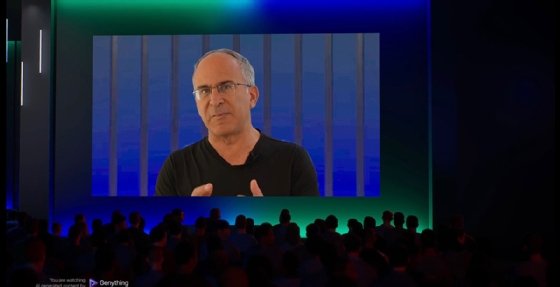
To demonstrate the platform's capabilities, Touchcast CEO Ed Segal had the company's developers create a digital twin of himself to pitch to potential investors and answer their questions. The virtual replica's knowledge base included product documentation, answers to questions potential investors typically ask, and a brief overview of the company's business plan, products, services, and growth potential.
“This is literally part of our fundraising strategy,” Segal said of the digital clones.
Legal Considerations
Whether pursuing cutting-edge technology like Segal's or more modest uses of AI avatars, companies must consider legal liability, corporate lawyers said.
Courts are unlikely to treat digital humans differently than other forms of communication between companies, customers and partners: Companies are responsible for everything their avatars say, so they will need to establish strict guidelines for the use of the technology.
“There are a lot of companies out there that are trying really hard to make money and increase profits and have very aggressive salespeople,” said Chanlee T. Howell, a partner at the law firm Foley & Lardner LLP. “Aggressive sales tactics can certainly lead to misleading statements or usage.”
Foley & Lardner is advising clients to ask their AI suppliers to cooperate in litigation, investigations and regulatory enforcement actions. Courts may require the makers of a company's digital humans to cooperate. Still, contractual obligations make the process much quicker and easier.
But getting AI vendors to agree to such terms could be difficult, Howell said.
“The bigger the deal, the more likely it is that the AI vendor will say, 'I don't like this, but I'll do it to get the deal done,'” he said. “But the initial response will be a firm no.”
Howell said legal issues have led some of Foley's clients to abandon AI cloning, even if it's just the voice of an executive. In one case, a Foley client abandoned plans to clone the voice of its CEO and other executives for messaging to employees.
“Even if we trusted the vendor, the risk of information being leaked or something going wrong outweighed the benefits,” Howell said.
People's fears and concerns about AI cloning
The digital humans used by businesses today look and move so unsophisticated that most people would believe they're real, but an AI startup wants to change that by helping fake humans interact with people more effectively.
“We're probably years away from having 100% lifelike avatars that can do everything a human can command,” Synthesia COO and CFO Stephen Cherild said, “but it's definitely the path we need to take.”
The study found that the pursuit of realism is likely to increase people's fears of AI clones. Participants in the study, conducted by scientists from the University of British Columbia and the Korea Institute of Science and Technology, expressed concerns that digital replicas of humans could threaten personal identity and become a substitute for human interaction.
“They speculated that AI cloning could turn individuals into tradeable commodities for the profit and pleasure of others, transgressing moral boundaries of identity,” the study states.
Participants were skeptical about whether mechanisms would be in place to ensure individual consent and control.
The participants in this empirical study (a survey method that collects data through direct observation and interviews) were 20 adults aged between 19 and over 70 years old. Their occupations included research technicians, students, entrepreneurs, real estate agents, teachers, software engineers, landscapers and retirees.
Segal's digital clone has been well-received by people who have handled it, Touchcast's CEO said, but he acknowledged that an AI digital clone that's indistinguishable from a human could one day cause unforeseen problems.
“We need to grapple with this new means of communication, understand it and figure out how to do it responsibly,” Segal said.
Meanwhile, companies currently experimenting with digital humans need to closely monitor public acceptance, a key factor in achieving a return on investment, Gartner said.
“To the extent that digital humans change humanity for the better, [there’s] If we have trust and transparency, we will be successful,” Resnick said.
Antone Gonsalves is Editor-in-Chief of TechTarget Editorial, where he reports on industry trends that matter to enterprise technology buyers. He has been in technology journalism for 25 years and is based in San Francisco. Have a news tip? Email us!


