Businesses manage an ever-increasing amount of content, from product catalogs and support articles to knowledge bases and technical documentation. Ensuring this information is accurate, relevant, and consistent with the latest business facts is a huge challenge. Manual content review processes are often time-consuming, costly, and unresponsive to dynamic business needs. According to McKinsey research, organizations that use generative AI for knowledge work such as content review and quality assurance can increase productivity by up to 30-50% and significantly reduce time spent on repetitive validation tasks. Similarly, Deloitte research highlights that AI-driven content operations not only improve efficiency, but also help organizations maintain higher content accuracy and reduce operational risk.
By combining Amazon Bedrock AgentCore, a purpose-built infrastructure for deploying and operating AI agents at scale, and Strands Agents, an open source SDK for building AI agents, organizations can automate comprehensive content review workflows. This agent-based approach allows businesses to assess content accuracy, verify information against trusted sources, and generate actionable recommendations for improvement. By using expert agents that work together autonomously, human experts can focus on strategic review tasks while the AI agent system handles content verification at scale.
The agent-based approach we present can be applied to all types of corporate content, from product documentation and knowledge bases to marketing materials and technical specifications. To show these concepts in action, we’ll look at a real-world example of a technically accurate review of blog content. These patterns and techniques can be directly adapted to different content review needs by adjusting agent configurations, tools, and validation sources.
Solution overview
The content review solution implements a multi-agent workflow pattern in which three specialized AI agents, built with Strands Agents and deployed on Amazon Bedrock AgentCore, work in a coordinated pipeline. Each agent receives the output from the previous agent, processes it according to its special features, and passes the enriched information to the next agent in the sequence. This creates a step-by-step refinement process that looks like this:
- content scanner agent Analyze raw content and extract relevant information
- Content verification agent Take these extracted elements and verify them against trusted sources.
- Recommended agent Convert validation results into actionable content updates
Manually scanning, validating, and updating documents is inefficient and error-prone, requiring multiple specialized agents to maintain technical content. Each agent has a focused role. Scanners identify time-sensitive elements, verifiers check current accuracy, and recommendation agents create accurate updates. The system’s modular design with clear interfaces and responsibilities makes it easy to add new agents and expand functionality as content complexity increases. To illustrate how this agent-based content review system works in practice, we’ll walk through an implementation that accurately reviews technical blog posts. Technology companies frequently publish blog posts detailing new features, updates, and best practices. However, due to the fast pace of innovation, some features are discontinued or updated, making it difficult to keep information up to date across hundreds or thousands of published posts. Although we demonstrate this pattern with blog content, this architecture is content agnostic and supports any content type by configuring the agent with the appropriate prompts, tools, and data sources.
Practical example: blog content review solution
We use three professional agents who communicate with us in sequence to automatically review postings and identify outdated technical information. Users can manually trigger the system or schedule it to run periodically.
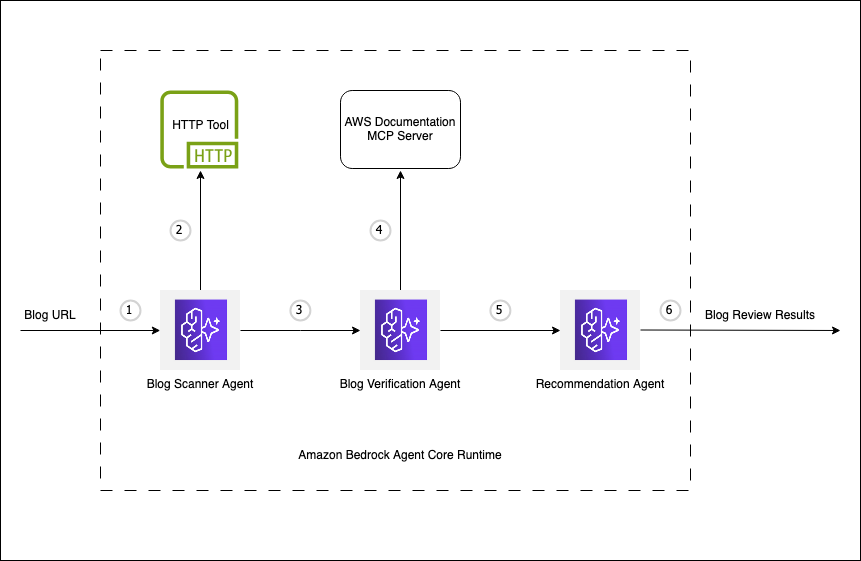
Figure-1 Blog content review architecture
The workflow starts when a blog URL is provided to the blog scanner agent, which uses Strands to retrieve the content. http_request Use tools to extract key technical claims that require validation. The validation agent then queries the AWS Documentation MCP server to retrieve the latest documentation and validates the technical claims against the current documentation. Finally, our recommendation agent synthesizes the findings and generates a comprehensive review report with actionable recommendations for your blogging team.
The code is open source and hosted on GitHub.
Multi-agent workflow
Content Scanner Agent: Intelligent Extraction to Detect Obsolescence
The Content Scanner agent acts as an entry point into a multi-agent workflow. Responsible for identifying potentially outdated technical information. This agent specifically targets elements that may become obsolete over time. The agent analyzes the content and produces structured output that categorizes each technical element by type, location within the blog, and time constraints. This structured format allows validation agents to receive well-organized data that can be processed efficiently.
Content Verification Agent: Evidence-Based Verification
The content validation agent receives structured technical elements from the scanner agent and performs validation against trusted sources. The validation agent uses the AWS Document MCP server to access current technical documentation. For each technical element received from a scanner agent, we follow a systematic validation process based on specific prompts focused on objective and measurable criteria.
Agents are asked to confirm the following:
- Version-specific information: Do the mentioned version numbers, API endpoints, or configuration parameters still exist?
- Feature availability: Are the service features described still available in the specified region or level?
- Syntactical correctness: Do the code examples, CLI commands, or configuration snippets match the current documentation?
- Validity of assumptions: Are the listed requirements, dependencies, or setup instructions still accurate?
- Prices and restrictions: Are the costs, quotas, or service limits mentioned consistent with currently published information?
For each technical element received from the scanner agent, the agent performs the following steps:
- Generate targeted search queries based on element type and content
- Queries the document server for current information.
- Compare the original claim with reliable sources using the specific criteria listed above
- Classify the validation results as follows
CURRENT,PARTIALLY_OBSOLETEorFULLY_OBSOLETE - Document specific contradictions with evidence
Actual verification example: When the scanner agent identifies the claim “Amazon Bedrock is only available in us-east-1 and us-west-2 regions,” the validation agent generates a search query “Regions where Amazon Bedrock is available” and retrieves the current regional availability from AWS documentation. Now that we know that Bedrock is now available in more than 8 regions, including eu-west-1 and ap-southeast-1, we break this down into: PARTIALLY_OBSOLETE “While the original claim listed two regions, the current document shows availability in us-east-1, us-west-2, eu-west-1, ap-southeast-1, and four additional regions as of the validation date.”
The validation agent output maintains the element structure from the scanner agent while adding these validation details and evidence-based classifications.
Recommended agent: Generate actionable updates
Recommendation agents represent the final stage of a multi-agent workflow, converting validation results into content updates that can be implemented immediately. This agent receives validation results and generates specific recommendations that maintain the style of the original content while fixing technical inaccuracies.
Adapt multi-agent workflow patterns to content review use cases
The multi-agent workflow pattern can be quickly adapted to any content review scenario without changing the architecture. Whether you’re reviewing product documentation, marketing materials, or regulatory compliance documents, the same three-agent sequential workflow applies. System prompts should be modified to allow each agent to focus on domain-specific elements and possibly exchange tools and knowledge sources. For example, in the blog review example http_request If you use tools to retrieve blog content and AWS Documentation MCP servers for validation, the Product Catalog Review System may use database connector tools to retrieve product information and query inventory management APIs for validation. Similarly, compliance review systems adjust scanner agent prompts to identify regulatory statements rather than technical claims, connect validation agents to legal databases rather than technical documents, and configure recommendation agents to generate audit-ready reports instead of content updates. The core set of steps, extraction, validation, and recommendations are consistent across all these scenarios, providing a proven pattern that scales from technical blogs to any enterprise content type. To customize your solution for other content types, we recommend the following changes:
- replace the value of
CONTENT_SCANNER_PROMPT,CONTENT_VERIFICATION_PROMPTandRECOMMENDATION_PROMPTVariables and custom prompt instructions:
- Official documentation for Content Verification Agent Update the MCP server.
- Add appropriate content access tools.
database_query_toolandcms_api_toolFor content scanner agentshttp_requestInsufficient tools:
These targeted changes allow us to handle any content type with the same architectural pattern while maintaining our proven three-agent workflow structure, ensuring reliability and consistency across different content domains without changing the core orchestration logic.
Conclusion and next steps
In this post, you learned how to use Amazon Bedrock AgentCore and Strands Agent to build an AI agent-powered content review system. We demonstrated a multi-agent workflow pattern in which expert agents work together to scan content, verify technical accuracy against trusted sources, and generate actionable recommendations. We also showed how this multi-agent pattern can be adapted to different content types by changing agent prompts, tools, and data sources while maintaining the same architectural framework.
We encourage you to test the sample code available on GitHub in your own account to experience the solution first-hand. As a next step, consider starting a pilot project with a subset of your content, customizing agent prompts for your specific domain, and integrating validation sources appropriate to your use case. The modular nature of this architecture allows you to iteratively adjust the capabilities of each agent while expanding the system to meet your organization’s complete content review needs.
About the author
 Saras Krishnan As a Senior AI/ML Specialist Solutions Architect at Amazon Web Services, I help enterprise customers design and deploy generative AI and machine learning solutions that deliver measurable business outcomes. He brings deep expertise in generative AI, machine learning, and MLOps to build scalable, secure, and production-ready AI systems.
 Santosh Kuriakose He is an AI/ML Specialist Solutions Architect at Amazon Web Services, where he leverages his AI and ML expertise to build technology solutions that drive strategic business outcomes for customers.
 Ravi Vijayan I’m a Customer Solutions Manager at Amazon Web Services. He brings expertise as a developer, technical program manager, and client partner, and is currently focused on helping customers fully understand the potential and benefits of cloud migration and modernization with generative AI.