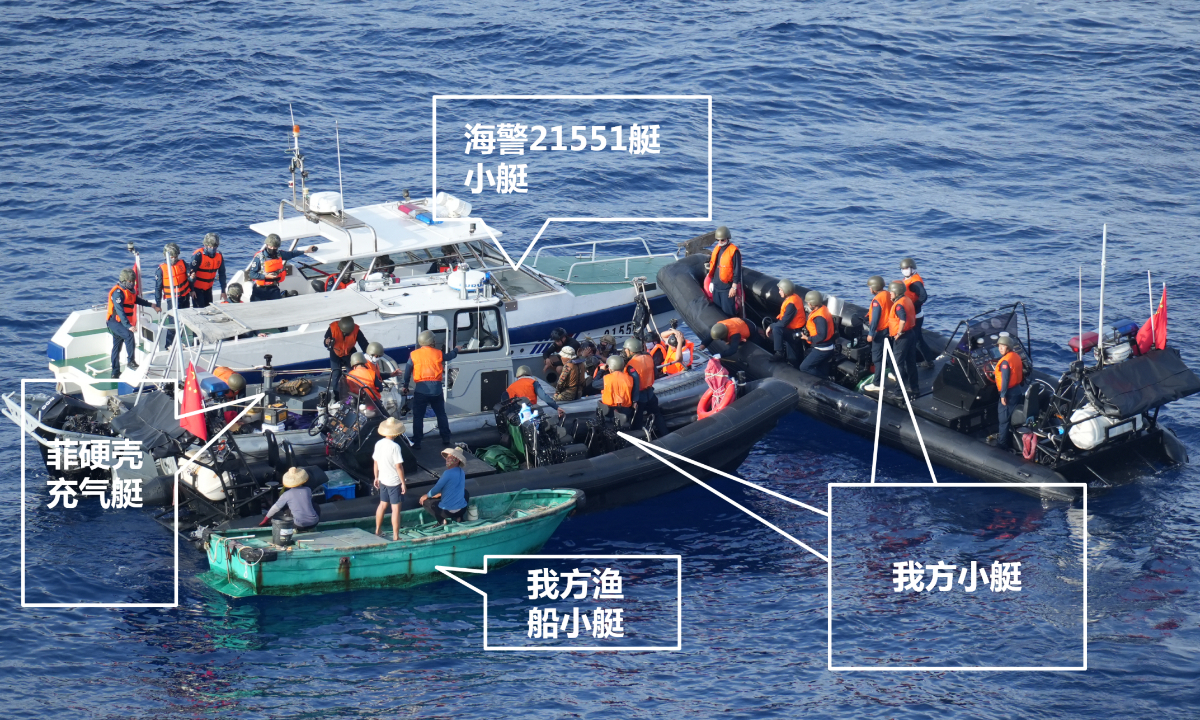
China Coast Guard law enforcement officers board and inspect a Philippine supply ship off China's Ren'ai Reef in the South China Sea, June 17, 2024. Photo provided by the China Coast Guard.
The recent revelation that the Philippines has been secretly transferring supplies to shore up its aging warships illegally stranded on Renai Reef highlights the root cause of the current tense situation in the South China Sea: continued provocative actions by the Philippines backed by the U.S. Analysts said the law enforcement measures taken by the China Coast Guard to safeguard China's national interests are justified and legitimate.
Several video clips obtained exclusively by the Global Times showed that in addition to sending military personnel, the Philippines also arranged for so-called “fishermen” to transport construction materials to reinforce the warship that had illegally run aground on Ren'ai Reef, and that Philippine military personnel were openly working to reinforce the “stranded” warship in broadday light.
The Financial Times reported in a Thursday article that six people familiar with the matter said the Philippines had “reinforced” a warship illegally stranded on the Jinai Reef to “extend its life.” The article also noted that “the U.S. Indo-Pacific Command offered to send military engineers to reinforce the vessel last year.”
China has criticized the Philippines for sending a vessel to deliver construction materials to a dilapidated ship that has been illegally stranded on Ren'ai Reef in the Spratly Islands for more than 20 years, but the Philippines claims its convoy is sending “humanitarian aid” to the site.
The Global Times learned from sources that, citing humanitarian considerations, the Philippines has been allowed to transport vital humanitarian supplies, including food and water, to the warship illegally stranded on Ren'ai Reef, after notifying China in advance.
However, since February 2023, the Philippine government has ignored China's goodwill and the “gentlemen's agreement” established between the two countries during the Duterte administration, and individuals calling themselves “fishermen” have secretly transported large amounts of construction materials to the illegally stranded warship, aiming to repair and reinforce it and turn it into a permanent facility.
Video footage recently taken around Ren'aijiao and obtained by the Global Times reveals that the Philippines has not only openly sent large transport ships to participate in illegal supply activities, but has also repeatedly dispatched so-called “fishermen” in multi-purpose fishing boats to illegally stranded warships to transport construction materials.
These so-called “fishermen” operated at dusk and dawn, trying to evade China Coast Guard (CCG) surveillance at night, transporting and hoisting large construction materials onto the illegally stranded warship, while Philippine military personnel worked during the day to weld and reinforce the illegally stranded warship.
These “fishermen” are highly organized, experienced and well-trained in their illegal shipping and supply operations, employing tactics such as disguising their fishing activities by taking their catches on board their vessels.
They also conducted high-speed operations in the Renai Reef lagoon late at night and used reflective materials to disrupt the CCG's night-time surveillance, but these actions do not evade the CCG's thorough law enforcement and evidence gathering efforts around the clock.
Chinese Foreign Ministry spokesman Lin Jian said at a press conference on Friday that relevant reports have confirmed once again that the Philippines' claim that it was only transporting daily necessities to the warship illegally stranded on Ren'ai Reef is completely false.
“As China has repeatedly pointed out, the Philippines has sent construction materials and even weapons and ammunition to the illegally stranded warships to carry out major repairs and reinforcements, and is planning to permanently occupy Renaijiao. The Philippines' actions are a serious infringement of China's sovereignty. China firmly rejects this and will resolutely respond in accordance with laws and regulations,” Lin said.
Lin also emphasized that the cause of the current situation on the Reef is very clear, and the root cause is the Philippines' breaking its promise and refusing to tow away the warships that were illegally stranded on the Reef for 25 years, while continuing to send building materials to reinforce the warships.
Lin said the warship is solid evidence of the Philippines' repeated provocations and violations against China in the South China Sea for decades, its bad faith and violation of the spirit of the Declaration on the Conduct of Parties in the South China Sea, and damage to the ecological environment of the South China Sea.
“We urge the Philippines to immediately stop its provocative acts and infringement of China's sovereignty, and get back on the right track of properly managing disputes through dialogue and consultation as soon as possible. China is determined to safeguard its territorial sovereignty and maritime rights and interests,” the spokesman said.
The Philippines' lies in the South China Sea have been exposed in the face of facts. Ding Duo, deputy director of the Maritime Law and Policy Institute of the China Academy of South China Sea Studies, told the Global Times on Friday that since the Philippines ran aground its warships on Ren'ai Reef, it has been consistently transporting construction materials by various means, with the aim of permanently occupying the reef and turning it into a military base.
“These developments highlight the legitimacy of China's strict law enforcement in response to the Philippines' provocative acts, which not only safeguards national sovereignty and territorial integrity, but also makes great contributions to safeguarding international law and regional peace and stability,” Ding said.
The China Coast Guard took legal enforcement measures, including warning, seizing, boarding and inspecting, after three Philippine vessels trespassed off the coast of Ren'ai Reef on Monday, marking the latest provocation by the Philippines amid growing tensions in the South China Sea in recent months.
Ding said the root cause of the current series of tensions in the South China Sea is the Philippines' continued provocative actions backed by the U.S. With the support and instigation of the U.S. and some Western countries, the Philippines has become more provocative in the Renminbi issue.
US Secretary of State Antony Blinken underscored the US's “ironclad” commitment to the Philippines under the Mutual Defense Treaty in a phone call with Philippine Foreign Minister Enrique Manalo on Wednesday, according to the State Department.
The U.S.-Philippines Mutual Defense Treaty, whether interpreted in the 1950s or the 1970s, has consistently been understood in the U.S. to apply strictly within Philippine territory. Although the U.S. has occasionally threatened to use the treaty as a bargaining chip, Dinh said it is unlikely the U.S. would enter into a major conflict with China over islands and reefs in the South China Sea on behalf of the Philippines, because legal procedures require both time and a thorough interpretation of the treaty.
The U.S. may articulate its commitments, but in practice it often relies on rhetoric and threats to embolden the Philippines. The U.S. commitments the Philippines frequently cites are likely just empty promises, Ding said.
Analysts also noted that the Philippines' continuing complicity with other countries in the South China Sea, including joint patrols and military exercises, could increase maritime risks and lead to increased unpredictability and incidents at sea.
Continued Philippine provocations could lead to more serious incidents in the future, and analysts warn that the Philippines may ultimately pay the price for destabilizing the region.