
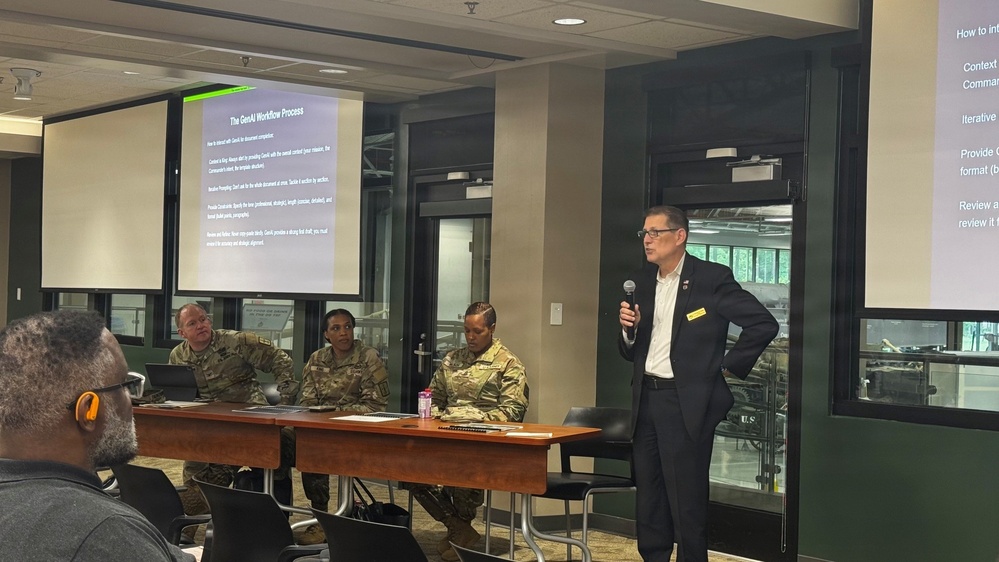
FORT LEE, Va. — Nearly every seat in the classroom at the Weapons Training Support Facility was occupied by Fort Lee Garrison Directors, and personnel gathered in a strategic offsite focused on one of the Army’s fastest-growing technologies: artificial intelligence, AI.
Even before the first presentation began, laptops were opened, notebooks were ready, and conversations were already underway.
Directors and staff from across the facility came together with a common purpose to find practical ways that AI could help Fort Lee operate more efficiently and effectively.
The workshop was part of a broader effort by Fort Lee leadership to identify innovative ways to improve operations in an environment of limited resources and increasing demand.
“We are trying to accomplish more with less,” said Col. Rich Benderewski, Fort Lee garrison commander. “These tools are available. Use them. Our employees are using these tools, and our adversaries are using these tools. We need to start using them to become more efficient.”
Mr. Benderewski encouraged leaders to challenge traditional processes and explore how emerging technologies can help organizations solve long-standing challenges.
“Whenever a requirement comes up, think of a different way to accomplish it,” Benderewski says. “If there are policy challenges, let’s have those conversations. We can’t let bureaucracy stop us from exploring tools to make us more efficient.”
The discussion was led by Dr. Thomas Easterly, director of the Planning, Analysis and Integration Office at Carlisle Barracks, Pennsylvania, who guided participants on the opportunities and challenges associated with generative AI and its growing role across the Army.
“The speed at which generative AI models produce answers and the sheer amount of information they contain speeds many mission-critical tasks,” Easterly said.
Throughout the day, leaders considered how AI can support strategic planning, data analysis, resource management, and other critical functions across facilities. Participants addressed their organizations’ strengths, weaknesses, opportunities, and threats while identifying potential pilot projects tailored to their departments.
While emphasizing the benefits of emerging technologies, Easterly reiterated the importance of maintaining human oversight and accountability.
“The people involved in the loop need to take into account everything that goes into that answer,” Easterly said. “When you use AI, you can’t forget critical thinking. AI is so good at it that it can take that away in an instant.”
Easterly explained that while AI can dramatically increase productivity and reduce the time needed to analyze information, leaders need to remain involved in the decision-making process.
“Anything that comes out of the commander’s office or the director’s office with an AI model is still your product,” Easterly said. “You can’t blame AI for mistakes. You are the final authority.”
The message resonated with participants as the discussion moved from theoretical applications to practical solutions to the challenges facing installations.
The event took months of planning and coordination, said Miguel Correa, Fort Lee’s chief planning specialist and one of the main organizers of the workshop.
“This was a large, multi-phase effort that started long before everyone was seated at ODTSF,” Correa said. “To do this effectively offsite, the Office of Planning, Analysis, and Integration had to analyze thousands of pages of historical documents, reports, and studies. We used generative AI to integrate that information into a baseline SWOT analysis.”
Correa said the effort was a true team project, developed in close collaboration with PAIO team member Chris Dutton. Dutton was awarded the Civilian Achievement Medal for his work supporting off-site and related planning efforts.
Correa said the planning team also worked with Easterly to conduct virtual pre-training sessions with directors to ensure participants were ready to put artificial intelligence tools into practice.
“The goal was to make sure the technology was ready for production when it arrived at the shop floor,” Correa said.
He added that one of the main objectives is to help leaders understand that artificial intelligence is not a stand-alone solution or a replacement for experienced talent.
“The biggest misconception is that AI is either an IT problem or a magic wand that works on its own,” Correa said. “AI doesn’t walk the walk and lacks human context. This technology is just a tool to help buy back time, our most precious resource.”
As the workshop progressed, the energy in the room shifted from cautious curiosity to active collaboration. Directors and staff exchanged ideas, shared data, and explored opportunities to collaborate across organizational boundaries.
“The energy changed from cautious curiosity in the morning to very cooperative behavior in the afternoon,” Correa said. “By the time the group started building the pilot project, the directors were exchanging ideas, sharing data, and collaborating on solutions that transcended organizational boundaries.”
For one of the workshop participants, Melissa Reese, the event demonstrated how artificial intelligence can address many of the challenges that organizations face on a daily basis.
“The biggest takeaway for me was seeing how the challenges we talk about every day, like manual record-keeping, aging infrastructure, and disconnected systems, can be addressed in a practical way through AI,” said Reese. “The workshop made it clear that AI is no longer a distant concept. We are at a point where we can start applying it to real challenges across the garrison.”
Reese said the discussion also changed the perception of what artificial intelligence can do for Army organizations.
“I came into the workshop thinking of AI primarily as automation or a collection of smart tools,” she said. “After discussions, we found that it is much more than that. AI is a power multiplier that helps us work smarter by integrating the data we already have and providing clearer, faster insights.”
By the end of the workshop, each department had planned its immediate next steps. Correa said the focus now is on turning these initial concepts into reality.
“The immediate next step is to move from planning to execution,” Correa said. “The departments left behind draft 24-month artificial intelligence action plans and pilot projects. We will now work with each organization to refine those plans, identify needed resources, and establish measurable return-on-investment metrics.”
Benderewski said the workshop was just the beginning of Fort Lee’s artificial intelligence journey and encouraged leaders to continue seeking innovative solutions that improve organizational effectiveness and mission performance.
As Fort Lee continues to look for ways to modernize operations and improve services, leaders said this workshop was an important step in integrating emerging technologies while maintaining the critical thinking, accountability and leadership that remain essential to mission success.
For Fort Lee leaders, the workshop was more than just an introduction to emerging technology. This marked the beginning of a deliberate effort to utilize artificial intelligence as a force multiplier while preserving the human judgment and leadership necessary to support soldiers, families, and the Fort Lee community.


