
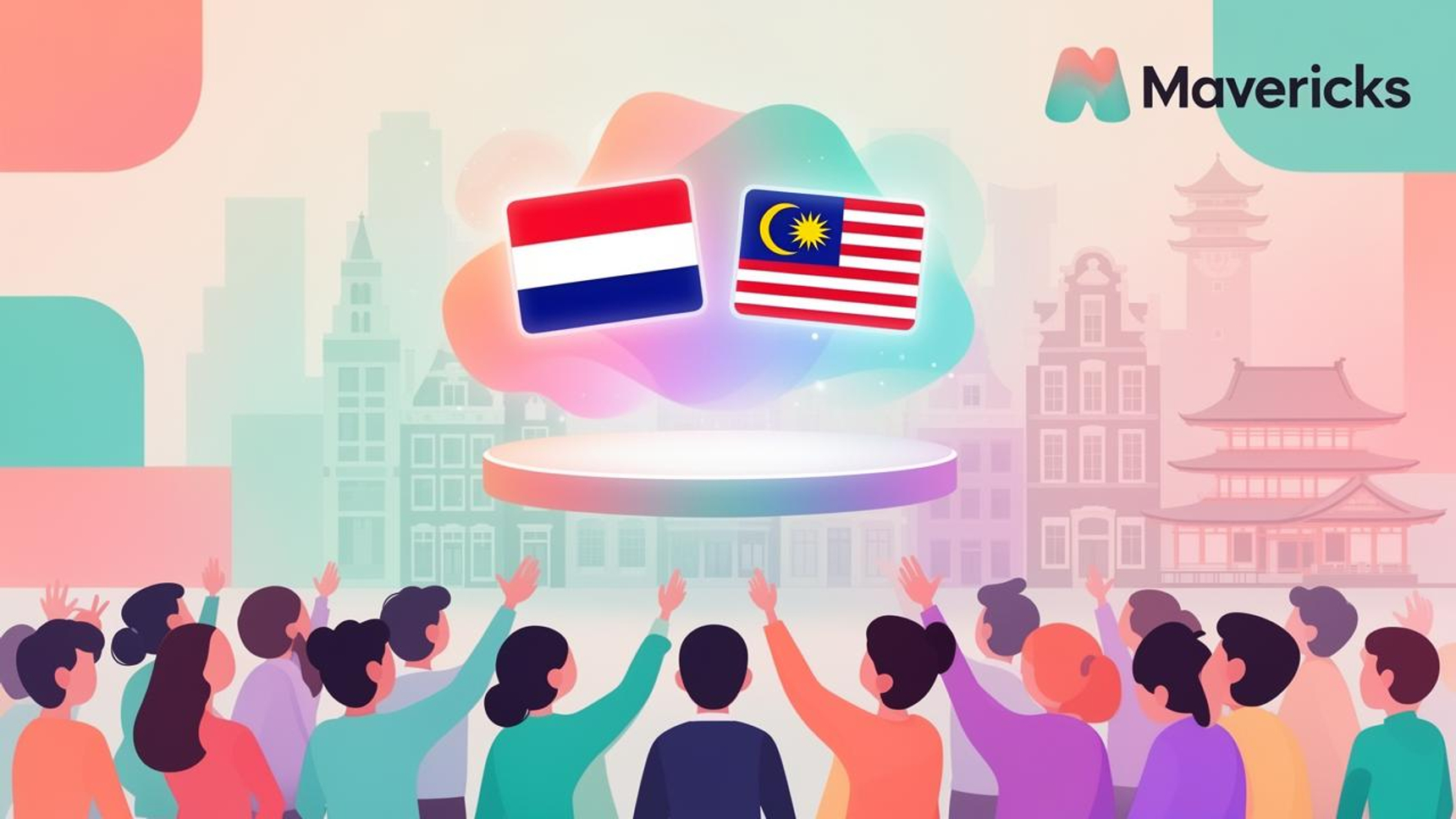
Mavericks Co., Ltd. (Headquarters: Bunkyo-ku, Tokyo, President: Shota Okuno), which provides the AI video generation service “NoLang,” announced on July 7, 2026 that it has added Dutch and Malay as new output languages for video generation. This follows the addition of Turkish language the previous day, and now we have established a system that allows videos with local language narration and subtitles to be generated directly from Japanese material without the need for a translation agency or voice actor. More than 700 Japanese companies have bases in the Netherlands, and as the cross-border e-commerce market continues to grow in Malaysia, it is attracting attention as an option to streamline the dissemination of information across language barriers.
■ Netherlands and Malaysia: Growing need for local language videos
According to data from the Japan External Trade Organization (JETRO), the number of bases established by Japanese companies in the Netherlands reached 701 as of October 2024, almost doubling in the 10 years since 2014. As an important market that is often chosen as a European regional headquarters, disseminating IR information and product introductions in Dutch is essential for building relationships with local employees, business partners, and investors.
Meanwhile, Malaysia’s e-commerce market is also steadily growing. In a multi-ethnic and multilingual society, a market characteristic is that the appeal of the Malay language determines the degree of penetration among local consumers. A survey of 8,709 consumers in 29 countries by CSA Research found that 76% “prefer to buy products where information is available in their native language,” and 40% “don’t buy from websites that are only available in another language.” Even in different cultural regions, such as the Netherlands in Western Europe and Malaysia in Southeast Asia, the importance of local language content is a common issue.
However, localizing videos and documents by outsourcing to translation companies or recording narrations was a huge burden in terms of both time and cost, creating a hurdle for simultaneous expansion into multiple markets.
■ Generate multilingual videos from Japanese materials with one click
With this update, users can now create videos in which their avatar explains content in the target language by simply selecting “Dutch” or “Bahasa Melayu” from the “Language Settings” menu on NoLang’s video generation screen. This is available for all video generation modes in NoLang, including text input, PDF materials, and audio files.
Upload a script or PDF material created in Japanese, set the output language to Dutch or Malay, and a video with local language script, narration, and subtitles will be generated directly. It also supports PDF-based video generation modes such as “ask for presentation of materials,” “summarize materials,” and “analyze materials,” allowing you to instantly develop existing Japanese materials such as financial results materials and product materials into explanatory videos for the Netherlands and Malaysia.
Additionally, generated videos can be converted to Dutch or Malay in one click using the convert button on the viewing screen, allowing you to leverage your existing video assets for multilingual expansion.
When it comes to subtitle display, we use fonts that are compatible with the Latin script of Dutch and Malay, so characters are displayed correctly without missing or distorted characters. In addition, NoLang has a mechanism that automatically adjusts the narration playback time and video length according to the standard number of characters per minute for each language, preventing unnatural dragging and rushing in languages such as Dutch and Malay, and generates videos with a natural tempo.
■ Three use cases: from IR disclosure to cross-border EC
With the addition of Dutch and Malay, NoLang has created an environment that can deliver immediate results for the following use cases:
The first is the production of IR videos and explanatory videos for companies expanding into the Netherlands. By uploading Japanese financial results and investor presentation materials and selecting Dutch as the output language, you can create IR videos for local shareholders, business partners, and investors. By inputting introductory materials for your product or service, you can directly localize them as an introductory video with Dutch narration and subtitles, eliminating the need to outsource to a translation company or arrange for narration recording each time.
The second project is the production of product introduction videos for cross-border e-commerce targeting the Malaysian market. By simply inputting existing materials such as product specifications and product catalogs, you can create product introduction videos with Malay narration and subtitles, and use them as is on product pages on e-commerce sites and social media advertisements.
Third, create multilingual onboarding videos for local employees and business partners. By uploading existing Japanese manuals and guides and switching the output language to Dutch or Malay, you can use them as introductory instruction videos for local staff. Information that was previously hidden by language barriers can now be provided in local languages, representing a meaningful change for both the growing company and the local community.
■ Language expansion with addition of Turkish language, towards multilingualization of video infrastructure
Just one day ago, on July 6th, Mavericks added Turkish as an output language for NoLang. Turkey’s population is approximately 88 million people, and the e-commerce market is rapidly expanding, growing 52.2% year-on-year, and the B2C e-commerce market is predicted to reach $11.7 billion (approximately 1.9 trillion yen) by 2029. According to a JETRO survey, more than 80% of Japanese companies operating in Turkey expect to become profitable, and 49.1% plan to expand their business within the next one to two years, indicating that the market is expanding. Japanese companies’ willingness to invest.
NoLang is an AI video generation service from Japan that has exceeded 200,000 registered users and over 100 companies since its release in July 2024, and is equipped with assets such as over 100 avatars and over 300 types of voices. Generate videos in just seconds by inputting text, PDF, pptx materials, website URLs, images, or audio/video files.
With the addition of Dutch and Malay, we now support three new languages, including Turkish. Mavericks will continue to gradually expand its support for languages with high user needs and the native languages of the foreign community whose presence is rapidly increasing in Japan, positioning it as a “multilingual video production infrastructure” mainly in Japan and Asia, and plans to support the dissemination of information that transcends language barriers.


