

Deep learning models, such as those used in medical imaging to help detect diseases and abnormalities, must be trained with large amounts of data, but often there isn't enough data to train these models, or the data is too diverse.
Ulugbek Kamilov, an associate professor of computer science and engineering and electrical and systems engineering at the McKelvey School of Engineering at Washington University in St. Louis, along with doctoral students Shirin Shoushtari, Jiamin Liu and Edward Chandler in his research group, developed a way to get around this common problem in image reconstruction. The team will present their results this month at the International Conference on Machine Learning in Vienna, Austria.
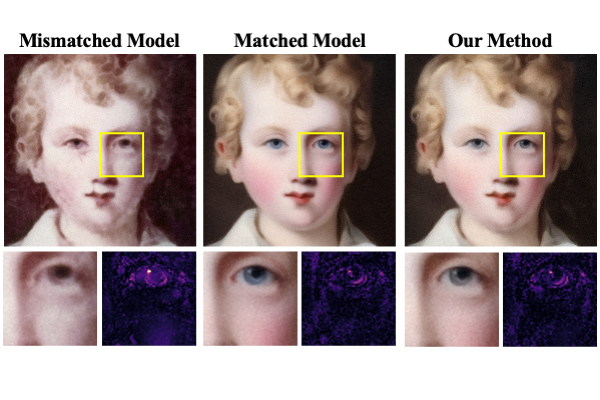
For example, the MRI data used to train a deep learning model may come from different vendors, hospitals, equipment, patients, or body parts imaged. Applying a model trained on one type of data to other data can introduce errors. To avoid these errors, the team employed a widely used deep learning approach called plug-and-play priors, which accounts for changes in the data used to train the model and adapts the model to new incoming data sets.
“With our method, it doesn't matter if you don't have a ton of training data,” Shoushtari says. “Our method allows us to adapt our deep learning models with a small amount of training data, no matter which hospital, which machine, or which part of the body the images are from.”
For more information, visit the McKelvey School of Engineering website.


