

Because future events such as weather or satellite orbits are calculated in small time steps, calculations must be efficient and as accurate as possible at each step to avoid accumulating errors. A team at Kobe University has introduced a new way to use deep learning to create customized and accurate simulations that are more computationally efficient while respecting the laws of physics.
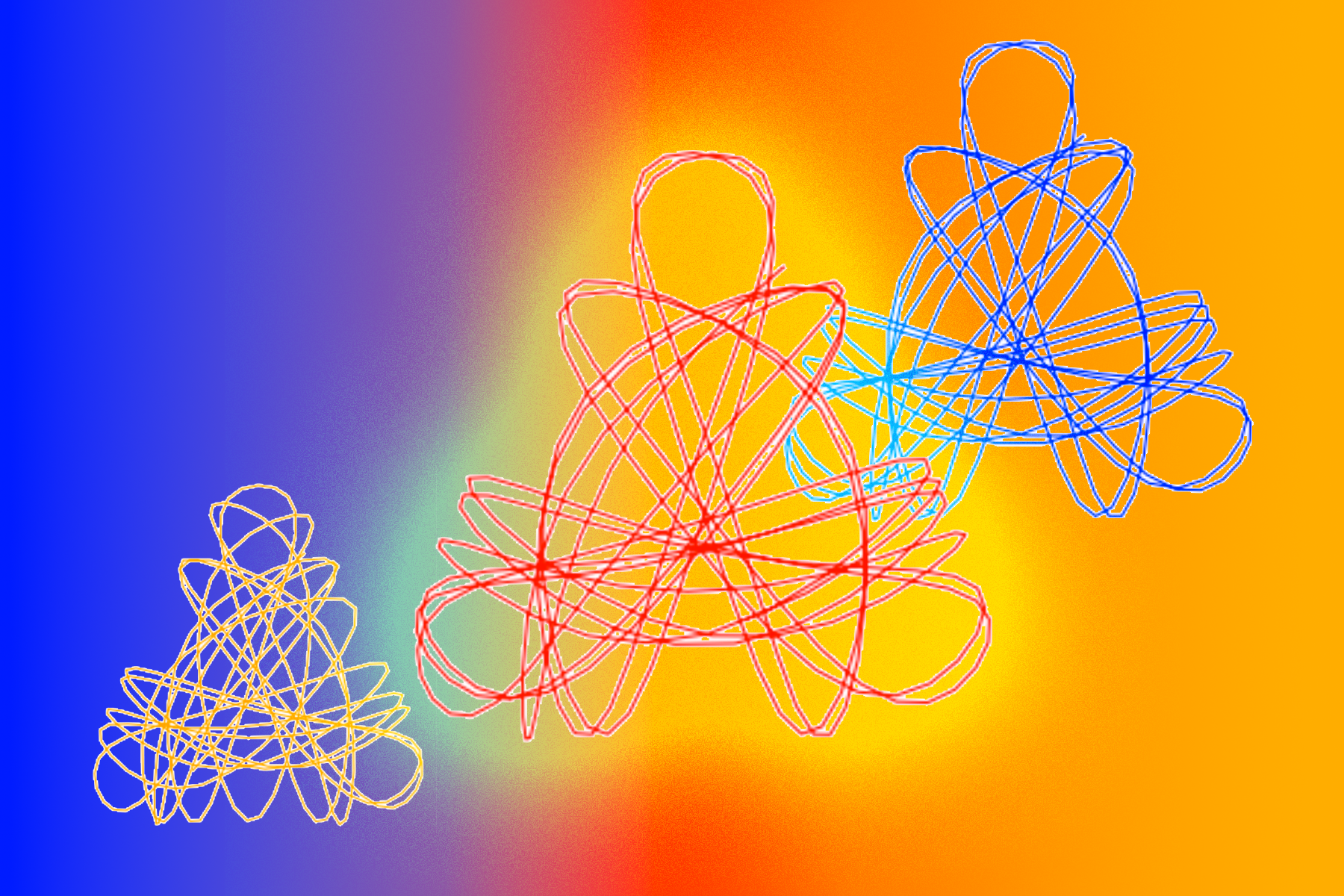
To simulate the behavior of physical systems more accurately than ever before, a team led by Professor Ryuji Yaguchi of Kobe University has developed an approach that can learn physically accurate calculation methods based on a wide range of target data (blue: ground truth, yellow: previous accurate simulation, red: new approach). © Kobe University (CC BY-SA)
From studying the behavior of atoms to setting the orbits of spacecraft, from developing materials to predicting the weather, the modern world relies on computer simulations. Since the computation proceeds in time steps and each step is only an approximation, even the smallest inaccuracies lead to significant errors on larger time scales. Takaharu Yaguchi, a machine learning expert at Kobe University, explains, “Recently, deep learning techniques have begun to be used, but they often violate the laws of physics required for accuracy. Traditional physics simulations may be more accurate, but they are very time- and resource-intensive.”
Mr. Yaguchi has 20 years of experience developing physics simulations that uphold principles such as the law of conservation of energy. So, in collaboration with the Norwegian University of Science and Technology, he was looking for an approach that combines the accuracy of physics-respecting methods with the efficiency of deep learning.
in 39th Annual Conference on Neural Information Processing Systems (NeurIPS 2025) Yaguchi's team now announces that they have discovered a way to learn conservation of energy behavior from target data and thus perform highly accurate timestep calculations. And not only did they show mathematically that their method obeys important physical laws, but they also demonstrated the superior accuracy of their method in sample simulations of a wide range of typical physical systems. “The method created in this way provides a degree of accuracy for simulating long-term predictions of various phenomena with chaotic behavior that are difficult for humans to manually design. Of particular importance is that this approach yields methods tailored to the system of interest, from materials development to weather prediction,” Yaguchi explains.
The researchers also considered the computational resources required. Their new approach was found to take only about 70% of the computation time of the next most accurate traditional calculation method. Yaguchi said, “Thus, our proposed approach can compute more accurate solutions in less time, including the time required to generate test data and train a model based on that data.”
Professor Yaguchi looks to the future with great expectations, saying, “If we can give this method an additional property called 'simplexity,' we may be able to run simulations of energy storage systems almost completely error-free.Creating such a method was previously thought to be impossible, but our approach may make it possible.''

Simulation of stellar motion in a plane using the Enon-Heil model as an example: Compared to various alternative simulation approaches (third to sixth from the left), the approach developed by Takaharu Yaguchi and his team (second from the left) is closest to the true long-term behavior of the physical system (far left). This can also be seen as the least error (far right) (the colors of the “Global Error” plot correspond to the colors of the various model plots). © E. Celledoni et al. Advances in neural information processing systems 2025 (DOI TBA) (CC BY-SA)
Acknowledgment
This research was funded by the Japan Science and Technology Agency (grants JPMJCR1914, JPMJCR24Q5, and JPMJAP2329), the Japan Society for the Promotion of Science (grant 25K15148), and the National Institute for Fusion Science (grant NIFS25KISC015). This research was carried out under the Horizon Europe MSCA staff exchange project “REMODEL – Research Exchange in Mathematics for Deep Learning with Applications” and the RIKEN Center for Innovative Intelligence, in collaboration with researchers from the Norwegian University of Science and Technology.
original publication
E. Ceredoni Others.: UEPI: Universal Energy Behavior Conservation Integrator for Energy Conservation/Dissipation Differential Equations. Advances in neural information processing systems (2025). Doi:
Released on EurekAlert!
Deep learning makes simulations more accurate than ever
inquiry
For inquiries, please contact gnrl-intl-press.[@]office.kobe-u.ac.jp


