
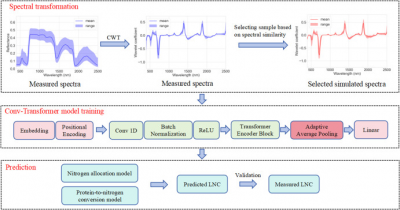
This approach significantly improves the reliability and transferability of nitrogen assessments across multiple crop species by combining plant radiative transfer theory with deep learning and hyperspectral reflectance data.
Nitrogen is a basic nutrient for plants and forms the backbone of proteins, chlorophyll, and nucleic acids. Its concentration in leaves directly reflects photosynthetic capacity and growth potential. Traditional nitrogen measurements rely on destructive sampling and laboratory chemical analysis, which is costly and time-consuming. Hyperspectral sensing provides a non-destructive alternative by linking nitrogen-related biochemical properties to spectral absorption signatures. However, existing approaches face trade-offs. Empirical models require extensive field data and often fail when applied to new environments. Physically based models are more portable, but struggle with incorrect position flips. Hybrid methods combine both strategies, but generally suffer from “domain shifts” where the simulated spectra used for training differ from real-world measurements.
a study (DOI: 10.1016/j.plaphe.2025.100125) Published in plant phenomics An October 10, 2025 announcement by the team of Daoliang Li and Kang Yu from China Agricultural University and Institute of Precision Agriculture provides a promising path to more rapid and non-destructive monitoring of crop nitrogen status.
In this study, we systematically evaluated methods for estimating leaf nitrogen content (LNC) from hyperspectral reflectance using a combination of spectral transformation, parametric and nonparametric modeling, and cross-crop validation. First, the simulated directional hemispherical reflectance (DHRF) spectrum and the measured bidirectional reflectance (BRF) spectrum were processed using continuous wavelet transform (CWT) and first derivative (FD) to reduce the mismatch caused by specular reflection and domain shift. The transformed spectra showed that the difference between simulated and measured data was significantly reduced, especially in the visible and near-infrared regions, and the main absorption features were enhanced, improving the comparability of the spectra. Based on these transformed spectra, parametric regression models using 30 vegetation indices (VIs) were tested. When trained on the full simulated dataset, some VIs derived from the nitrogen allocation model (e.g., GARI, GNDVI, GRVI, CI800,550) achieved moderate accuracy, but all VIs performed poorly for the protein-to-nitrogen conversion formulation. When the regression model was recalibrated using a representative subset of simulated samples (T100 dataset), the LNC estimation accuracy improved significantly, with indices such as SR708,775 reaching RMSE=0.303 gm⁻² and R² = 0.494, demonstrating that sample representativeness exceeds pure sample size for parametric approaches. We then evaluated a nonparametric hybrid method by combining machine learning or deep learning models with spectral transformation. Across simulated datasets, deep learning models generally performed better than traditional machine learning models, with Conv-Transformer achieving the best performance among hybrid methods and outperforming physically-based inversion. Training on the T100 dataset further improved the accuracy of Conv-Transformer (RMSE = 0.247 gm⁻², R² = 0.665), exceeding the results obtained using the full simulation database. Finally, validation between ablation and cropping demonstrated that both the spectral similarity-based sample selection strategy and the modified Transformer architecture synergistically contribute to improved performance. Consistent improvements were observed for maize, wheat, rice, and sorghum, confirming that the DeepSpecN framework effectively mitigates domain shifts, enhancing the accuracy and robustness of LNC predictions across different crops.
The results demonstrate that accurate foliar nitrogen estimation is possible even in situations where data are lacking, without the need for costly on-site calibration. This feature is particularly valuable for precision agriculture, where timely nitrogen diagnostics can support optimization of fertilization, reduce environmental pollution, and improve crop yields. Because this approach relies on leaf-scale bidirectional reflectance, it is more practical than integrating sphere measurements and is well suited for routine agricultural monitoring and technology transfer.
###
References
Toi
10.1016/j.plaphe.2025.100125
Original source URL
https://doi.org/10.1016/j.plaphe.2025.100125
Funding information
This research was supported by the “AmAIzed” project funded by AgroMissionHub, the National Natural Science Foundation of China (grant number 32373186), and the CAU-TUM joint doctoral training program.
About plant phenomics
plant phenomics is dedicated to publishing new research that advances all aspects of plant phenotyping from the cellular to the plant population level using innovative combinations of sensor systems and data analysis. Plant Phenomics also aims to connect phenomics to other scientific areas such as genomics, genetics, physiology, molecular biology, bioinformatics, statistics, mathematics, and computer science. plant phenomics Therefore, there is a need to contribute to the advancement of plant science and agriculture/forestry/horticulture by addressing important scientific challenges in the field of plant phenomics.


