

Main points
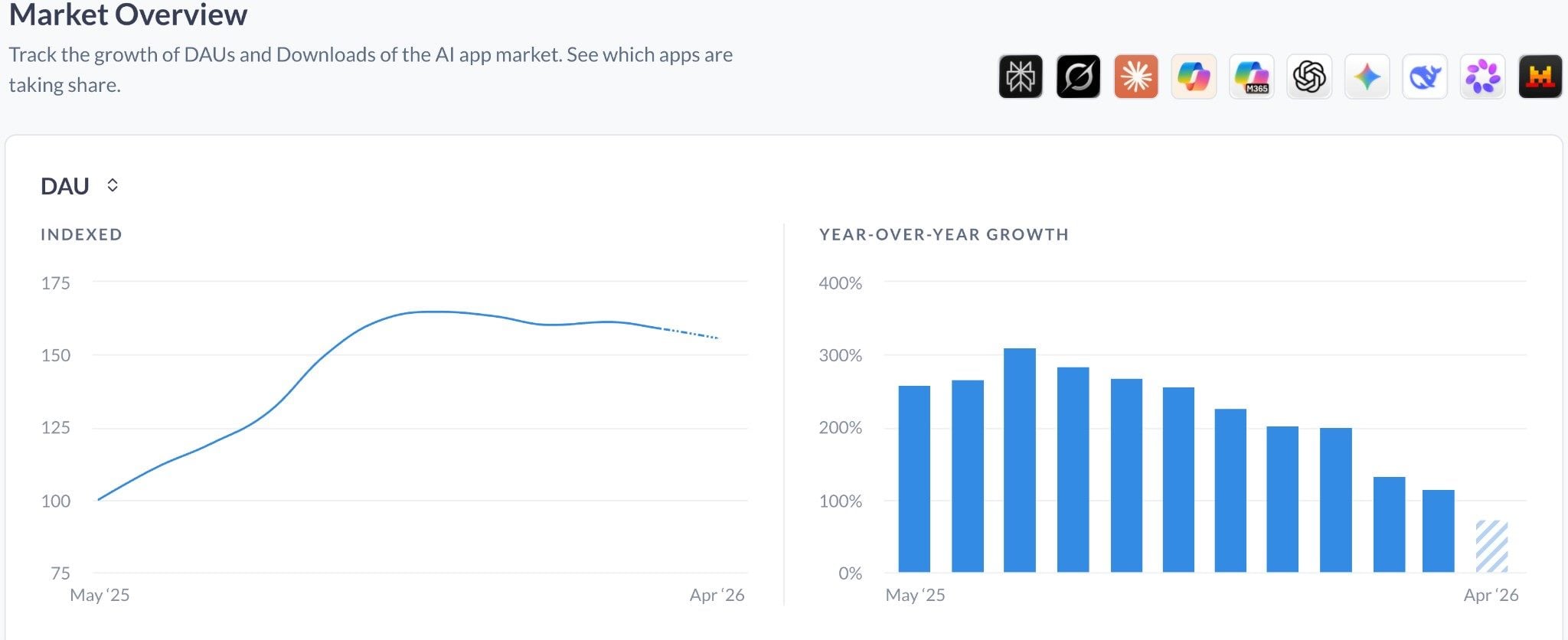
- Consumer AI growth slows. Despite accelerating enterprise AI adoption, growth in daily active users of chatbots has leveled off.
- Spending on enterprise AI is skyrocketing. Cloud and AI infrastructure providers continue to experience significant growth related to enterprise demand.
- Consumer use cases remain elusive. Outside of ChatGPT, AI still lacks a mainstream consumer breakout application with continuous engagement.
Late last month, the market soared after OpenAI’s disappointing revenue numbers were revealed in the Wall Street Journal. The company is hurtling toward an (inevitable) $1 trillion-plus IPO, and any flaw in its story will cause a small panic.
But once the dust settled, the larger underlying story baked into the numbers received little attention. That means consumer AI may have reached a plateau.
table of contents
Consumer AI FAQ
Editor’s note: Key questions about the slowdown in consumer AI adoption and the continued rise of enterprise AI.
Cracks begin to appear in the consumer AI growth story
The current moment in generative AI began with the consumer application of ChatGPT, but the technology is still struggling to find its true self in consumer applications, and even ChatGPT’s breakneck growth appears to be fading. According to the magazine’s report, OpenAI missed its goal of 1 billion ChatGPT active users by the end of 2025, and may still be short of that number (it reported 900 million weekly active users in February of this year). Across chatbots, daily active user growth has leveled off, according to third-party analytics companies like Apptopia.
“Including April, DAUs have declined in four out of the last five months,” Adam Blacker, director of communications at Apptopia, told me.
Enterprise AI continues to accelerate
Generative AI apps for the enterprise are gaining popularity in fields such as law, healthcare, and software development, but the corresponding consumer breakout has yet to materialize. The widespread use of ChatGPT is certainly an exception, but otherwise the technology hasn’t translated into the series of consumer hits that many initially expected. For example, there are no mainstream generative AI companions, fitness apps, life coaches, or fantasy adventure games.
Compared to the boom in AI for businesses, progress in AI for consumers has been uneven, and the contrast was starkly illustrated in the earnings reports of major tech companies in late April. If your company owns the infrastructure that supports enterprise AI, you’re sitting pretty. Amazon reported 28% growth in its Amazon Web Services division, up from 17% to 18% in recent quarters. “The last time we saw growth at this clip, AWS was about half the size,” said Amazon CEO Andy Jassy. Meanwhile, Google Cloud Platform grew by 63% and Microsoft Azure by 40%.
The consumer side of tech companies’ profits is a different story. Meta told investors it would spend more money than expected (up to $145 billion this year) in pursuit of “individual superintelligence,” but the market punished them, shedding 8.5% in a single day late last month.
Apple, notorious for its AI “failures,” felt no pain after consumer products like the iPhone and MacBook Neo delivered impressive results. For now, it seems wise for Apple to refrain from investing heavily in training the underlying models in order to build less-desired consumer applications.
Related article: 5 things to fix before extending AI in your customer experience
Trends in consumer and enterprise AI
A comparison of where momentum is increasing and where momentum is slowing down.
| category | current trends | key signal |
|---|---|---|
| Consumer AI apps | slowing growth | Daily active user growth flattens out across chatbots |
| Adoption of ChatGPT | Still huge but cool | OpenAI missed its target of aggressive active users |
| Enterprise AI | sudden acceleration | Cloud infrastructure growth skyrockets for Amazon, Google, and Microsoft |
| Spending on AI infrastructure | aggressive expansion | Big tech companies continue to increase investment commitments in AI |
| Mainstream consumer AI apps | Limited breakout success | Few enduring consumer AI experiences surpass chatbots |
| agent AI tools | growing rapidly | Coding-focused AI applications are showing strong adoption momentum |
Novelty alone cannot sustain consumer AI
Until now, consumer AI has grown rapidly primarily due to novelty. ChatGPT’s Studio Ghibli moment generated a lot of interest and attracted many new users to the power of generated images, but that excitement eventually fizzled. OpenAI’s enhanced voice mode for ChatGPT has also caused a spike in user numbers, but the company still has work to do to realize the feature’s potential.
This does not mean that the age of AI is losing momentum. Adoption of new agent apps such as Codex and Claude Code is rapidly increasing. Anthropic is on track to make more than $30 billion this year on the back of Claude’s coding abilities.
And OpenAI’s latest GPT-5.5 model doubled Codex’s revenue in less than a week. Perhaps these “super apps” will capture the attention of the masses and become as standard as phones and laptops. But for now, the consumer slowdown is interesting.
 Find out how to join our contributor community.


