Computational Flavors Market Outlook 2025 to 2035
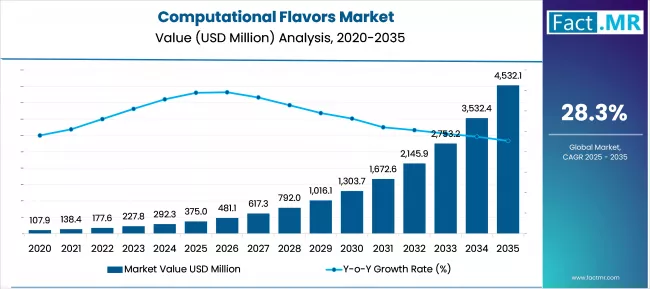
The global computational flavors market is expected to reach USD 4,532 Million by 2035, up from estimated value of USD 375 Million in 2025. During the forecast period 2025 to 2035, the industry is projected to expand at a CAGR of 28.3%.
Rising demand for personalized, clean-label foods, the need to accelerate R&D and cut development costs, and AI, machine learning, big data advancements drive the market. They focus on product attributes and features for predictive flavor modeling, optimized sensory outcomes, and product innovation scalability.
Quick Stats for Computational Flavors Market
- Industry Value (2025): USD 375 Million
- Projected Value (2035): USD 4,532 Million
- Forecast CAGR (2025 to 2035): 28.3%
- Leading Segment (2025): Artificial Intelligence (AI) (25% Market Share)
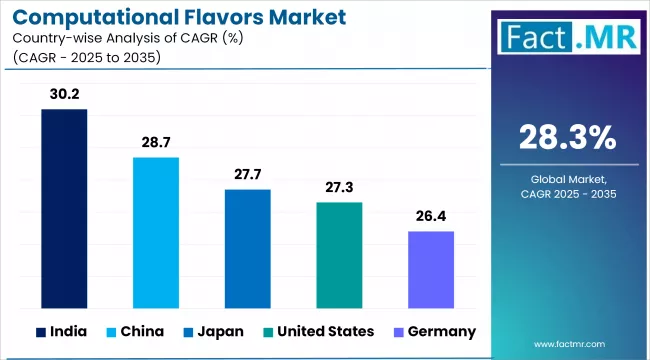
- Fastest Growing Country (2025-2035): China (28.7% CAGR)
- Top Key Players: are Givaudan, International Flavors & Fragrances (IFF), Symrise AG, and Firmenich (DSM-Firmenich)
What are the key factors driving growth in the Computational Flavors Market?
Flavor development utilizing artificial intelligence (AI) accelerates research and development timelines, improves reproducibility, and lends itself to the ease of customizing flavor profiles across a spectrum of taste preference. The implementation of machine learning, big data, and cloud analytics provides faster product innovation, reduces costs, and allows for product differentiation.
Flavor manufacturers and companies are using computational solutions and customer engagement and collaborating in novel foods and beverage applications and food systems in response to consumer demand, as they focus on systematic development of new products, speeding up the product development cycle, and improving market competitiveness.
What are the key trends driving growth in the Computational Flavors market?
Some of the key trends being pursued are explorations in generative AI for new flavor design; predictive modeling methods for developing sensory optimization and integration with natural ingredient databases. Such enhancement R&D efficiency through cloud collaborative platforms, AI-augmented taste dissimulations, and machine learning algorithms. Increasing focus on flavors is plant-based, exotic, and functional. There is an increased partnership between startups and some big players in the industry to employ AI tools in the innovation space for faster development of personalized and sustainable flavor solutions for global markets.
What factors hinder the growth of the Computational Flavors market?
Regulatory ambiguities related to AI-generated flavors and challenges in maintaining clean-label standards continue to pose significant obstacles. Smaller manufacturers probably will not have the budgets necessary to invest in computational platforms. Also, consumer skepticism toward AI-generated flavors and the need for taste quality validations can inhibit uptake of the flavor solutions. However, despite an impressive innovation potential and the demand for personalized flavor solutions, these elements deter market growth.a
What are the key regional trends driving the Computational Flavors Market growth?
North America
North America is going to be the big market for flavor innovation because it has an advanced R&A infrastructure, a totally extensive AI integration, and demonstrated flavor houses. Growth is driven by the demand for personalized, clean-label, and plant-based flavors, supported by strategic partnerships, technology investment, and legislation supportive of computational flavor innovation.
East Asia
For East Asia, especially China and Japan, innovation is much rapid because of increasing consumer demands for functional, personal, and clean-label foods. The aspect furthered by AI-oriented flavor solutions, government-backed innovation programs, and growing food manufacture capabilities could create an area of development for computational flavor technologies that are applied to flavor creation in the regions.
Western Europe
Western Europe has a highly developed flavor-house infrastructure, a very developed ecosystem of food innovation, and good regulatory support. Companies in this part of the world develop AI-informed flavor design with predictive modeling combined with sustainability, responding to conscious consumer demands for new kinds of clean-label and plant-based flavors across food and beverage sectors.
Country-wise Outlook
Innovation and R&D Leadership Drive the United States’ Computational Flavors Market
The U.S. market advances rapidly due to its great R&D infrastructure, the large-scale adoption of AI in food and beverage innovation, and favorable regulatory environments. Major flavor houses and startups are partnering with universities and manufacturers to create personalized, clean-label, and plant-based flavor solutions.
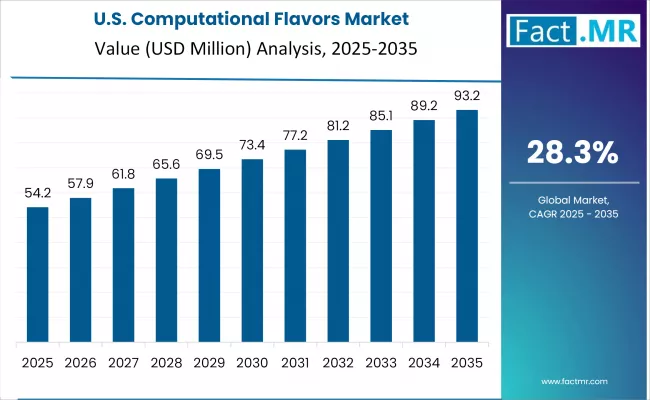
Strategic collaborations, equity investments, and advanced computational platforms that create a rapid acceleration in predictive flavor modeling, novel formulation design, and large-scale commercialization are placing the U.S. at the forefront, globally, of flavor innovation and commercialization computationally.
Rapid Industrial Expansion and AI Integration Propel China’s Computational Flavors Market
With the escalating demand for functional and personalized foods, the expanding plant-based foods market, and government support to accelerate AI-driven innovation, the growth of markets within China is assured. Flavor houses and technology start-ups leverage computational tools for flavor optimization, fast-tracking R&D, and shortening time to production. By integrating with cloud services and big data analytics, manufacturers can respond rapidly to consumer trends, establishing China as the dominantly-growing center of computational flavor technologies in the region of Asia.
Technological Advancement and Digital Innovation Shape Japan’s Computational Flavors Market
Precision formulation, advanced digital infrastructure, and the incorporation of AI-assisted flavor development are what drives the market in Japan. Local companies work together with food manufacturers to bring personalized and novel flavor solutions to beverages, confectionery, and functional foods.
A strong ecosystem of robotics and automation with support from various innovation programs run by the state strengthens predictive modeling, ingredient optimization, and R&D workflow efficiencies, positioning Japan as one of Asia’s best centers for computational flavor innovation and application.
Category-Wise Market Outlook
Artificial Intelligence (AI) Leads Technology Adoption
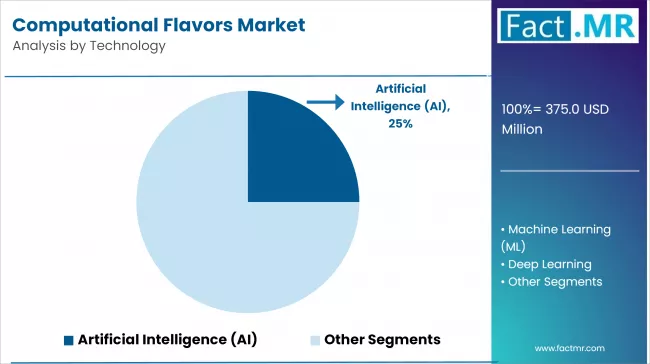
There will be a continuing focus on AI as the rapidly-growing technological sub segment. This is probably true because it uses predictive flavor modeling, rapid formulation optimization, and the analysis of large sensory and ingredients datasets. It is, however, the type of technology that both established flavor houses and startups want to adopt, because it can forecast consumer tastes and flavor interactions and speed up R&D cycles.
Global trends in flavor development are increasingly centered on personalized, clean-label, and plant-based products, driven by the integration of computational technologies and their scalable applications across food and beverage innovation.
Sweet Flavors Drive Flavor Type Growth
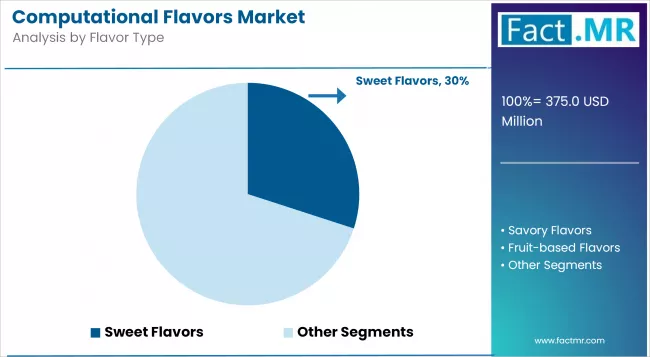
Currently, sweet flavors are experiencing the dominant growth, propelled by robust consumer demand in indulgent, functional, and plant-based confectionery products. It is the popularity of sugar alternatives along with healthier sweeteners and clean-label ingredients that inspires flavorists to turn to computational tools to thereby optimize taste while health-conscious formulations remain intact.
These advanced models in AI predictive modeling really have enabled a consistent appeal across products that would drive innovation and acceptance by users in the confectionary, beverages, and bakery categories.
Cloud-Based Solutions Accelerate Deployment Growth
The dominantly growing segment is cloud deployment models which provide remote access, collaborative development, and real-time updates for all global R&D teams. These solutions enable flavor houses and manufacturers to leverage computational tools without significant upfront infrastructure investments.
They also facilitate seamless integration of artificial intelligence with big data analytics, offering scalable and efficient flavor development capabilities. Such platforms complement cross-regional collaboration as well as speed flavor innovation. They enable perpetual market and sensory feedback learning, and that makes them the preferred way of deploying future computational flavor solutions.
Competitive Analysis
Competitive Outlook: Computational Flavors Market
The computational flavors market is extremely competitive, with established flavor houses such as Givaudan, IFF, Symrise AG, Firmenich, Kerry Group, Takasago International, Sensient Technologies, MANE, and McCormick & Company, each possessing decades of flavor development experience. The companies are using AI, machine learning, and predictive analytics to design flavors based on consumer preferences, optimize sensory experience, and speed up go-to-market approaches.
They have strong market ranks because of several investments in research and development, proprietary flavor databases, and strategic alliances with manufacturers in the food and beverage industry along with technological partners. All these give them the foothold to fulfill demand for personalized flavors and attractive labels that are clean and plant-based from different parts of the world.
In order to create new flavors, smaller and more specialized companies such as Trilogy Flavors, Analytical Flavor Systems, FlavorWiki, Tastewise, Osmo, NotCo, and Aromatech are using generative AI, predictive modeling, and rapid prototyping. Their approaches are focused on technology collaborations, regional expansions, and specialized product offerings. In order to advance computational flavor solutions to the next level, these businesses collaborate to create a start-up ecosystem that navigates rapid innovation, precise flavor design, scale, and customer experience.
Key players in the Computational Flavors market are Givaudan, International Flavors & Fragrances (IFF), Symrise AG, Firmenich (DSM-Firmenich), Kerry Group, Takasago International, Sensient Technologies, MANE, McCormick & Company, Trilogy Flavors, Analytical Flavor Systems, FlavorWiki, Tastewise, Osmo, NotCo, Aromatech.
Recent Development
- In September 2024, McCormick partnered with IBM Research to utilize AI in creating innovative new spice flavors. The AI system analyzes decades of spice data to develop base formulas and incorporates unique ingredients and trend forecasts, significantly reducing the time required for developing new spices.
- In June 2024, Wageningen Food & Biobased Research introduced FLAVOUR-AI, an AI-powered fermentation screening approach. FLAVOUR-AI enables organizations to efficiently utilize fermentation processes to improve flavor volatile profiles, advancing the development of natural and clean-label flavors in food products.
Fact.MR has provided detailed information about the price points of key manufacturers of Computational Flavors market positioned across regions, sales growth, production capacity, and speculative technological expansion, in the recently published report.
Methodology and Industry Tracking Approach
At least 250 representatives from each of the surveyed countries were among the more than 10,000 respondents in the Fact.MR survey of the Computational Flavors Market 2025. The remaining one-third of respondents were industry experts, technology developers, regulatory specialists, consultants, and advisors for AI solutions, while the other two-thirds were end users, such as food and beverage producers, flavor houses, and R&D teams.
Adoption trends, AI integration, predictive flavor modeling, regulatory frameworks, and innovation trends influencing next-generation flavor development were all examined in the survey, which was carried out from September 2024 to August 2025.
More than 250 secondary sources, including patents, product launches, industry standards, sustainability reports, and market research, were considered for a comprehensive analysis using advanced modeling and predictive analytics. Historical assessments of adoption trends, technological maturity, and evolving regulatory requirements were conducted starting in 2018. The insights, strategies, and long-term recommendations in the 2025 report assist stakeholders in navigating both new opportunities and challenges in the rapidly evolving market for computational flavors.
Segmentation of Computational Flavors Market Research
-
By Technology :
- Artificial Intelligence (AI)
- Machine Learning (ML)
- Deep Learning
- Generative Algorithms
- Big Data Analytics
- Cloud-based Platforms
-
By Flavor Type :
- Sweet Flavors
- Savory Flavors
- Fruit-based Flavors
- Dairy & Cream Flavors
- Beverage Flavors
- Exotic & Novel Flavors
-
By Deployment Model :
- On-Premises Solutions
- Cloud-Based Solutions
- Hybrid Solutions
-
By Application :
- Food & Beverages
- Nutraceuticals
- Pharmaceuticals
- Personal Care & Cosmetics
- Fragrances & Perfumes
-
By End User :
- Flavor Houses
- Food & Beverage Manufacturers
- Ingredient Suppliers
- R&D Laboratories
- Fragrance Developers
-
By Region :
- North America
- Latin America
- Western Europe
- Eastern Europe
- East Asia
- South Asia & Pacific
- Middle East & Africa