

Both natural language processing and machine learning are subtopics within the broader field of AI, and although the two are often mentioned together, there are also crucial differences.
Machine learning (ML) is an essential field that has driven many AI advancements, including important developments in natural language processing (NLP). While there is some overlap between ML and NLP, each field has its own unique capabilities, use cases, and challenges.
ML is essential to many AI applications as it uses algorithms to teach computer systems how to perform tasks without being directly programmed, whereas NLP specializes in enabling computer systems to understand and generate human language, and often relies on ML algorithms during training.
What is Machine Learning?
ML is a subfield of AI that focuses on training computer systems to understand and use data effectively. Computer systems use ML algorithms to learn from historical data sets by finding patterns and relationships in the data. One key feature of ML is its ability to improve computer performance over time without explicit programming, making it well suited to automating tasks.
While ML has recently become more popular, especially with the rise of generative AI, the practice has been around for decades. ML is generally considered to date back to 1943, when logician Walter Pitts and neuroscientist Warren McCulloch published the first mathematical model of a neural network. This model, along with other computational advances, paved the way for modern ML algorithms and techniques.
Types of Machine Learning
There are four main approaches to training ML models: supervised learning, unsupervised learning, semi-supervised learning, and reinforcement learning. Each learning type involves its own set of practices for data collection, data labeling, and algorithm training.

Machine Learning Use Cases
ML offers businesses multiple benefits: using ML to automate tasks saves companies time and money, and ML models can handle tasks at a scale that is too large to manage manually.
There are many different strategies and approaches to implementing ML in the enterprise. Developing ML models for an organization's specific use cases is complex and requires careful attention to detail, technical expertise, and large amounts of detailed data. MLOps, a discipline that combines ML, DevOps, and data engineering, helps teams efficiently manage the development and deployment of ML models.
Because ML tends to help us understand and leverage data, it has a wide range of use cases across industries, from healthcare to financial services, business to retail. Examples of ML use cases include:
- Make a prediction.
- Generate content.
- Classify and cluster data points.
- Power recommended engine.
- Supporting self-driving cars.
- Assists in medical diagnosis.
- Detect fraud and threats.
- Filter spam.
- Automate organizational processes.
- It complements other AI and software engineering processes.
What is Natural Language Processing?
NLP is a subfield of AI that uses a variety of techniques, including ML algorithms, to train computer systems to understand and mimic human language.
NLP teaches computers to understand natural language, paving the way for computer-human communication and making workflows more efficient. NLP helps in analyzing and deriving insights from both structured and unstructured natural language data such as emails, documents, articles, etc.
The field of NLP, like many other AI sub-fields, is commonly considered to have begun in the 1950s. One key development was in 1950, when computer scientist and mathematician Alan Turing first devised the Imitation Game (later known as the Turing Test). This early benchmark test used the ability to interpret and generate natural language in a human-like manner as a measure of machine intelligence, with its emphasis on linguistics being a key foundation for the NLP field.
Early iterations of NLP were rule-based, relying on linguistic rules rather than ML algorithms to learn patterns in language. As computers and their underlying hardware evolved, NLP evolved to incorporate more rules and eventually algorithms, becoming more integrated with engineering and ML.
The rise of ML in the 2000s saw the rise of NLP capabilities and a shift from rule-based to ML-based approaches. Now, in the age of generative AI, NLP has become more widely recognized than ever before due to the popularity of large-scale language models such as ChatGPT. NLP's ability to teach computer systems language understanding makes it ideal for use cases such as chatbots and generative AI models that process natural language input and generate natural language output.
Natural language processing technology
There are two main techniques in NLP: syntax and semantics.
Syntax-driven techniques analyze the structure of a sentence to determine patterns and relationships between words. Examples include syntactic parsing (analyzing grammatical structures), word segmentation (dividing text into words), sentence breaking (dividing blocks of text into sentences), and stemming (removing common suffixes from words).
Semantic techniques focus on understanding the meaning of individual words and sentences. Examples include word sense disambiguation, i.e. determining which meaning of a word is relevant in a particular context, named entity recognition, i.e. identifying proper names or concepts, and natural language generation, i.e. generating human-like text.
NLP is divided into two main phases. The first phase is data pre-processing, which prepares the data for analysis. Examples of data preparation techniques include:
- Entity Extractionor identify relevant information.
- Lemmatizationor returning a word to its base form. Lemma.
- Part of speech taggingor identifying words by their grammatical functions.
- Stopword removalor removing common and unimportant words. and or of.
- Tokenizationthat is, breaking down text into short units such as words, phrases, or syllables called tokens.
Once data preprocessing is complete, the second stage is algorithm development. This phase includes two main types of algorithms: rule-based and ML.
From the 1950s to the 1990s, NLP primarily employed a rule-based approach, where systems learned to identify words and phrases using detailed linguistic rules. As ML gained prominence in the 2000s, ML algorithms were incorporated into NLP, allowing for the development of more complex models. For example, the introduction of deep learning led to much more sophisticated NLP systems.
Natural Language Processing Use Cases
NLP is employed in many AI systems and tools where computers need to understand and use natural language. Below are some examples of NLP in action:
- Analysis and classification of text data.
- Grammar and plagiarism checker.
- Language generation and translation.
- Sentiment analysis.
- Spam detection.
- voice recognition.
Natural Language Processing and Machine Learning
Since the field moved away from rule-based processing, NLP often uses ML and deep learning techniques to teach computers natural language understanding.
ML and deep learning algorithms are well suited to processing large, complex text data sets. As a result, ML and deep learning form the basis of many NLP techniques. A common analogy is that ML is to NLP what mathematics is to physics, with ML being fundamental to the NLP process.
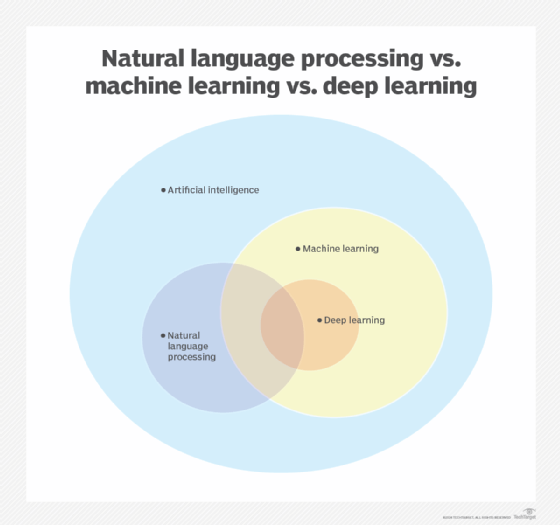
While there is some overlap between NLP and ML, especially in NLP's reliance on ML algorithms and deep learning, simpler NLP tasks can be performed without ML, but organizations looking to handle more complex tasks and achieve the best results with NLP often recommend incorporating ML.
Despite their overlap, NLP and ML also have unique characteristics that distinguish them from each other, especially in terms of applications and challenges.
application
Broadly speaking, NLP and ML have different focuses: ML trains computer systems to identify patterns in data in general, while NLP focuses specifically on patterns in language. This difference also makes their applications unique: ML has a wide range of uses, including supporting other AI processes such as NLP, while NLP has a narrower function and is centered on language-related tasks.
ML has a wide range of applications, including:
- Anomaly Detection, It involves identifying outlier entities, events, or data for evaluation.
- Business Process AutomationThis includes automating a variety of business tasks.
- Computer VisionThis involves digitizing and analyzing images to help ML models make predictions and decisions.
- Medical DiagnosisThis includes identifying medical conditions and recommending treatments.
- Predictive analytics, This involves creating models that can accurately predict events, behaviors, and trends.
- Recommendation EngineSuggest content based on user behavior.
- supply chain managementThis includes optimizing supply chain processes and dealing with disruptions.
- Threat detection, This includes identifying instances of fraud, malware, and other security threats.
In contrast, NLP offers a more limited set of language-specific applications, such as:
- Machine TranslationThis allows computer systems to translate input text from one language to another.
- Natural Language Generationenables computer systems to generate linguistic output and is the basis of many generative AI architectures, including OpenAI's GPT series of models.
- Text ClassificationClassify text into different categories based on tagging.
- Text ExtractionThis involves extracting key data and creating summaries and analyses.
assignment
ML offers many benefits and has played a major role in advancing AI in recent decades, but it also comes with its own challenges.
First, many ML models and systems are expensive. They require high-quality data, and lots of it. Collecting and labeling that data is costly and time-consuming for companies. Additionally, the complex nature of ML requires hiring ML teams of trained experts, including ML engineers, which can be another obstacle to successful adoption. Finally, ML bias can have many negative effects on companies if not carefully considered.
NLP often relies on ML algorithms and faces similar challenges related to complexity, cost, and bias, but it also faces additional challenges: the nuances of human language.
Language is complex and full of sarcasm, tone, intonation, cultural nuances, and other subtle nuances. The evolving nature of natural language makes it difficult for any system to accurately learn all of these nuances, making it inherently difficult for a system to perfect its ability to understand and generate natural language.
Olivia Wisbey is the Associate Site Editor for TechTarget Enterprise AI. She holds a BA in English Literature and Political Science from Colgate University, where she served as a peer writing consultant for the university's Writing and Speaking Center.


