



Photo provided
COLCHESTER — The Rev. Russell E. Willis, pastor of Colchester United Church, has been thinking deeply about how artificial intelligence can be used ethically in business and life.
His latest book, “AI and the Crisis of Control: How Leaders Can Reclaim Responsibility in the Age of AI,” explores the potential accountability issues that arise when leaders rely on AI without understanding its moral complexities. Willis approaches this issue as a former engineer and social ethicist who wants people to use AI in ways that support positive moral outcomes.
“Basically, it’s becoming so complex and so fast that it’s becoming increasingly difficult to have real management, real governance, real accountability,” he said.
Mr. Willis began his professional career as an engineer at Texas Instruments, where he worked on military-grade semiconductors deployed by Bell Labs and NASA. That experience led him to question the use of technology and who remains in charge of it.

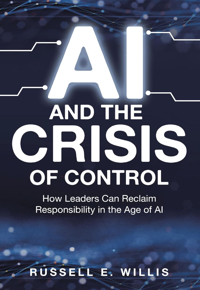
Photo provided
Although the “AI and control crisis” is aimed at leaders, the impact of AI decision-making could extend to everyday life, he said.
Willis gave the example of hiring for work, hypothesizing that a person with an ideal resume takes several years off work to care for a sick relative, then reenters the workforce. AI application screening systems could automatically filter out applicants before they are reviewed by HR professionals curious about gaps in their career timelines.
Willis said AI can cause unintended harm because it is programmed to measure success in terms of efficiency.
“In the world of AI, success is traditional success,” he says. “Our values are to go faster and more efficiently. Rather than saying that, does that really lead to human flourishing?”
To use AI responsibly, companies must consider the ethical implications of their actions and their desire to make more money.
“I basically argue that you can’t control AI, but you can live responsibly within it, and that often means saying no to certain things,” Willis said. “Just because you can do it doesn’t mean you have to do it.”
One company that recently defended its values in this way was Anthropic, an AI company that rejected a Pentagon contract that could lead to the development of autonomous weapons. Willis contrasted this with Boeing, which several years ago claimed its 737 MAX planes were mechanically sound despite multiple crashes.
“How often do companies say no to multibillion-dollar deals? That’s pretty rare. And this is an example that has to happen more often in the future because just making money is not a sufficient answer to say, ‘We’re going to do this,'” Willis said.
Willis is not anti-AI. He uses the technology in his nonprofit consulting work, but said the way accountability is measured needs to evolve.
“Our responsibility structures have to match complexity, and then we have to foster responsible imagination. If we’re going to be responsible, we have to think outside the box. We have to start thinking this way, not the old way, because otherwise we won’t have any impact within AI.”
Anyone interested in purchasing Willis’ self-published books can do so at: Amazon. He also self-publishes poetry collection“The Month Baby Came: A Collection of Poetry—Daily Prompts to Dance with Timeless Wonders.”


