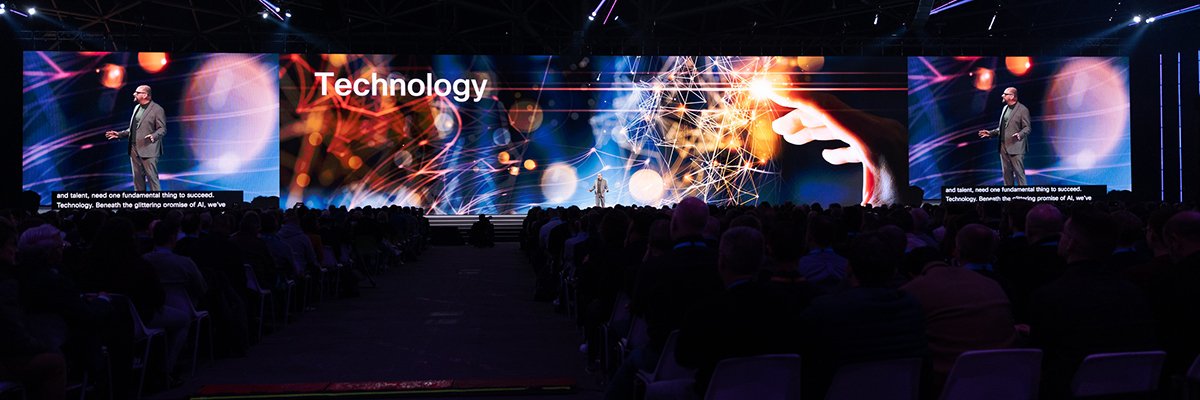
Seeking to meet the increasingly complex and pressing needs of enterprises where innovation in artificial intelligence (AI) is moving faster than ever, Cisco is expanding its ambitions for secure and reliable agent AI by announcing a series of products and services that ensure customers can move quickly and provide the infrastructure they need to deploy AI safely and reliably.
Announced at the Cisco Live 2026 Conference in Amsterdam, the new system is said to enhance the IT and networking giant’s ability to deliver networking, security, observability and sovereignty through a unified technology platform.
However, as Gordon Thomson, president of Cisco’s Europe, Middle East, and Africa (EMEA) region, emphasized, in a world defined by AI, companies that don’t lead with AI in their operations risk being left behind, and to get the most out of AI, Cisco has had to think differently about four different key areas: time, trust, people, and technology.
time is passing
“Time is one of our most valuable assets. IDC estimates that by 2030, investments in AI could generate $22.3 trillion in economic benefits. But be careful: Time is already running out. “Are we moving fast enough? Are we still operating the same way we were a year ago, two years ago, even three years ago? If so, the risks are real,” Thomson said.
“When we asked enterprise technology leaders about the changes they foresee from agenttic AI, 78% of leaders said agentic AI will significantly change the way their industries operate over the next few years. So all industries will feel this seismic shift. Few will be exempt. And 80% of leaders said agents will be essential to surviving in 2027, which is just next year,” he added.
The speed we are moving today is not fast enough. The potential of AI surrounds us, but our preparedness really needs to catch up, and soon.
Gordon Thomson, Cisco
“We all need to redefine not only the way we think, but also the DNA of our organizations, because the speed at which we are moving today is not fast enough. AI possibilities surround us, but our preparedness really has to catch up. Time is ticking. Preparation can no longer be a long-term goal. None of us can operate as we did last year.”
The executive revealed further findings from the investigation. Cisco AI Readiness IndexIt found that only 11% of organizations in EMEA said they were fully ready for AI. These companies are “already keeping their competitors in the rearview mirror,” Thomson said, noting that they are five times more likely than other companies to turn pilots into products and 60% more likely to see measurable value from investments in AI products and services.
foundation of trust
Regarding trust, Thomson said this quality is not just a value, but a foundation: “the currency that enables progress and accelerates change.” According to him, there are many layers and levels of trust. For example, security trusts could not enable an AI-driven economy that Cisco could not protect. He emphasized that AI needs to start with safety and security.
Next, he noted that trust in innovation is more important than ever. “You can trust that our innovations not only create the next big thing, but also ensure that our ecosystem is always open. We’re backwards compatible and ready for what comes next. We also deliver innovations built around our customers’ trust requirements.”
Thirdly, there was the executive trust and then the sovereign trust. The latter is about finding the right balance between flexibility and control, something Cisco has also realized is more important than ever.
talent ecosystem
Continuing his speech, Mr Thomson warned that an AI-powered economy where only a few people can participate will not be resilient. He said a key challenge for Cisco is to ensure that all organizations, all communities, and all individuals can not only participate in AI, but also reap the benefits that AI can promise.
Agent AI does not replace human potential. It unlocks human potential. Therefore, different skill sets will need to be built across the talent ecosystem as talent will increasingly work alongside AI agents.
Gordon Thomson, Cisco
“Only this ecosystem of talent will drive sustainable growth, competitiveness and shared prosperity, but our workforce is changing and we need to keep up. Agential AI is moving from a concept to a capability: it can reason, it can plan, it can act alongside people. But most importantly, agentic AI will not replace human potential; it will unlock human potential. We need to build different skill sets across the talent ecosystem as we work collaboratively and collaboratively with agents.”
AI-enabled infrastructure
Finally, Thomson talked about technology, saying that AI has brought the technology industry to a critical point in terms of infrastructure, computing, networking, security, and monitoring, noting that the infrastructure that businesses have traditionally relied on is not built for the scale and speed of future workloads. A Cisco survey found that 62% of IT leaders expect workloads to increase by 30% or more over the next two to three years, 65% say they struggle to centralize data, and more than a third are currently unable to prevent or detect AI threats.
Tomson said the technology of the future will be different. “The solution is not to pile on small new products; that only creates complexity and slows down the work. [Success] We need a platform that uses data more efficiently, more securely, and more scalably. As a result, we can now deliver AI-enabled data centers, future-proof workplaces, and digital resilience built on a foundation of secure global connectivity.
“Delivering these capabilities at pace is what we need to grow. … It’s no longer just about rolling out product features, it’s about delivering real business outcomes. We do it in the platform, not the product. We’re working fast because AI doesn’t wait. The convergence of time, technology, talent, and trust is no accident. These things are decisive. We can make AI a reality. Today, not tomorrow.”
Integrated AI platform
Key platform and service announcements at Cisco Live include three key areas that will be delivered as part of the unified platform: AgenticOps across networking, security, and observability “transforms” how IT teams reduce complexity and operate efficiently at scale. Includes updates to the AI Defense security solution and advancements to the Secure Access Service Edge (SASE) product.
Designed to power gigawatt-scale AI clusters for training, inference, and real-time agent workloads, the G300 switch is said to improve job completion times by 28% and maximize graphics processing unit (GPU) utilization, allowing users to scale out AI cluster builds. The G300 offers intelligent collective networking, which is said to increase network utilization by 33% and improve job completion time by 28% compared to non-optimized traffic. G300-powered systems are designed for AI network builders such as hyperscalers, neoclouds, sovereign private deployments, service providers, and now enterprises.
To address the diverse requirements of AI environments, Cisco has updated its Nexus One platform with a unified management plane that brings together silicon, systems, optics, software, and programmable intelligence into one integrated solution.
Nexus One’s unified fabric is said to allow customers to deploy quickly and adapt their networks as demand changes, even across multiple sites. The Cisco N9000 system serves as the common hardware for a diverse set of fabrics, including the Nexus Hyperfabric, and provides a unified management plane for centralized operations. Built-in automation and customization through application programming interfaces (APIs).
AgenticOps innovations span the entire Cisco portfolio and are designed to help automate, scale, and simplify IT operations in the age of AI. The system leverages cross-domain telemetry across applications such as Cisco Networking, Security Cloud Control, Cisco Nexus One, and Splunk. These capabilities include tools, skills, and platform enhancements across networking, security, and observability.
In March, native Splunk platform integration will enable customers to analyze network telemetry directly where the data resides, without having to move the data to an external platform. This is an essential feature for sovereign cloud deployments and compliance-sensitive environments where data locality is paramount.
In the security space, AI Defense enhancements are the largest-ever update to the product, bringing AI supply chain governance and runtime protection to the use of agent tools. This is claimed to reduce the risk of infringement and tampering. Advances in AI-driven SASE include intent-aware inspection of agent AI interactions and tool requests to assess the “why” and “how” of agent traffic to avoid emerging threats.