In July, Seoul became the focal point of the global machine learning community as the COEX Convention & Exhibition Center hosted the International Conference on Machine Learning (ICML 2026) from the 6th to the 11th. Unlike previous years, this year’s sponsor roster and exhibition layout sent an unmistakable signal: China’s internet giants and quantitative investment firms are transforming this premier academic conference into a full-scale, multi-dimensional hunting ground for AI talent.
From exhibition booths to coffee shops, from technical presentations to dinner cruises, Chinese companies were everywhere. Driven by both fundamental research paper publications and top-tier talent recruitment, the talent war unfolding in Seoul has far exceeded the intensity of any previous edition.
Sponsor Matrix: A Systematic Layout from Diamond to Gemstone
A glance at the ICML 2026 sponsor list reveals a systematically orchestrated presence by Chinese firms. JoinQuant claimed the highest tier as a Diamond sponsor, while Alibaba, ByteDance, and Xiaomi held Platinum status. The Beijing Academy of Artificial Intelligence (BAAI), Kuaishou, and Minhe Investment were Gold sponsors. Huawei, Meituan, Jiaqi Investment, Tencent, and Kuande Investment occupied the Silver tier. Baidu was a Bronze sponsor, with Longqi Technology and the Shanghai Artificial Intelligence Laboratory appearing at the Gemstone level.
JoinQuant’s appearance as the only Diamond sponsor from China sent a strong signal in itself. Within ICML’s sponsorship hierarchy, Diamond status corresponds to the highest financial commitment and the most central exhibition resources. A Chinese quantitative private equity firm entering at this level indicates that the frontier of machine learning is shifting from traditional internet giants toward more vertical industrial applications. The quantitative trading track that JoinQuant represents is essentially about using models to process high-dimensional financial data, mine non-linear market patterns, and optimize execution strategies—precisely aligning with ICML’s recent expansion from pure algorithmic research toward “AI for Science” and “AI for Industry.”
Quantitative firms like Minhe, Kuande, Longqi, and Jiaqi also participated as Gold, Silver, or Gemstone sponsors. Together with JoinQuant, they validated that financial quantitative trading has become one of the frontier scenarios for machine learning value verification and talent competition. At its booth, JoinQuant displayed slogans such as “Flat Teams, Greater Scope” and launched a “JoinQuant Night” event where attendees could engage in deep conversations with JoinQuant investment partners, technical interviewers, and HR staff.
Booths Become Hunting Grounds: Paper Authors Present Their Work
Inside the COEX exhibition hall, each company’s booth offered the most direct manifestation of this battle. Attendees gathered in front of booths, engaged in discussions, and conversed eagerly with company representatives.
Alibaba was among the Chinese firms with the most papers accepted at ICML. Teams across Alibaba Holding, Taobao and Tmall Group, Alibaba International, Alibaba ATH, and Amap collectively had over 170 machine learning papers accepted. Alibaba brought its latest research results and demos to its booth, themed around “AI for Industry and AI for Science,” showcasing full-chain innovation capabilities from fundamental research to industrial deployment. This covered areas including Wan high-fidelity audio-video generation, the Happy series of native applications, full-modal active perception Agents, open-source innovation based on ModelScope, and the Qoder family of product innovations. On-site activities included Expo Day and multiple booth talks, where paper authors personally explained their research to attendees.
ByteDance’s booth continued to focus on the underlying diffusion algorithm optimization of the SeedEdit/PixArt visual large model series, as well as parallel inference architectures for multimodal video streams. At the “Frontier Technology Campus Recruitment Academic Night,” ByteDance arranged for over a dozen paper authors from multiple global teams to share their technical work, covering directions such as intelligent advertising sales, long-video understanding and multimodal foundation models, commercial content creation, TikTok business infrastructure and foundational capabilities, international e-commerce large models, and content and model safety.
Xiaomi also brought its latest papers and live demos. Luo Fuli, head of Xiaomi’s MiMo team, delivered a keynote speech titled “MiMo-V2.5 Series: Efficient Intelligence via Architecture–Training–Inference Co-Design.” On the second day of the conference, Luo appeared at Xiaomi’s booth, drawing a crowd of attendees.
Tencent had over 50 papers accepted at ICML from multiple business and research teams, including Hunyuan, WeChat, Tencent Cloud, Youtu Lab, Tencent Games, Tencent Marketing, and Tencent Video. During the conference, Tencent showcased achievements such as its visual foundation model and BOX AI. Its top-tier talent program, Qingyun, also launched a series of academic exchange activities, with Tencent-affiliated scholars engaging in lively discussions with attendees about the latest papers.
Huawei’s Noah’s Ark Lab continued to make its mark at ICML 2026, primarily focusing on extreme multimodal compression (quantization and pruning) of the Pangu large model, as well as meteorological and aerodynamic simulations for scientific computing. Huawei dispatched senior technical experts, R&D teams, and HR staff to engage with attendees at its booth.
BAAI opened a Young Scientist Exchange Channel at its booth, focusing on recruiting talent in research areas such as embodied intelligence, world models, AI for Science, and Flag OS. Positions included Chief Scientist, PI, Researcher, and Engineer, leveraging academic prestige and ample computing resources to attract overseas talent back to China.
The team Meituan sent included not only technical experts from its LongCat self-developed foundation model team and business R&D platform but also HR personnel. ICML became an extended front for Meituan’s high-end campus recruitment, targeting talent in foundation models and AI agents, while its Beidou Program focused on areas such as large model applications, autonomous driving, and drones. Kuaishou also stationed technical leaders, technical experts, and HR staff from multiple core businesses at its booth, introducing attendees to Kuaishou’s AI technology matrix and large model products.
Dinners and Yachts: The Talent Battle Extends to the Dinner Table
Beyond the exhibition floor, dinners represented another front in the talent war. On the evening of July 8 alone, Alibaba, ByteDance, Xiaomi, and several other major firms hosted simultaneous banquets. Paper authors, technical leaders, frontline researchers, and HR staff were the regular cast at these occasions. In the evening breeze of Seoul, the AI talent war among Chinese tech giants quietly extended from the booths to the dinner table.
Alibaba hosted the “AliStar Wonder Night” dinner during ICML, where attendees could engage in deep conversations with technical leaders from multiple Alibaba businesses and paper authors. Alibaba Star HR staff were also on-site to explain specialized talent policies and development paths. Xiaomi likewise held a top-talent technical exchange dinner on the evening of July 8, inviting ICML student attendees and young researchers to meet face-to-face with technical team leaders, core researchers, and paper authors. Huawei planned to set up sessions for dialogue with top scholars and in-depth exchanges with technical interviewers and HR at its “Huawei Talent Night” on July 9.
Kuaishou’s Kuaistar talent program went further by hosting a “STARRY NIGHT” dinner cruise on the Han River, elevating the talent exchange scenario to a more ceremonial space.
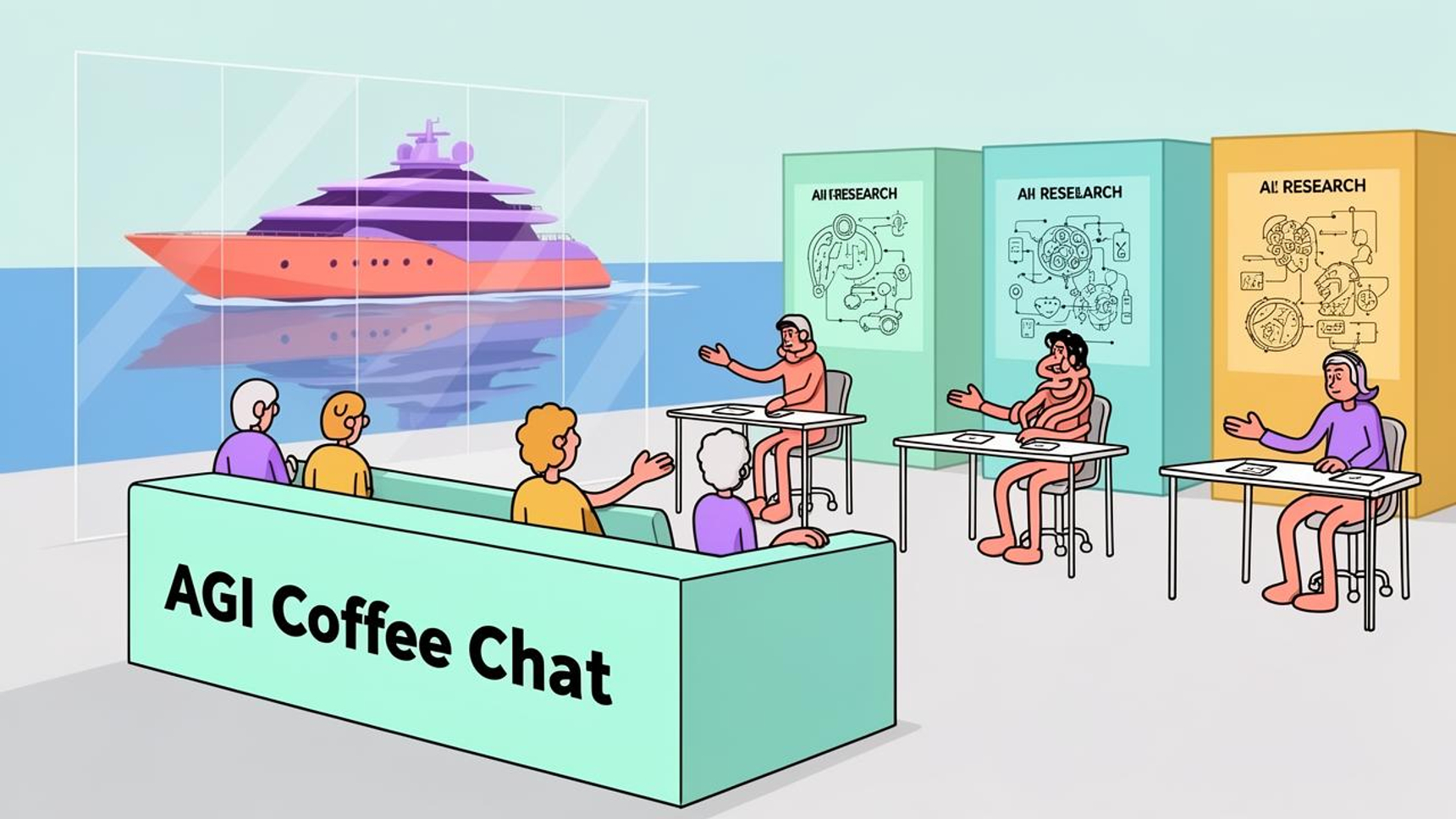
Notably, although Ant Group did not appear in the main sponsor tiers, it booked a coffee shop within walking distance of the venue to create a “de-agenda-ized” AGI Coffee Chat, allowing attendees to meet paper authors face-to-face and converse with leaders from Ant Bailing, Afu, Maxiaocai, Ant International, and Da’anquan teams. Ant also partnered with SGLang to host an exclusive “ANT GROUP × SGLang” Academic Inspiration Night limited-edition joint dinner.
Talent War Escalates: From Resume Collection to Paper Acceptance Screening
The talent war at top academic conferences has undergone a clear generational upgrade. In the past, conference booths were more about brand display and resume collection; today, having technical leaders personally present at booths, conducting one-on-one exchanges at dinners, and even using paper acceptance as a screening criterion have become standard practice for Chinese tech giants.
This talent war unfolding in Seoul may represent the most concentrated collective appearance of China’s AI forces at an international top-tier conference. However, how many of the connections made at booths and dinners will ultimately translate into researchers actually joining these companies’ AI teams remains a question only time can answer.
The Other Side of Commercialization: AI’s Unbalanced Ledger
Behind the heated talent war, China’s AI giants face an even more tangible challenge—AI commercialization remains a muddled ledger.
From 2023 to the present, AI has iterated from Chatbots to Copilot assistance, and onward to Agents and Cloud Agents. Models can now handle increasingly complex tasks—multi-step reasoning, tool invocation, long-chain execution—with token consumption per single call growing geometrically. As AI can do more, demand has exploded, per-user computing consumption has grown, and usage scale continues to expand.
A ten-thousand-fold surge in token consumption does not mean enterprises have a corresponding ten-thousand-fold increase in demand. Model capabilities are racing ahead, and model vendors burdened with rigid physical computing costs are eager to put a clear price tag on capabilities and recoup cash.
Tan Dai of Volcano Engine once proposed an explanatory framework: “The price per token is rising, but the value created is rising even faster.” The logic is sound, but it leaves open the question of who verifies that value is indeed rising faster—a problem that becomes particularly thorny when sellers bear cost pressures and buyers lack a yardstick to measure effectiveness.
The confusion over “what it’s worth” manifests even more directly in the actual business operations of major firms. A Meituan insider revealed that the company spends 2 to 3 billion yuan (approximately $295.6 million to $443.4 million) annually on AI data procurement, while the entire R&D department’s annual budget is only about 1 billion yuan (approximately $147.8 million). The massive data investment has not yielded the desired results; for instance, in its core road network recognition scenario, AI accuracy remains only between 60% and 70%, far from deployment readiness.
Suppliers cannot calculate costs, and clients cannot calculate returns. When both buyers and sellers cannot make sense of the bill, the market spontaneously gravitates toward relatively controllable costs. According to sources familiar with the matter, Jimeng, ByteDance’s Seedance-based video generation product, consumed at least half of the company’s internal computing resources. After a series of measures including canceling discounts and launching VIP models, it recouped only about 10% of costs. Computing resources burned fiercely, and the inability to recover costs threatens business continuity.
Anthropic has largely established a viable B2B business model through Coding, with annualized revenue surpassing $45 billion. This provides a reference point for domestic AI firms—treating Coding as a foundation and expanding into the broader white-collar and traditional software markets, where clear replacement costs give both buyers and sellers a unified yardstick. There are some sprouts of this in China: AI customer service is relatively mature, but when it comes to internal processes without standard pricing, suppliers and clients fall into repeated bargaining.
Technology can already answer whether something can be done; business has yet to answer whether it is worth doing. The moment when enterprises can clearly know the cost of a specific link, or when suppliers can provide a list of replacement values and write them into contracts—the moment when a deal signed in the morning no longer needs to be reconsidered by afternoon—will truly arrive only then. And at that point, AI entering productivity will have genuinely set the commercial flywheel in motion.