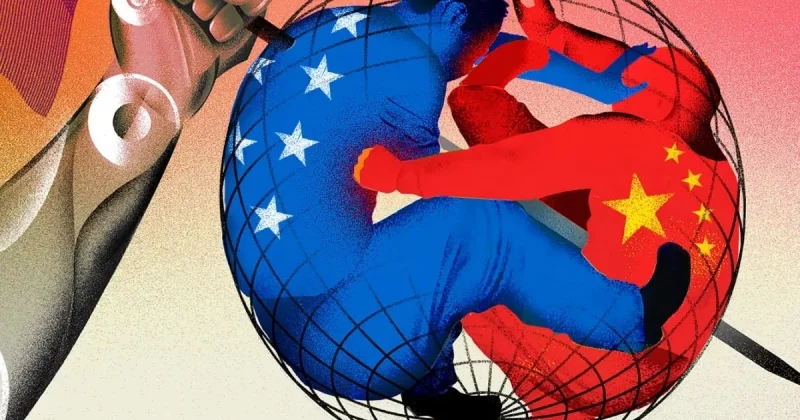
China’s generative AI industry is quietly crossing a threshold that should make Silicon Valley uncomfortable. While American companies hone impressive demos and clear waiting lists, Chinese AI companies are moving their video generation tools into full-scale commercial operations, generating hundreds of millions of dollars in annual revenue from products that are already part of the daily habits of more than 500 million users.
The value of the country’s AI industry has exceeded 500 billion yuan (approximately $72 billion). This number is no longer supported solely by speculative investment. It’s backed by products that people actually use.
The commercial gap is real
ByteDance’s Seedance 2.0 is the first model capable of producing cinematic 1080p video with quad-modal inputs. This means it can take text, images, audio, and video as prompts and produce high-resolution output. Outperforms direct competitors on quality benchmarks. It is not the result of a dusty experiment. It’s a product that sits within an ecosystem like TikTok and Douyin, platforms with billions of monthly users who create and consume video content every day.
Shengshu Tech has released “Vidu Agent”, a tool designed to convert images into high-quality videos. The goal is simple. It’s about reducing video production pipelines from days to minutes.
Then there’s Zhipu AI. Its GLM-5 model is packed with 744 billion parameters. Beyond the raw scale, what’s notable is its positioning as a step toward GPU independence for China’s AI sector. With U.S. export controls limiting access to Nvidia’s cutting-edge chips, Chinese labs are forced to optimize further and build differently.
Meanwhile, many U.S. video generation companies remain in what the industry politely calls the “experimental stage.” In English, they are still figuring out how to charge for their products.
Ecosystem benefits
Companies like ByteDance and Kuaishou don’t operate their AI models in isolation. These are directly connected to the massive social media and e-commerce ecosystem, creating a feedback loop that most U.S. AI startups can only dream of. More than 515 million people in China are already using generative AI tools, giving these companies a data flywheel that no amount of venture capital can replicate overnight.
What this means for investors and the broader technology environment
The implications for direct investment are complicated by the fact that most of these Chinese AI companies are not listed in a way that is easily accessible to Western investors. ByteDance remains private. Shengshu Tech and Zhipu AI are venture-backed. Kuaishou is traded in Hong Kong but is subject to the usual geopolitical risk premiums, making foreign investors cautious.
As tensions between the US and China continue to shape who has access to which chips, and both governments tighten their regulatory frameworks around AI, the narrative around decentralized alternatives to AI computing is gaining momentum. The real constraints that Chinese companies face when it comes to chip access, and the real innovations they are producing despite those constraints, add substance to the idea that distributed computing infrastructure may ultimately become important.