BEIJING, April 8 (Xinhua) — AI-driven technology is revitalizing China’s smart breeding sector and driving the digitalization and intelligentization of the seed industry.
Innovative applications powered by AI are proliferating during the ongoing spring farming season. Nanfan smart breeding platform focuses on breeding data processing and recently launched two major technology tools: gene-environment interaction algorithm tool and breeding simulation tool.
Gene-environment interaction algorithm tools integrate crop genetic information with environmental data such as weather and soil conditions to analyze crop characteristics. This reduces computational time compared to traditional statistical models and allows quantifying the influence of genetics and environment on crop traits.
Reproduction simulation tools have wide applicability and can simulate the reproduction process using various reproductive methods. Simulating processes such as parent matching and offspring selection before field trials allows accurate prediction of cross results and screening of optimal breeding schemes.
“This corresponds to a ‘rehearsal’ before the actual breeding work, and can significantly reduce the workload of field trials while increasing predictability and efficiency,” said Li Huihui, deputy director of the National Nanfan Research Institute of the Chinese Academy of Agricultural Sciences (CAAS).
Jointly developed by the National Nanfan Research Institute, the Institute of Crop Science under CAAS, and Alibaba’s DAMO Academy, the platform integrates the entire breeding process, including data management and analysis, suitable parent identification, and AI-based variety prediction.
Of note is the newly operational agricultural intelligence hub for breeding jointly announced by Yazhou Bay National Laboratory in the coastal city of Sanya, Hainan province, and technology giant Huawei, which now serves as a smart assistant for breeders. The hub is expected to reduce breeding cycles from 8-10 years to just 3-4 years by efficiently integrating large amounts of multidimensional data.
Innovative technologies are increasingly being introduced to support agricultural production. GEAIR, the world’s first full-process intelligent breeding robot, attracted great attention at the 2026 Seed Congress and Nanfan Silicon Valley Forum in late March.
Developed by the Institute of Genetics and Developmental Biology of the Chinese Academy of Sciences (CAS), GEAIR highlights the deep integration of biotechnology and AI technologies in the field of agricultural intelligent breeding.
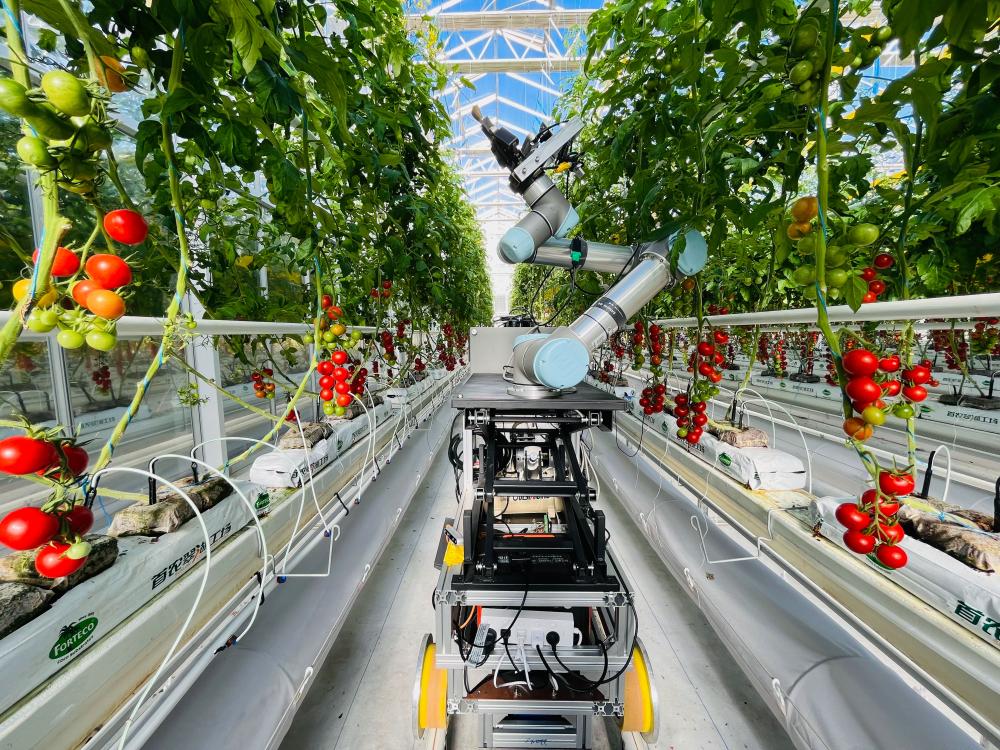
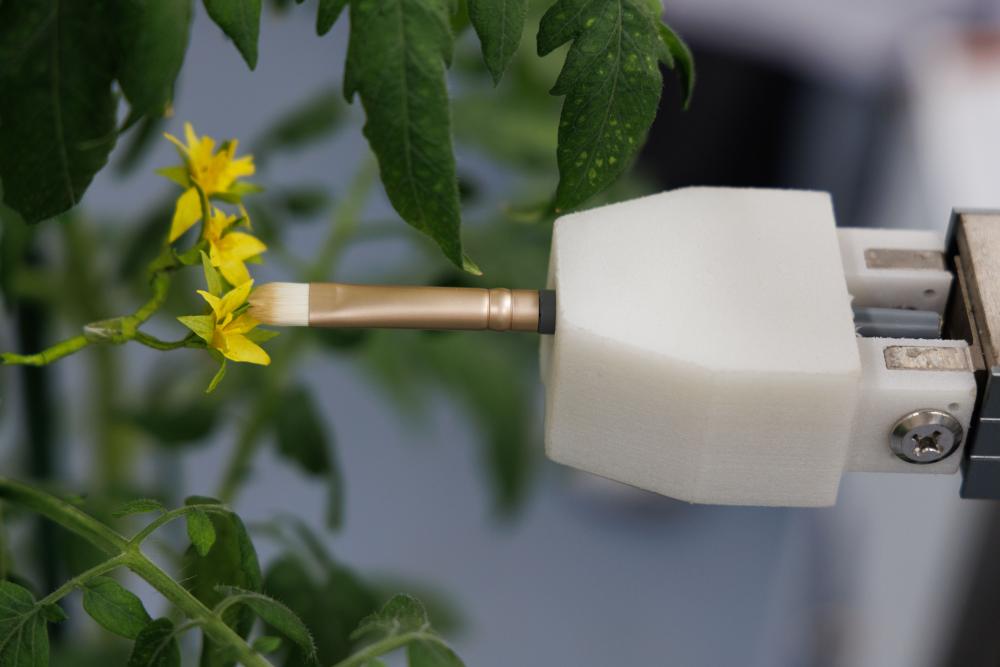
A scene once only seen in science fiction movies has become reality in a greenhouse. GEAIR can accurately identify flowers and extend its robotic arm to gently complete hybrid pollination. It can move between flowers effectively and carry out the entire breeding process with precision.
According to the CAS research team, the robot pioneered the “crop robot” co-design concept, deeply integrating biotechnology and AI, and enabling automated hybrid pollination with AI. Currently in stable commercial operation, breeding costs have been significantly reduced and breeding cycles have been shortened.
The tight integration of AI, big data, and other digital technologies is revolutionizing traditional breeding.
Li Jiayang, a CAS academic member and director of Yazhouwan National Laboratory, pointed out that China’s breeding sector is currently at a critical juncture in the transition from the era of “molecular marker-assisted selection” to the era of “molecular design breeding.”
“Breeding has moved from ‘opportunity’ selection to ‘blueprint-based’ assembly, allowing for on-demand customization of ideal crop varieties,” Lee said.
Looking ahead, Lee predicts that the next decade will usher in an era of “intelligent breeding,” characterized by the cultivation of “intelligent varieties” that actively sense changes in the environment and control their physiological states, and the realization of “intelligent cultivation” by promoting the deep integration of AI and big data with biotechnology and traditional breeding. ■